Magnus Burlywick

Backstory
Magnus did not discover flatwater paddle-up foiling because he was searching for the most efficient way to cross a lake. He discovered it because someone at the beach told him, “You cannot paddle that giant board fast enough to make it fly.”
Magnus considered this less of an observation and more of a formal challenge.
The next morning, he arrived with a long downwind board, an oversized paddle, a stopwatch, and enough snacks to support a small expedition. His plan was simple: paddle harder than physics could reasonably expect. For the first hour, Magnus produced an impressive amount of spray, noise, and forward motion, but absolutely no flight. He counted every stroke aloud and blamed the board whenever he lost track.
His early attempts followed the same pattern. Magnus would sprint, reach maximum speed, throw his weight backward, and launch the nose toward the sky. The foil would rise briefly, stall, and return him to the water with the dignity of a dropped refrigerator. He eventually realized that flatwater paddle-up foiling was not won through strength alone. The board needed speed, but the foil also needed rhythm, controlled weight shifts, and a smooth transition from paddling to pumping.
Magnus began studying every part of the start. He refined his paddle stroke, learned to keep the board running straight, and timed each compression with the foil’s movement beneath him. Instead of trying to yank the board into flight, he learned to build speed patiently, introduce small bouncing motions, and let the hydrofoil rise one controlled cycle at a time.
His first successful takeoff came on stroke ninety-seven. The board released from the surface, the foil climbed cleanly, and Magnus continued pumping across the lake with a look of complete disbelief. He was so surprised that he forgot to stop counting and shouted “ninety-eight” several seconds after he had already put the paddle under his arm.
Since then, Magnus has become a symbol for riders who are willing to work through the awkward stage. Beginners appreciate that he openly admits how exhausting paddle-up starts can be. Experienced foilers respect his discipline, efficient technique, and stubborn ability to keep trying when everyone else has returned to shore.
Magnus Burlywick's Merch Shop

Check out Magnus Burlywick's merch store page. All the Foiling Freaks stuff featuring Magnus Burlywick.
Magnus Burlywick's Foiling Discipline
Magnus Burlywick is into paddle up foiling - A human-powered foil start where the rider paddles hard enough to lift onto foil from flat water, then links glide and pumping technique without wind, motors, or a tow. Click the link for more information about the sport.
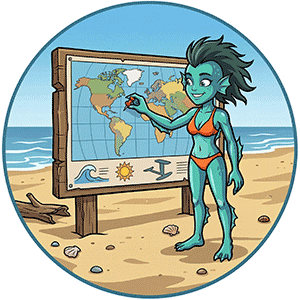
If you are into paddle up foiling, make sure to drop your pin on the Foilers Pin Map and help paddle up foiling claim the leaderboard.
Be more than just a dot on the map. Join the Foiling Freaks community and create your own foiling profile with a custom handle, rider photos, videos, disciplines, bio, and more.
First Flight
Magnus’s first real flight came after a morning filled with almost-successes. He had already completed dozens of acceleration runs, each one ending with the downwind foil board lifting briefly before settling back onto the water. His shoulders were tired, his paddle strokes were getting shorter, and he had announced his “final attempt” at least four times.
On the next run, Magnus stopped trying to overpower the board. He built speed with long, controlled strokes, kept the hydrofoil paddle board level, and introduced a gentle bounce as the foil began to carry more of his weight. Instead of leaning backward to force the takeoff, he stayed centered and let the nose release naturally.
The board rose cleanly on stroke ninety-seven. Magnus lowered his stance, tucked the paddle against his side, and transitioned directly into foil pumping. For several seconds, the lake became completely quiet beneath him. There was no hull slap, paddle splash, or shouted counting, only the smooth sensation of flatwater foiling.
The flight ended when Magnus became so excited that he stood upright and forgot to keep pumping. He touched down, raised his paddle overhead, and yelled “one hundred” despite having stopped counting three strokes earlier. That first flatwater foil start taught him that strength creates opportunity, but timing completes the takeoff.
Personality
Magnus is persistent, methodical, and far more patient than his dramatic grumbling suggests. He approaches every paddle-up foiling session like a scientific experiment conducted by someone who occasionally argues with the equipment.
He records stroke counts, launch distances, wind direction, and whether each attempt felt smooth, desperate, or suspiciously lucky. Magnus likes measurable improvement, but he also understands that flatwater paddle up foiling does not progress in a straight line. Some days he launches quickly. On other days, he spends an hour proving that yesterday’s success was not transferable without effort.
Although he looks like someone who would rely entirely on strength, Magnus has become a devoted student of efficiency. He studies paddle placement, board trim, foot pressure, and the transition into foil pumping. He respects the small technical details that allow a rider to conserve energy while still generating enough speed for takeoff.
Magnus is especially supportive of beginners. He never dismisses a short lift or an awkward first flight. He knows how difficult stand-up paddle foiling can feel when every attempt requires a long reset and another exhausting sprint. His encouragement usually sounds like a challenge, but it always means the same thing: you are closer than you think, so turn around and try again.
Favorite Conditions
Magnus prefers a wide stretch of deep, flat water with almost no wind. A calm lake, sheltered bay, or protected inlet gives him enough room to accelerate without correcting for chop or crosswind. He wants a clean surface where every paddle stroke contributes to forward speed.
His ideal setup includes a long, narrow downwind foil board with efficient glide and enough volume to remain stable during the acceleration phase. Magnus appreciates a board that carries momentum between strokes and releases smoothly once the foil begins generating lift.
For a successful flatwater foil start, he looks for deep water with plenty of clearance beneath the mast and front wing. He avoids weeds, submerged obstacles, boat traffic, and crowded swimming areas. Open space lets him focus on cadence, board trim, and the timing of each compression.
Magnus enjoys a light tailwind when practicing longer runs, but perfectly calm water remains his favorite. In those conditions, he can feel exactly when the foil begins to lighten the board. The transition from displacement to flight becomes clear, controlled, and repeatable.
Magnus's Code
Magnus’s first rule is to build speed before demanding flight. A paddle foil requires sufficient forward momentum for the wing to generate lift. Trying to force the board upward too early usually wastes energy and interrupts the acceleration.
His second rule is to keep the board moving in a straight line. Every unnecessary correction steals speed. Magnus plants the paddle close to the rail, keeps his strokes compact, and avoids twisting the board during the final approach to takeoff.
His third rule is to work with the foil’s cycle. Once the board begins to lighten, Magnus coordinates his paddle strokes with small compressions through his legs. He does not jump wildly or throw his weight backward. He lets the foil rise gradually while maintaining control.
His fourth rule is to save enough energy for flight. Flatwater paddle-up foiling does not end when the board leaves the surface. The rider must still stabilize the foil before transitioning to pumping. Magnus believes a successful launch is useless if the rider is too exhausted to continue.
His final rule is never to let one failed attempt define the session. A missed launch can reveal poor trim, weak cadence, rushed timing, or simple fatigue. Magnus treats each failure as useful information, then paddles back to the starting point and applies what he learned.
Beginner Tips
Choose calm, deep water for your first sessions. Flatwater foiling is already physically demanding, so wind and surface chop can make learning much harder. Use an open area with no swimmers, boats, weeds, or underwater hazards.
Begin with a board designed to accelerate efficiently. A longer downwind foil board generally carries speed better than a short, wide board. The correct volume and stability will also help you maintain strong paddle strokes without fighting the board from side to side.
Practice your acceleration before focusing on lift. Keep the hydrofoil paddle board level, paddle close to the rail, and build cadence gradually. Smooth strokes usually create more usable speed than frantic splashing.
As the board begins to feel lighter, introduce small, controlled compressions. Coordinate the downward movement with your paddle stroke, then allow the foil to rise as you extend. Avoid leaning far backward, which can cause the foil to climb too quickly and stall.
Stay low during the transition. Once the board releases, bend your knees and keep your weight centered. Tuck or carry the paddle securely, then begin foil pumping before your remaining speed disappears.
Do not measure progress only by complete flights. A straighter acceleration run, an earlier release, or a cleaner transition into pumping is a meaningful improvement. Paddle up foiling often requires many attempts before the entire sequence connects.
Rest between sprints. Fatigue can shorten your stroke, disrupt your balance, and make it difficult to repeat good technique. Magnus recommends returning to shore before your paddle starts feeling heavier than your board, although he rarely follows his own advice.
Preferred Ride
Magnus loves a wide stretch of flat water with light wind, deep foil clearance, and enough open space for a long acceleration run. His ideal location is a calm lake or sheltered bay where he can focus entirely on paddle cadence, board speed, and takeoff timing.
He prefers a long, narrow downwind board that releases cleanly from the water and carries speed between strokes. Once on foil, Magnus likes to tuck the paddle against the board and settle into a steady pumping rhythm. His favorite session includes repeated flatwater launches, long pump runs, and one final attempt after everyone else has declared the day finished.
For Magnus, the perfect ride is not necessarily the longest one. It is the takeoff where every stroke, bounce, and weight shift connects smoothly. He loves the moment when the board stops dragging, the surface noise disappears, and all the effort suddenly becomes quiet flight.
What Makes Him Magnus
Magnus is built like someone who should solve every problem with brute force, but his greatest strength is his willingness to learn finesse.
He is determined, methodical, and almost comically serious about counting paddle strokes. He records his attempts, compares takeoff distances, and can spend an entire afternoon adjusting one small part of his technique. At the same time, he never takes failure personally. A missed launch is simply another experiment, although he may glare at the water for several seconds before admitting it.
Magnus encourages other riders by showing them that persistence and technique can accomplish more than raw athletic ability. He celebrates short flights, cleaner paddle strokes, and even failed launches that used less energy than the attempt before. He believes improvement should be measured in small victories, especially in a discipline where success may come after dozens of exhausting starts.
What truly makes Magnus himself is that he refuses to confuse difficulty with impossibility. He may complain, grunt, and argue with his board, but he always turns around for another run.
Signature Move
The Burlywick Hundred: The Burlywick Hundred is Magnus’s signature flatwater paddle-up sequence. He begins with powerful but controlled strokes, gradually increasing cadence while keeping the downwind board level and tracking straight. As the board reaches speed, he introduces small, timed compressions through his legs to help the foil unload and rise without disrupting the paddle rhythm.
During the final strokes, Magnus shortens his paddle movement and coordinates each stroke with the board’s upward cycle. When the foil begins carrying his weight, he stops paddling, lowers his center of gravity, and transitions directly into efficient foil pumping.
The goal is to reach stable flight before the one-hundredth stroke. The move is technically possible because it combines board speed, paddle power, hull release, and controlled pumping rather than relying on a sudden jump or unrealistic burst of lift.
Magnus has completed the sequence in far fewer than one hundred strokes, but he keeps the name because “The Burlywick Forty-Three” does not sound nearly as heroic.
Fun Facts
- Magnus counts paddle strokes aloud, even when nobody is listening.
- His personal record book includes separate categories for clean launches, ugly launches, accidental launches, and launches that “should have worked.”
- He once paddled so hard that he broke his paddle.
- Magnus calls unsuccessful takeoffs “surface-level research.”
- He keeps emergency snacks on the nose of his board because he considers every flatwater session an endurance event.
- His paddle is named Perseverance.
- He believes calm water can still sense fear.
- Magnus has a habit of saying “last attempt” at least six times before leaving the water.
- He can identify poor board trim by the sound of the hull slapping the surface.
- His favorite compliment is, “That looked easier than it probably was.”
- He always cheers when a beginner gets the foil to lift, even if the flight ends immediately.
- Magnus claims every missed takeoff strengthens the next one, although he has never presented evidence beyond pointing at his shoulders.
Magnus's Motto
“Build the speed, find the rhythm, and earn the release.”
