River Foiling
What is River Foiling?
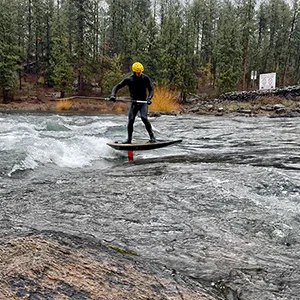
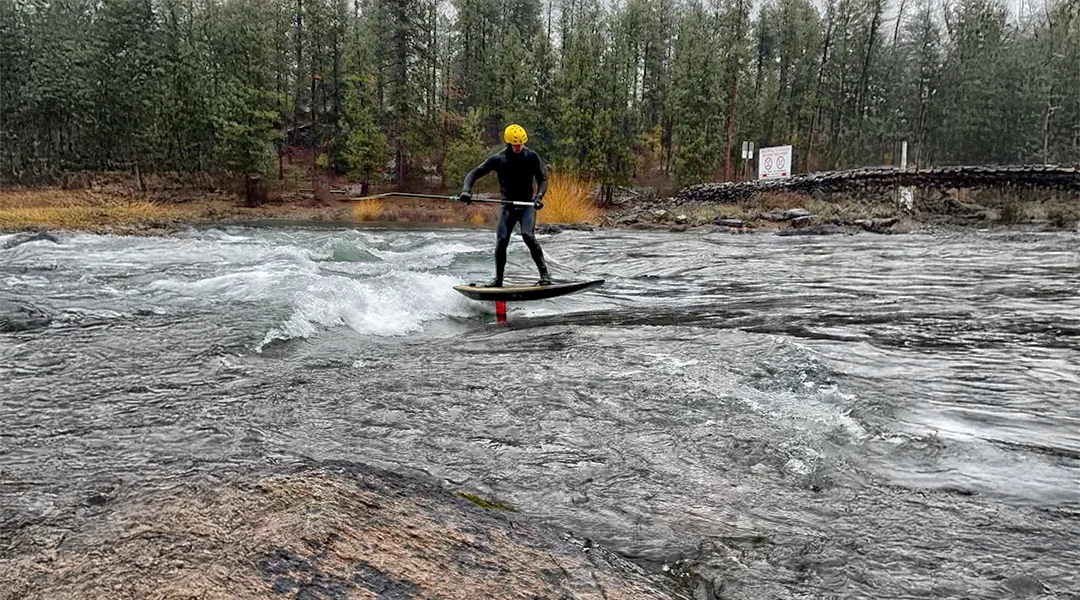
River foiling is hydrofoiling on moving river features such as standing waves, wave trains, and rapids. The ride happens on a stationary wave, where the wave stays in one place, and water flows through it. You position your foil and either surf in place or connect to nearby features when possible.
This is not “foiling on a river” in the broad sense of wind sports on wide rivers. River foiling is river surf foiling and standing wave foiling, where the current is the engine, and the river feature is the track.
Who is into river foiling?

If you are into river foiling, make sure to drop your pin on the Foilers Pin Map and help river foiling claim the leaderboard. Check the pin map and leaderboard for how many people into river foiling have marked themselves on the map.
Be more than just a dot on the map. Join the Foiling Freaks community and create your own foiling profile with a custom handle, rider photos, videos, disciplines, bio, and more.
How it Works
A hydrofoil generates lift when water flows over the wing. In river foiling, the power source is the river current. The current provides water speed across the foil, and the standing wave provides a stable, repeatable face to surf.
A typical session goes like this
- Enter from slack water. River features usually have an eddy nearby, a slower area of water behind an obstruction. The boundary between the eddy and the main flow is the eddyline, and it is a turbulent seam you must cross cleanly to get onto the wave.
- Large enough bodies of water can allow for a tow-in approach, such as using a jet ski.
- Some locations allow for a static rope and handle to be used to keep you in position on the wave.
- Accelerate into the feature. You use the current, the push of the feature, and sometimes a paddle to get enough speed for the foil to lift. Once the foil is flying, you trim to keep a stable height in turbulence.
- Hold position or connect features. Stationary river surfing is about maintaining the sweet spot of the wave. On large, fast rivers, you can exit one feature, ride briefly downstream to the next, and reset via an eddy.
What Makes it Different
River foiling has constraints that ocean and lake foiling do not
- The wave is stationary, but the water is moving fast. Your board can appear “parked” relative to the riverbank while the foil is flying in a conveyor belt of current.
- Turbulence is constant. Eddy line foiling and river seam riding require balance in turbulence, because the boundary between currents is unstable and can roll the foil unexpectedly.
- Hazards are closer and less forgiving. In rapids foiling, you are surrounded by rocks, hydraulics, and strainers that do not exist in open-water foiling.
- Space is limited. The feature might be powerful, but the usable riding area is confined. Downstream recovery and exit planning are part of every run, not an afterthought.
Safety and Etiquette
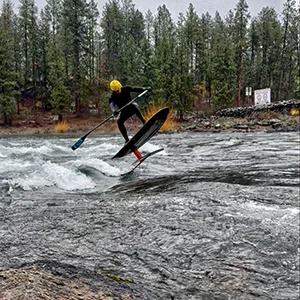
River safety for foiling starts with respecting whitewater hazards and dangers found in fast-moving, aerated river sections. The foil adds speed and sharp hardware, but the river hazards are what turn mistakes into emergencies.
Primary hazards and how you mitigate them
- Strainers and sweepers: obstacles, such as branches or fallen trees, that let water pass through but can trap a person or board. You avoid them completely, and you never “just try a line” when there are submerged branches or trees in play.
- Hydraulics and holes: recirculating currents that can hold a swimmer. You stay away from retentive hydraulics, and you treat low-head-dam hydraulics as no-go zones.
- Foot entrapment: fast water can pin feet between rocks. You do not stand up in fast current during a swim, and you train in swiftwater self-rescue.
- Leash entanglement: ankle or calf leashes can become an entrapment hazard in moving water. If you choose to use any leash, it needs a quick-release system, and you must practice releasing under load, because “quick-release” is not automatically easy when the river is pulling hard.
- Dedicated safety team: Having a dedicated safety team and system in place is critical for hazard mitigation. A dedicated safety team and a plan do not eliminate the risks. Underwater entrapment in flowing water is extremely dangerous.
Core safety kit and habits
- A helmet and a proper PFD are standard for whitewater hydrofoil sessions.
- Carry a river knife or cutting tool when using ropes or leashes to manage entanglement risks.
- Scout features from shore before riding. Know your intended line of sight, swim plan, and downstream hazards.
Etiquette
- River features have traffic. Give priority to the rider already on the wave, enter only when the lane is clear, and do not drop in from an eddy when it forces a collision line.
- Keep your gear and your body out of the main flow when you fall. Clear the feature and get to an eddy quickly so you are not a hazard to others trying to enter.
- Do not bring a foil into crowded river surf zones until you can reliably control your line and your exits. A foil changes the consequence profile for everyone nearby.
Starter Guide
River foiling is not an entry-level hydrofoiling option. The safest path is gradual progression.
Minimum gear list
- A foil board and hydrofoil setup suitable for stable, low-speed lift and fast recovery from turbulence.
- A paddle if your approach and recovery require it.
- Helmet, PFD, and cold-water protection appropriate to the river.
- A cutting tool and basic rescue readiness, such as a throw rope, should be in the group.
Difficulty and learning curve
- Difficulty: High. You are combining hydrofoil control with whitewater river reading, eddy management, and hazard avoidance.
- The early learning curve is mostly about reading river flow and foil balance in turbulence, not about “getting up” like tow sports.
Cost ranges
- River foiling uses standard foiling equipment plus river safety gear.
- For general hydrofoil board and foil packages, complete packages commonly span roughly the low thousands into the mid-thousands of dollars, depending on materials and performance level.
How to start safely
- Learn river surf fundamentals first: eddies, eddylines, the sweet spot, and safe swim zones.
- Take a swiftwater safety or rescue course and practice self-rescue basics before you try to foil in rapids.
- Start on friendly, well-understood standing waves with clean eddies and low consequence exits. Avoid wood, avoid dams, avoid blind corners.
- Go with experienced river users. River foiling is not the place for solo problem-solving.
Gear Selection
Board choice
River foiling can start from an eddy, a shoreline, or a low platform, and the board choice usually follows the entry style.
- Prone style river wave foiling: A common starting point for a surf-foil style board is around 4'8" and about 38 litres for a beginner to mid-level rider, with smaller volumes as skill increases.
- Paddle-assisted river feature foiling: If you are using a paddle to manage positioning and entry timing, higher-volume SUP or downwind foil boards are common in foiling because they float easily and let you stabilise before committing. A practical sizing reference is about 20 to 30 litres above rider weight in kilograms; for example, a 70 kg rider would choose about 90 to 100 litres minimum.
- Pump-style board for short feature linking: Compact pump boards exist in the 90 cm class with very low volume, for example, 90 cm length, 42 cm width, and about 11.6 litres. These may be used if you use a jet ski tow-in or a dock start to get to the river wave.
- River use adds a hard constraint: You must have enough depth and a clean corridor because a low-volume pump board does not “float you through” a mistake.
Front wing and stabiliser
Standing wave foiling and rapids foiling demand early lift and calm control in turbulence.
- Pump foiling wing sizes often cluster around 1500, 1700, and 1900 cm² in common product sizing, with larger sizes generally being easier at lower speeds and for heavier riders.
- A pump-foiling sizing reference states that if you weigh around 70 kg, a 1900 cm² front wing is a minimum to learn well, and heavier riders should go up in size.
- The foil must provide low-speed lift and stability in aerated, chaotic water.
Mast length
River depth and rock clearance drive mast choice.
- Shorter masts, around 60-70 cm, are widely recommended for beginners in foiling contexts because they are easier to manage and require less clearance.
- It is possible to get foils in even shorter lengths, such as 40-50 cm, for training and very shallow rapids.
- For a hydrofoil in rapids and shallow-feature zones, you match mast length to verified depth at your chosen line.
Fuselage length and stability tuning
- Longer fuselages provide more pitch stability; shorter fuselages feel more aggressive but less pitch-stable once flying.
- A longer fuselage provides more stability because the stabiliser sits farther back, increasing the lever arm.
Leash and river-specific safety hardware
Leashes are a major risk factor in moving water, and river communities treat them differently from ocean foiling.
- A common river-surfing safety position is: avoid ankle leashes, and if you use a leash in moving water, use a waist-mounted quick-release system that you can reach instantly.
- There is also caution that quick-release leashes can fail and that there is no widely accepted fail-safe, self-releasing standard across the market.
- For river foiling, add the whitewater basics: a helmet, a proper PFD, footwear that lets you run on slick rocks, and a cutting tool in the group in case anything tangles. Also, have a dedicated safety team in place.
Conditions
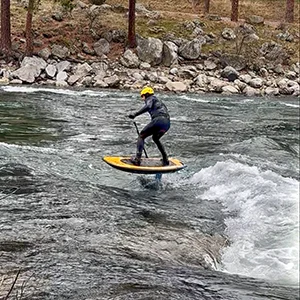
River foiling depends on features created by the current and the structure.
- A standing wave is stationary and forms when water flows downhill over an object, such as a rock, ledge, or engineered structure, creating a surfable hydraulic feature.
- The quality of river waves is strongly tied to water level and flow, and many parks and waves are only “on” in certain ranges.
Good conditions for standing wave foiling
- Clean, predictable features with a usable eddy for setup and downstream recovery.
- Clear visibility and minimal floating debris so you can avoid hazards early.
- Flow that produces a defined wave face without turning the feature into a retentive hole.
Bad conditions
- Wood hazards, especially strainers and sweepers, can pin and trap people and equipment.
- Flood or high-water conditions that increase hazard severity and reduce control margins.
- Low-head dams and retentive hydraulics are high-risk hazards in river running.
River feature zones are confined. You may share the same entry, the same wave, and the same exit line with surfers and paddlers. So crowded zones should be avoided.
Where to Go
River foiling is possible at well-known, easy-to-scout standing waves with clean eddy access. In practice, that often means whitewater parks and established river surf waves.
General location types
- Engineered whitewater parks with standing wave features and defined channels.
- Natural river waves with consistent formations and a safe shoreline for scouting and recovery.
River foiling is highly dependent on conditions and location and is typically reserved for expert-level foilers. Search for rideable locations online and contact other river foilers.
Setup and Tuning
River foil technique rewards predictable trim and pitch stability because turbulence constantly tries to knock you off balance.
Mast position
- Moving the mast forward generally increases front-foot pressure, and small adjustments of 1 cm or so are meaningful.
- Mast position and tail tuning interact. Combining aggressive tail changes with an overly forward mast position can create inconsistent lift and instability.
- A practical target for standing wave foiling is neutral trim at the speed you actually ride on the feature, not neutral trim at your sprint speed entering the seam.
Shims and stabiliser angle
- Increasing the stabiliser angle increases support and pitch stability; decreasing it reduces drag and increases speed and freedom.
- Shimming guidance also commonly describes a trade: “faster and looser” versus “slower and more pitch stable,” depending on how your stabiliser mounts.
Fuselage length
- If the river is turbulent and you are learning, pitch stability is a performance advantage.
- Longer fuselage equals more pitch stability.
Mast stiffness
- In fast, choppy environments, torsional stiffness can matter for control and precision, especially as you start carving in current.
Tips and Tricks
- Scout every feature from shore first. Know the entry line, the exit line, and what happens if you have to swim. That is baseline river safety for foiling.
- Treat the eddy line like the gate. Approach so you are parallel with the wave face as you cross the eddy line, then slide directly onto the face.
- Keep your foil low and conservative until you understand the turbulence pattern. Foil balance in turbulence comes from calm knees and small corrections, not big reactions.
- Make downstream recovery automatic. In moving water, every fall is a downstream problem. Clear the feature, get to the nearest safe eddy, then reset.
- Be ruthless about wood. If there is a strainer or sweeper anywhere near the swim line or downstream corridor, you do not ride that feature. Being pinned underwater by trees or branches is a common cause of river fatalities.
- Decide your leash strategy before you launch. In moving water, ankle leashes are widely treated as a serious hazard; if you use a leash, it must be waist-mounted and quick-release, and you must be able to release it instantly under load.
- Respect that leash safety is still debated, including concerns about quick-release failure rates and lack of fail-safe standards.
Skills Ladder
Beginner
You start by learning to surf river features before you ever try to fly a foil in them. River foiling only works when you can read the current, identify an eddy, and cross the eddy line on purpose without getting spun out. You should be proficient at foiling in other disciplines before attempting white water foiling.
Skills to build
- River flow reading: identify the main tongue, seams, and where the standing wave is actually surfable and not just whitewater noise.
- Eddy entry and exit: Use the eddy to stage, then cross the eddy line cleanly onto the wave face.
- Low, conservative foil flight: the first success is controlled lift and controlled touchdown, not speed.
- Downstream recovery: every fall is a downstream problem, so you build the habit of clearing the feature, swimming to a safe eddy, then resetting.
Gear shifts that help at this stage
- Stability-first foil tuning: More pitch stability is worth more than tight turning because turbulence is constant on river features.
- Depth-matched mast: You select mast length based on verified depth on your line.
Intermediate
You can enter the feature reliably and hold a line. Now you learn to make the foil work in turbulence.
Skills to build
- Foil balance in turbulence: stay quiet through the knees and hips while the water under you is inconsistent.
- Seam and eddy line management: cross seams without overreacting and without letting the foil roll out from under you.
- Stationary river surfing on foil: hold position on the standing wave by trimming and carving in the current rather than drifting downstream.
- Paddle integration, if you use one: paddle strokes become positioning and balance tools.
Gear progression
- More efficient front wings once you can stay flying: efficiency helps you hold speed through turbulent patches, but it demands cleaner roll control.
- Fine-tuning with tail angle and mast position so the foil trims neutral at the speed of the feature, not at your entry sprint.
Advanced
At the advanced level, you can treat the river like a park of features, not a single wave.
Skills to build
- Feature linking: exit one wave cleanly, run a short downstream line, then catch the next eddy and re-enter another feature when the river layout allows it.
- High-consequence decision-making: you only ride features with clean downstream outcomes and no hazard exposure.
- Tidal rapid and high-flow feature foiling: when the “river” is moving at extreme speed, turbulence management becomes the main skill. The Skookumchuck tidal rapids session is a documented example of how violent that turbulence can feel.
Niche Specific
River foiling is powered by current, not wind, not a tow, and not waves moving across open water. The standing wave stays in one place while water moves through it, and you ride that stationary feature.
The eddy line is the gateway. River feature foiling is defined by repeated crossings between slower eddy water and faster downstream flow. That boundary is turbulent and can kick the foil sideways if you enter poorly.
Aerated water is the hidden difficulty. Rapids and breaking features inject air and bubbles into the flow, and hydrofoils behave differently in bubbly, ventilated water than in clean water.
The usable riding area is tight. In most river surf zones, you have a defined entry, a defined pocket, and a defined exit, with hazards close to all three. That is why downstream recovery planning is a critical part of the sport.
Common Problems
Getting rejected at the eddy line
- What happens: you cross the seam and the board yaws or rolls, you lose the wave, and you get flushed.
- Fix: approach with a clear angle and committed speed, cross the eddy line in one clean move, then stabilise before you try to climb or carve.
Foil stalls or feels “dead” in aerated water
- What happens: the feature looks powerful, but the foil loses grip and lift in the bubbly section.
- Fix: ride lower and more conservatively, prioritise a clean-water line on the feature when it exists, and accept that some hydraulics simply do not provide clean enough flow for stable foiling.
Bottom strikes and rock hits
- What happens: you tag a bottom or a rock with the foil, stop instantly, and get launched.
- Fix: only ride features you have scoped for depth and hidden structure. If you cannot clearly identify the safe depth corridor, you do not follow it.
Leash and entanglement risk
- What happens: moving water loads a leash against rocks, debris, or the riverbed.
- Fix: Treat ankle leashes as a serious entrapment risk in rivers. If you use a leash at all, use a quick-release system you can reach instantly and practice releasing under load. Leash safety in rivers is widely debated because releases can be hard to locate and operate in real entrapment conditions.
Unsafe swims, foot entrapment, and wood hazards
- What happens: you fall into fast water and drift into strainers, or try to stand and get your foot pinned.
- Fix: follow whitewater swim fundamentals and treat strainers, sweepers, and foot entrapment as top-tier hazards. Build a downstream plan before you launch.
World Records
There are no recorded world records for River Foiling in our database yet. If you know of one, or you hold that epic distinction, submit it for inclusion.
World Firsts
- First hydrofoil river surfing on a standing river wave: First hydrofoil river surfing on a standing river wave. Holder: Kai Lenny
- First hydrofoil session in the Skookumchuck tidal rapids: First hydrofoil session in the Skookumchuck tidal rapids. Holder: Brian Grubb, Matt Elsasser, Isaac Levinson

Know about a broken record, an update needed to an existing world first, or a brand new world first that deserves to be in the public record? Submit it.
History
River foiling sits on top of river surfing history. Standing-wave river surfing has documented roots dating back decades, including the Eisbach wave in Munich, created in 1972 by installing concrete blocks to shape the flow, which later became a globally known river surfing spot.
Hydrofoiling those same kinds of river features is much newer in public documentation and media. A clear modern milestone is foiling in the Skookumchuck tidal rapids in British Columbia. In October 2023, Brian Grubb, Matt Elsasser, and Isaac Levinson were documented foiling there, describing extreme turbulence with occasional sheets of clean water that allowed smooth turns.
FAQs
Is river foiling the same as river surfing?
No. River surfing is riding a stationary river wave on a conventional board. River foiling uses a hydrofoil to lift above the surface while still using the same stationary features and the same eddy and seam dynamics.
Do I need a paddle for river foiling?
Sometimes. If you are staging in eddies and need precise positioning and resets, a paddle can help manage entry timing and recovery. If the feature provides enough current energy and your entry is dialled, you can foil without paddling, but the river still dictates what is realistic. Some rivers allow for jet ski or dock start pump foiling techniques to get on the wave.
What is the single biggest safety issue that makes river foiling different?
Entrapment hazards. Rivers add strainers, sweepers, foot entrapment risk, and powerful hydraulics, and those hazards remain dangerous even if you are an expert foiler.
Can I use a normal surf-foil setup in rapids?
You can, but performance and control can degrade in aerated, turbulent water. River features often demand more stability, more conservative riding height, and careful depth management than open-water surf foiling.
How do I know if a river feature is appropriate for foiling?
A foilable feature has a predictable standing wave, a usable eddy for setup, a clear downstream recovery path, enough depth on the line, and no wood hazards in the swim corridor. If any one of those is missing, it is not a responsible place to put a hydrofoil in the water.
Which Foiling Freaks are into River Foiling
-
 Riff Granitepaw
He meant to do that. Checkout Riff Granitepaw's merch page.
Riff Granitepaw
He meant to do that. Checkout Riff Granitepaw's merch page.
STATIC FLOW - White Water Hydrofoiling
This video follows Brian Grubb, Isaac Levinson, and Matt Elsasser as they travel into coastal Canada to explore whether a perfectly formed standing wave in a tidal rapid can be ridden on foil. Timed with the powerful full moon tides, their mission turns a remote natural feature into an unlikely foiling playground, showcasing both the creativity and progression of the sport.
If you know this discipline inside and out and want to help review and or edit the info on this page, drop us a line. We will credit you as a reviewer or editor and set you up with a proper bio page with links back to your site.
We could use a few more high-quality images to illustrate this discipline. If you have shots you own and are willing to share, contact us for where to send them. Bonus if you also credit the rider and give us a URL to link back to you.