Vintage Standup Foiling
What is Vintage Standup Foiling?
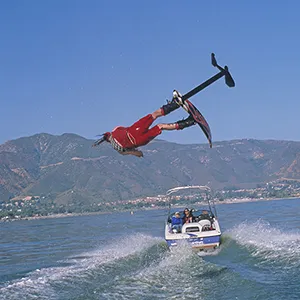
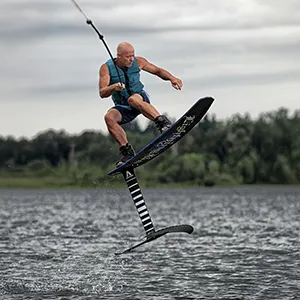
Vintage standup foiling is the early boat-towed era of riding a hydrofoil while standing, before modern surf-style foil boards became common. The rider stood on a wakeboard foil board, or “air board”-style deck, held a tow handle behind a boat, and used a fixed foot retention system to stay connected while the foil lifted out of the water.
This phase sits between the older two-ski, Dynaflite-style hydrofoil waterskis of the 1960s and 1970s and today’s standup wake foil boards. Dynaflite production began in 1963, using a two-ski stand-up hydrofoil arrangement that predates the board-style stand-up era.
A key milestone in the vintage standup timeline is the move to a single board platform: in 1991, a standup foil was ridden like a wakeboard after an Air Chair foil assembly was mounted to a surfboard, then outfitted with bindings to keep the rider’s feet on the deck.
In 2005, Sky Ski introduced the first commercial stand-up foil board. The convertible stand-up Sky Ski starts with a traditional sit-down hydrofoil. The seat tower could be removed, and snowboard bindings could be attached to the board, allowing the rider to stand on the board.Some of these vintage standup foil boards still exist and are still ridden today (one of them being yours ’truly ’ the author). This article is mainly intended for historical purposes.
Who is into vintage standup foiling?
If you are into vintage standup foiling, make sure to drop your pin on the Foilers Pin Map and help vintage standup foiling claim the leaderboard. Check the pin map and leaderboard for how many people into vintage standup foiling have marked themselves on the map.
Be more than just a dot on the map. Join the Foiling Freaks community and create your own foiling profile with a custom handle, rider photos, videos, disciplines, bio, and more.
How it Works
The power source is boat tow. The boat provides the acceleration to get the foil up to flying speed, and once the hydrofoil generates lift, the rider balances pitch, roll, and yaw using stance, tow-line tension, and subtle body movements. The original versions using Sky Ski wings did not generate their own lift; they relied on angle of attack, which required higher boat tow speeds.
A typical run looks like this
- Deep-water start behind a boat with the board and foil aligned and the rider’s feet secured in bindings.
- The rider builds speed on the surface in a “taxi” phase (when the board planes across the top of the water before liftoff), then transitions onto foil as lift increases.
- Once flying, the rider controls altitude by managing body position and tow-line load, and controls direction with edging and small steering inputs through the board.
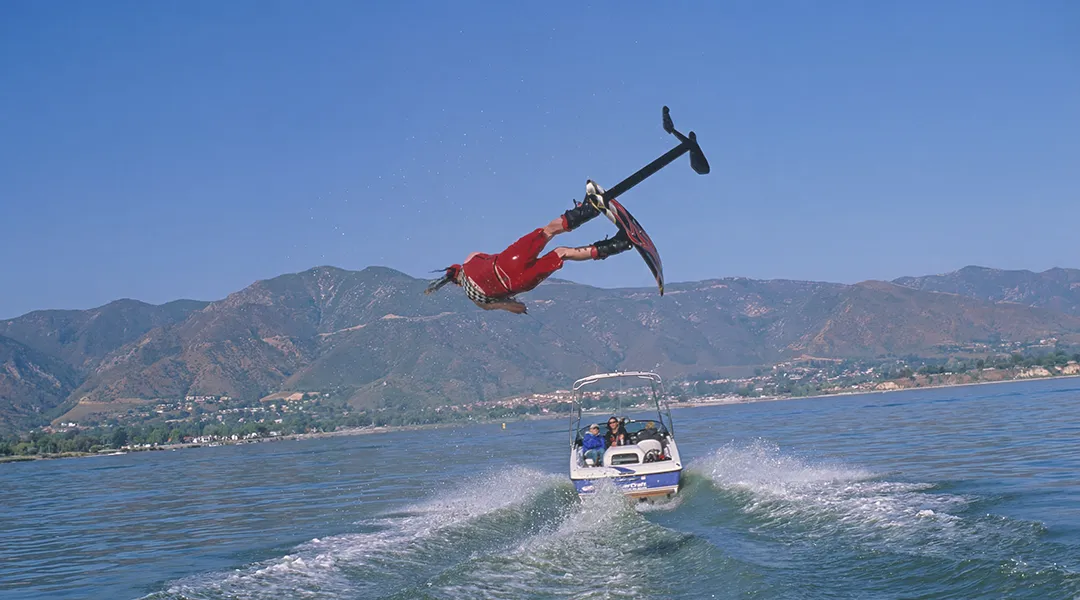
Vintage standup Sky Ski style riding often emphasized jumps, wake crossings, and aerial maneuvers, because towing delivers steady speed and repeatable takeoff ramps. A notable milestone was Jake Kinnison landing the first backroll off a wake on a stand-up foil board in 2005.
What Makes it Different
Vintage standup foiling differs from modern standup foiling in several fundamental ways.
- It is tow-only by design. The entire system assumes a boat is providing speed, which changes board size, foil tuning, and the whole skill set compared with paddle, wind, or pump-driven foiling.
- Foot retention is central, not optional. Riders used bindings such as snowboard boots to “click into” a stand-up hydrofoil wakeboard. That locked-in connection increases control at speed.
- The equipment lineage traces back to sit-down hydrofoils. Sky Ski was founded in 1998 by Mike Murphy, who previously helped found Air Chair, the first sit-down hydrofoil company, and later developed a “Convertible” that could be ridden sitting down or standing up, like a wakeboard.
- It is also distinct from big-wave surf foiling. In the same era, surf foiling gained visibility through ocean-facing experimentation and media attention, while the Sky Ski Convertible “air board” concept targeted boat towing rather than big-wave ocean missions. Both big-wave and boat-towed standup foils in this era looked similar; however, they differed in board shaping and wing design.
Safety and Etiquette
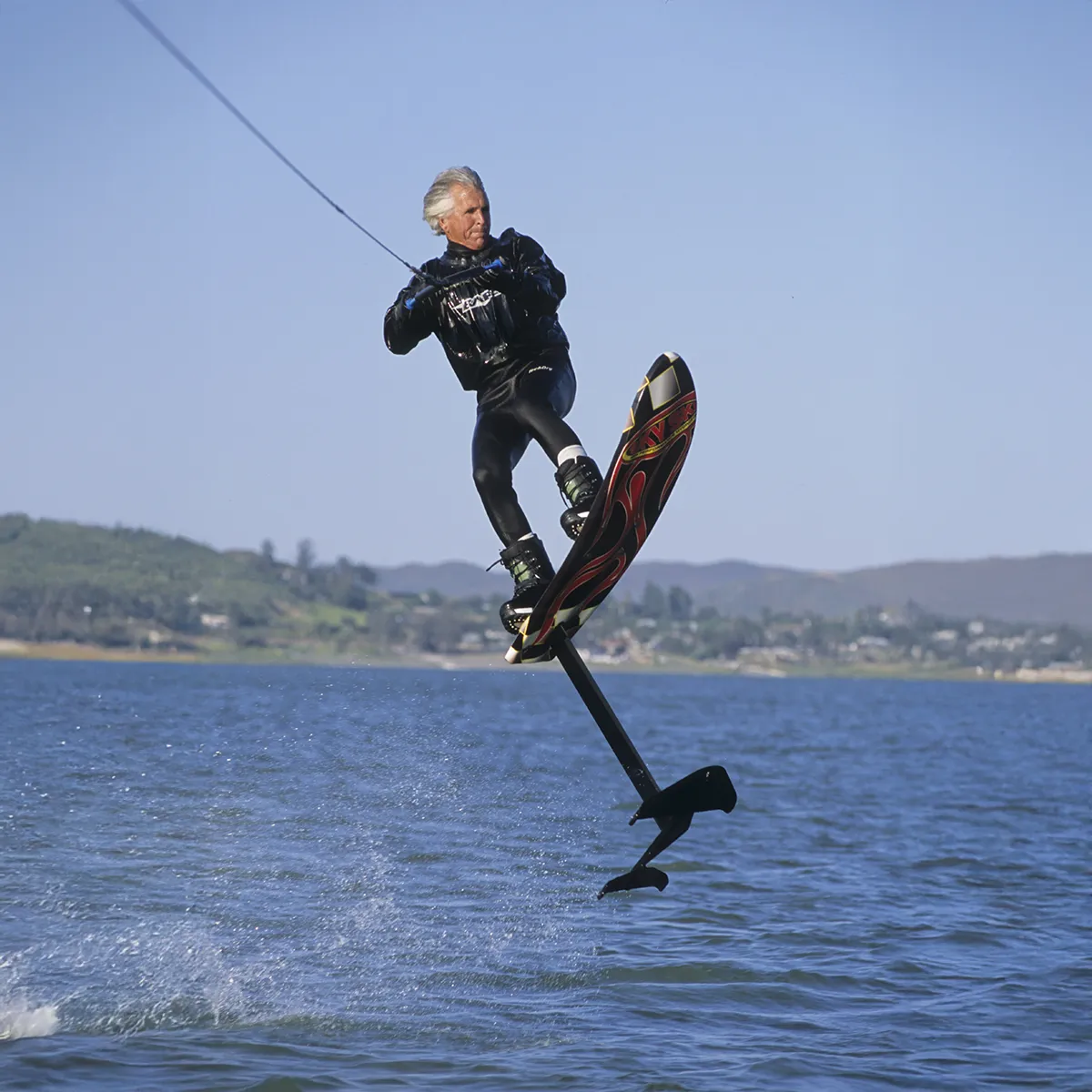
Vintage standup foiling involves high speeds, sharp hardware, and fixed foot retention. These conditions present serious and predictable hazards.
Primary hazards and mitigation
- High-speed crashes: Impacts from towing and wake jumps can be hard. Wear a helmet and impact vest, and master conservative ride height before jumping.
- Binding-related injury risk: Being attached to the board increases leverage on ankles, knees, and hips during unexpected catches or violent falls. Choose a setup you can exit quickly, and do not push aerials until falls are clean and controlled.
- Foil contact: Treat the foil like a moving blade. Keep the riding lane clear, and never start near swimmers.
- Boat traffic and tow-lane risk: use a spotter, keep the tow path clear, and run predictable patterns so other boats can avoid you.
Etiquette
- Do not tow a foil in crowded areas, narrow channels, or near docks where falls can slide you into hard objects.
- Follow normal tow-sports courtesy: one rider in the water at a time in the active lane, clear communication between driver, spotter, and rider, and immediate pickup after falls.
Starter Guide
Vintage standup foiling is not a good first step into foiling. The safest progression is to learn controlled tow foiling first, then step into vintage standup systems if you can find one.
Minimum gear list
- A tow-capable foil board and foil system designed for standing behind a boat.
- Bindings (straps or boots that hold your feet in place) are appropriate for towing and secure foot retention.
- Two ropes and a handle, a boat, a driver, and an attentive spotter.
Difficulty ranking and learning curve
- Difficulty: advanced if you are new to foils, intermediate if you already ride sit-down hydrofoils or tow foils.
- Expect the first hurdle to be stable taxi and lift-off control, then consistent height control over wakes, then safe wake crossings, and only later aerial progression.
How to get started
- Getting your hands on an original vintage stand-up foil board would be the hardest part.
- Learn tow foiling fundamentals in calm water: stable takeoff, low ride height, and clean falls.
- Add wake crossings only after you can hold altitude without oscillation.
- Keep early sessions short and controlled to reduce fatigue-driven mistakes.
- Find a local tow-sports foiling community through general social media search and get guidance on safe tow speeds, safe riding lanes, and local towing rules.
Gear Selection
Board platform and foot retention
Vintage standup foiling was built around a stand-on deck with fixed foot retention, keeping the rider connected while being towed. Early standup “air board” style setups progressed from no foot retention, to footstraps, then to snowboard boots with quick-release snowboard bindings to keep the rider firmly attached during jumps and wake hits.
The “convertible Sky Ski” concept was a sit-down hydrofoil that could be configured toward standup use, which is why the standup Sky Ski era is so closely tied to removable towers and binding-based control.
Foil architecture
These systems used a traditional multi-part foil assembly: strut, fuselage, front wing, and rear wing from a sit-down Sky Ski.
That is a different feel from modern surf foils because the whole setup was optimized around fast boat towing speeds, wake crossings, and aerial tricks, not paddling or wind power.
Tow gear
A boat, tow rope, and handle are mandatory. For Sky Ski training specifically, a “deep V” handle is considered a beginner aid and should be swapped out once no longer needed. A non-stretch tow line is recommended to reduce the risk of handle recoil.
Protective gear
A properly fitting Coast Guard-approved PFD is baseline safety gear.
For standup configurations, helmets and impact vests are common-sense additions because crashes happen fast.
Conditions
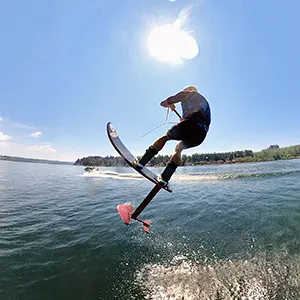
Vintage standup foiling works best in controlled tow conditions: flat to lightly rippled water, clear visibility, and a wide, predictable tow lane. You want water where the driver can hold a consistent line and speed, and where the rider is not forced into emergency turns.
Standard Sky Ski safety rules translate well to standup towing.
- Avoid unfamiliar or shallow water. Never ride in water less than 8 feet deep.
- Build speed progressively. Do not exceed 15 mph until the taxi position is mastered, and a speed of 25 mph or less is typical. This is much faster than the 10-12mph range of modern boat-towed foils.
- Avoid floating objects such as sticks, weeds, or ropes, as they are especially dangerous to a foil assembly.
Bad conditions are anything that increases the consequences: heavy chop that causes repeated breaches, crowded boating lanes, narrow channels, and any water with submerged hazards.
Where to Go
The right locations are simple
- Protected lakes and wide river sections with steady depth and low traffic, where you can run long straight passes and wide turns without interference.
- Dedicated tow-sport zones where you can keep a clean riding corridor well away from swimmers, docks, and anchored boats.
Avoid busy marinas, public swim beaches, and any place with shallow bars or unknown bottom contours.
Setup and Tuning
Vintage standup foiling had limited “tuning” compared with modern track-based foils. Most of your performance comes from proper speed and technique.
Hardware and assembly
Sky Ski assembly guidance is explicit
- The foil system is a strut inserted into a fuselage, with front and rear wings bolted on and periodically rechecked for tightness.
- Anti-seize is recommended on key bolts, and Loctite is explicitly discouraged for those bolts.
- Some wing shimming is possible; however, mast position is always fixed.
Tow line length and handle choice
Rope length is described as a matter of personal preference, with typical guidance that beginners often learn more easily on 55 to 65 feet, and experienced riders often prefer 75 to 95 feet.
Use the training handle approach only during learning, then transition to a standard handle to reduce the risks associated with large handle openings.
Speed progression
The taxi phase is your tuning tool. Start slow, master the taxi, then add speed gradually until stable flight is repeatable.
Tips and Tricks
- Master the taxi before you chase air. Taxi first, then fly. The speed caps exist for a reason.
- Use micro-movements. Small body changes have a dramatic effect on foil behavior, especially while learning.
- Keep your head up and eyes forward. Looking down is a fast path to losing balance.
- Treat foot retention like a performance and safety system, not just convenience. The move from straps to snowboard boots and quick-release bindings was about staying connected and in control at speed, but it also increased the leverage and injury risk in crashes, so you progress jumps slowly.
- Run a real pre-ride check every set. Inspect for loose or damaged parts and confirm critical bolts are tight before each ride.
Skills Ladder
Beginner
In vintage standup foiling, “beginner” means you already know how to be towed, and you are learning foil flight while standing on a wakeboard foil board-style platform.
- Deep-water start and taxi control: you get up behind the boat, settle into a stable surface ride, and hold a straight, predictable line before you ever try to fly.
- First flights: ease the foil up, then immediately focus on holding a low, steady ride height rather than chasing height or wake jumps.
- Foot retention competence: you learn to ride with bindings as a control tool, not as a security blanket, because being attached changes how every fall loads ankles and knees.
Gear changes that help
- Conservative tow speeds and plenty of depth while learning. Sky Ski’s guidance includes not exceeding 15 mph until the taxi is mastered and avoiding water deeper than 8 feet.
Intermediate
You can fly cleanly, cross the wakes, and recover from touchdowns without crashing.
- Stable wake crossings: you carry a consistent height over the wake and land without oscillation.
- Controlled edging and direction changes: you steer with small inputs and keep the foil loaded through turns, rather than scrubbing speed.
- Binding management: You keep your lower body quiet and avoid “catching” the foil with your feet locked in.
Gear changes that help
- Transition from training handles to normal handles once you no longer need the extra support. Sky Ski specifically calls out a beginner “deep V” handle as a temporary tool.
Advanced
This is where vintage standup foiling became its own style: fast runs, bigger wake hits, and aerial moves.
- Height control at speed: you stay composed when speed increases, and the foil’s lift builds rapidly.
- Jumps and airs: you use the boat wake as a predictable ramp, landing cleanly and protecting your lower body from binding-loaded crashes.
- Convertible riding competence: you can run a convertible Sky Ski in standup mode with snowboard boot style retention, where the locked-in feel raises both control and consequence.
Niche Specific
It is tow-only. Vintage standup foiling is built around a boat providing steady speed, so the entire technique set is about towing dynamics, wake management, and controlled height.
It is binding-centric. The early “air board” progression moved quickly toward keeping feet on the board, and stand-up sessions on a Sky Ski Convertible have been done with snowboard boots and step-in bindings.
It sits between Dynaflite-era hydrofoil waterskis and modern foilboards. Dynaflite production is documented as starting in 1963 under Cosmo Dynamics, later Custom Dynamics, long before the single-board standup era.
It is distinct from Laird Hamilton’s late-1990s and early-2000s surf-foil experiments. Those were similar hydrofoils on surfboards aimed at wave riding, not a tow-sport product category.
Common Problems
Getting launched by over-foiling
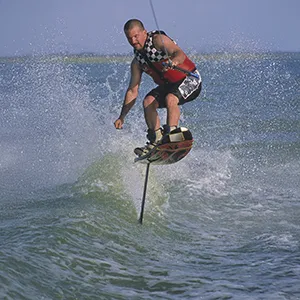
- What happens: you climb too high, ventilation cascades, and you crash hard at two speeds.
- How you solve it: ride lower, build speed gradually, and treat taxi mastery as mandatory before pushing faster.
“Handle control” confusion
- What happens: you fight the rope with big arm movements instead of balancing the foil with stance and subtle load changes.
- How you solve it: you keep inputs small and consistent. Vintage tow-era designs often required more active control, and Sky Ski’s later design work explicitly aimed to reduce the need for riders to move their hands up and down to manage altitude.
Lower-body leverage injuries
- What happens: with feet locked in, a sudden catch or awkward fall loads ankles, knees, and hips hard.
- How you solve it: you progress slowly, keep ride height conservative, and do not chase big airs until your falls are clean and predictable.
Shallow-water and obstacle strikes
- What happens: the foil hits bottom or debris and stops instantly.
- How you solve it: ride only in known, deep water and avoid floating objects. Sky Ski’s guidance is clear about depth and the avoidance of hazards such as sticks, weeds, and ropes.
World Records
There are no recorded world records for Vintage Standup Foiling in our database yet. If you know of one, or you hold that epic distinction, submit it for inclusion.
World Firsts
- First helicopter on a vintage stand-up foil board: First helicopter on a vintage stand-up foil board. Holder: Bobby Taylor
- First ride-away invert on a stand-up hydrofoil / Sky Ski Convertible: First ride-away invert on a stand-up hydrofoil / Sky Ski Convertible. Holder: Jake Kinnison

Know about a broken record, an update needed to an existing world first, or a brand new world first that deserves to be in the public record? Submit it.
History
- 1963: Dynaflite stand-up hydrofoils were produced by Cosmo Dynamics (later Custom Dynamics), an early commercial era of stand-up hydrofoil waterskis. These are in a different class of stand-up foil boards and covered in a separate article.
- 1991: a major milestone for stand-up board style foiling happened when an Air Chair foil assembly was mounted to a surfboard and ridden like a wakeboard, evolving quickly toward foot retention.
- 1998: Sky Ski was founded by Mike Murphy, who had been one of the founding members of Air Chair.
- Late 1990s to early 2000s: Laird Hamilton’s surf-foil experimentation on hydrofoils attached to surfboards helped popularize foilboards in the surfing world, overlapping in time but separate in purpose from tow-sport standup rigs.
- In 2005, Sky Ski built a production product that converts into a stand-up foil board, and at least some riders used snowboard boot setups to “click into” the stand-up configuration. This is the iteration of Vintage Standup-up foiling we are talking about in this article.
FAQs
Is vintage standup foiling the same as modern surf foiling?
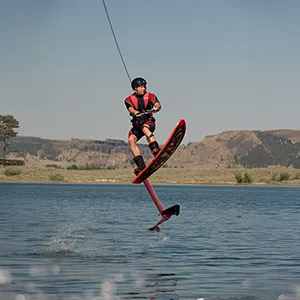
No. Vintage standup foiling is boat-towed and built around a wakeboard-foil board-style platform with bindings, while modern surf foiling is wave-powered and typically uses a surf-style board and a modular foil. Vintage standup foils would use the boat wake for tricks, but not to provide the lift and power for the foil.
What makes a convertible Sky Ski different from a normal sit-down hydrofoil?
It was designed to convert into a stand-up foil board configuration. Many riders still kept it primarily in sit-down mode, but the stand-up configuration was real and used occasionally.
Did riders really use snowboard boots for standup hydrofoiling?
Yes. Waterlogged snowboard boots and clicking into a Sky Ski Convertible in standup “air board” mode really was how they worked. And the boots took days to dry out.
What is the biggest risk difference compared to modern foilboarding?
Foot retention plus tow speed. Being attached improves control on jumps and wake hits, but it increases the risk of leverage injuries during catches and crashes.
What is the safest first step if I want to try this style?
Learn the fundamentals of tow foiling first: taxi control, low ride height, clean wake crossings, and conservative speed progression. Also, best of luck finding an original stand-up convertible Sky Ski.
Which Foiling Freaks are into Vintage Standup Foiling
-
 Bucklehorn Blue
Clipped in and lit up. Checkout Bucklehorn Blue's merch page.
Bucklehorn Blue
Clipped in and lit up. Checkout Bucklehorn Blue's merch page.
Vintage SkySki Convertable StandUp Hydrofoil
Taking a spin on the SkySki convertable stand-up hydrofoil. This was one of the first standup foil boards from back in the 90's. One of the first made by Mike Murphy at SkySki. Clicker snowboard bindings and snowboard boots and about 20+ mph behind the boat to get it to fly.
If you know this discipline inside and out and want to help review and or edit the info on this page, drop us a line. We will credit you as a reviewer or editor and set you up with a proper bio page with links back to your site.