Dual Ski Foiling
What is Dual Ski Foiling?
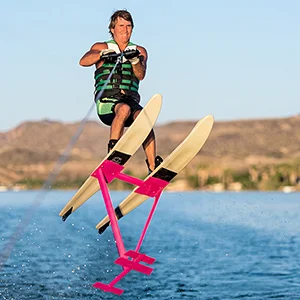
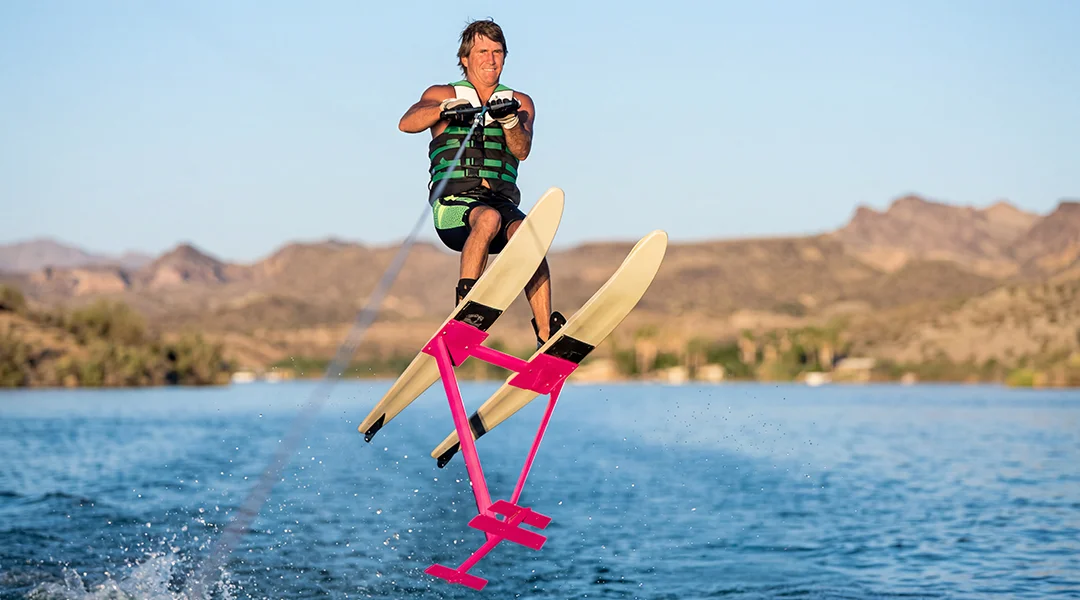
Dual Ski Foiling is the original format of waterski foiling. It uses a pair of standard water skis mounted to a rigid metal frame that carries a small hydrofoil wing beneath the skis. It was commercialized under the name Dynaflite and produced by Cosmo Dynamics (later Custom Dynamics) starting in 1963.
This is the starting point for the stand-up hydrofoil ski product category. It predates modern foil boards by decades and sits in the same historical family tree as later tow-foiling devices, such as sit-down hydrofoils and board-based standup foils.
While nobody rides these anymore, and they are only found hanging in man caves and garages, they mark the beginning of our history of stand-up hydrofoils. While other hydrofoil concepts predated the Dynaflite, the Dynaflite was the first commercially produced and sold product, and it is where our Foiling Freaks list of foiling disciplines starts. It is included here for historical purposes.
If anyone ever dusts one of these off and takes a run for old times' sake, send us pics.
Who is into dual ski foiling?

If you are into dual ski foiling, make sure to drop your pin on the Foilers Pin Map and help dual ski foiling claim the leaderboard. Check the pin map and leaderboard for how many people into dual ski foiling have marked themselves on the map.
How it Works
The power source is by boat tow. A hydrofoil run starts like normal water skiing. You begin behind the boat on two skis and build speed. As water speed increases, the hydrofoil wing generates lift. When the lift exceeds the system's weight, the frame rises, and the skis ride above the surface. This reduces drag.
Once flying, foil ride height is controlled by balance and subtle weight shifts. You manage pitch to keep the foil from climbing too high and ventilating, or settling too low and touching down. Direction changes are made with edging and the tow-rope technique, but the rigid dual-ski frame favors smooth, conservative lines over tight carving.
What Makes it Different
- You stand on two skis joined by a frame, which increases platform stability and makes the system feel more like traditional water skiing than modern board foiling.
- Fixed-vintage architecture: The foil wing and frame form an integrated structure rather than a modern modular mast-and-plate system with easily swapped wings and tails.
- Historical first: Dynaflite was the first commercial stand-up hydrofoil watersport product, with Walter Woodward and Lucas Emmanuell associated with the invention and early commercialization, and early successful flights credited to skier Frazier Sinclair.
Safety and Etiquette
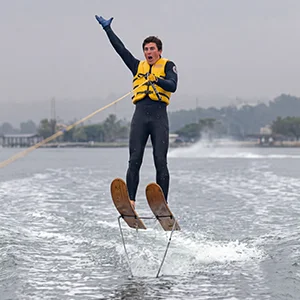
A dual ski hydrofoil setup combines tow-sport speeds with hard, exposed hardware below the rider.
- Run a proper tow setup: driver plus spotter, a clear tow lane, and predictable passes. Keep swimmers and other boats well away from the riding corridor.
- Choose depth and hazard-free water: a hydrofoil water ski can strike bottom, weeds, ropes, or floating debris and stop abruptly.
- Wear flotation at minimum: a PFD is standard tow-sport safety equipment.
- Avoid crowded areas: behind the boat, foiling needs wide buffers because turning and stopping are not instant.
Starter Guide
Minimum gear list
- A vintage hydrofoil ski setup (Dynaflite-style dual skis on a frame with a foil wing).
- Boat, tow rope, handle, driver, and spotter.
- PFD, plus practical impact protection.
Difficulty ranking and learning curve
- By modern standards, this system is considered difficult because riders learned foil lift control without the benefit of modern, adjustable foil systems and without today's supportive instructional environment.
- First, master stable surface towing behind the boat. Next, try brief controlled lifts. Then, work on longer flights with safe, conservative wake crossings.
Cost ranges
- These are found primarily as vintage or collector items rather than as commonly sold retail products.
Gear Selection
Skis, frame, and foil structure
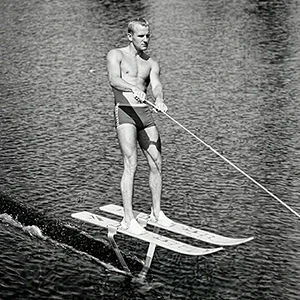
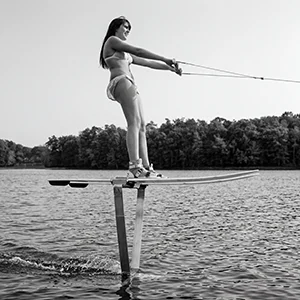
Dual Ski Foiling used two regular water skis clamped to a rigid frame, with hydrofoil surfaces mounted below. A preserved example is described as an aluminum V-shaped hydrofoil with two ski brackets at the top and a crossbar below, carrying three rectangular wing surfaces.
The original Dynaflite-style layout was not a modern mast-and-plate system. It used struts down to a fuselage-like structure that carried multiple foils, including front lifting surfaces and a rear stabilizing surface.
What you can realistically choose
This is vintage equipment. There were no standardized ranges for wing area, wingspan, or mast length, as there are with modern modular foils.
Safety gear and tow gear
Use a tow rope, a handle, a capable driver, and a spotter for safe behind-the-boat foiling.
Conditions
Good conditions
- Dual ski hydrofoil waterskiing works best in calm, clear water. The original design focused on stability and easy towing. It was designed to handle wave disturbances and speed changes, but it still requires clean water flow and steady towing.
Bad conditions are anything that raises strike or collision risk
- Shallow water, weeds, floating lines, or debris that can catch a foil.
- Crowded boat traffic where you cannot maintain a clean tow lane.
- Rough chop that makes ride-height control inconsistent at tow speed.
Where to Go
Historically, dual-ski hydrofoils were demonstrated at show-style venues and large, controlled waterways, including demonstrations at Cypress Gardens in Florida.
For practical modern use (if you ever encounter one as they haven't been ridden in decades), the right setting is
- A wide, open lake with consistent depth
- Minimal traffic
- Plenty of room for long straight passes and gentle turns
Setup and Tuning
Dual Ski Foiling had limited tuning compared with modern foils, but it did have meaningful setup variables.
Ski mounting and alignment
The original patent describes clamp-and-bracket systems for attaching to a pair of skis, with adjustment features, such as slidable brackets, to accommodate different ski positions and spacings.
Your main “tuning” is correct alignment and solid attachment. If the skis are misaligned, the whole system tracks poorly and amplifies wobble.
Pitch stability is baked into the foil layout
The patent describes a forward foil that gives positive lift. The rear foil provides negative lift. This classic setup helps control ride height.
That is the historical equivalent of modern stabilizer tuning: it is designed to self-correct pitch rather than relying on a rider to micro-manage every oscillation.
Historical performance variation
The Dynaflite hydrofoil had a stabilizer plus two “flying” wings, with one wing removable to change speed characteristics.
Tips and Tricks
- Treat the first goal as foil lift control, not wake crossing. Get clean, low flights first, then add wake interaction.
- Keep the tow rope technique quiet. A steady handle position and steady line tension reduce sudden pitch changes.
- Ride low. Vintage foil skis have a lot of structure underfoot, and over-foiling can lead to poor ventilation and hard crashes.
- Turn wide and early. The dual-ski platform and frame favor smooth arcs over snap turns.
- Use deep, obstacle-free water only. A foil strike is a stop-and-launch event on this kind of hardware.
- Run a strict “clear lane” rule. These systems have more submerged hardware than modern wake foiling, and other water users will not anticipate your path.
Skills Ladder
Beginner
Dual Ski Foiling starts as normal behind-the-boat water skiing, then adds foil lift control
- Deep-water start and stable surface towing on the two-ski frame before you try to fly.
- First controlled “pop-ups” onto the hydrofoil, staying low and level instead of chasing height.
- Basic tow rope technique that keeps line tension steady, because sudden load changes translate directly into pitch changes.
Gear changes at this stage
- Focus on correct assembly and alignment rather than performance tweaks. These systems are integrated frames, not modern modular foils.
Intermediate
You can fly consistently and manage the two big variables: ride height and wake texture
- Hold a steady foil ride height without oscillation.
- Smooth direction changes and conservative wake crossing on foil, using wide arcs rather than aggressive carving.
- Touchdown recovery: settle back to the surface, regain speed, and lift again without a crash cycle.
Gear changes at this stage
- If your specific Dynaflite-style setup has adjustable mounting points, you use them to correct tracking and balance, not to chase speed.
Advanced
At the advanced level, vintage hydrofoil skis become a high-skill tow foiling device
- Confident wake crossing and jumps at speed while keeping the foil from breaching.
- Stable flight through faster passes and rougher surface texture, without over-correcting.
- Show-style lines and longer flights, where control looks effortless because the pitch stays calm and consistent.
Niche Specific
- Dual Ski Foiling is a hydrofoil water ski built from two standard skis mounted to a rigid frame, with hydrofoil surfaces below the skis.
- The design priority was stability and controllable lift for behind-the-boat foiling, not tight turns or wave riding.
- Pitch stability is engineered into the foil layout. The foundational patent describes a forward foil that provides positive lift and a rear foil that provides negative lift to stabilize ride height.
- This format is the earliest commercial stand-up hydrofoil ski product line commonly cited in watersports foiling history, produced as Dynaflite by Cosmo Dynamics (later Custom Dynamics) starting in 1963.
Common Problems
Over-foiling and ventilation
- What happens: you climb too high, the foil ventilates, and you get launched.
- How you fix it: ride lower and treat foil lift control as the main skill, not speed or wake hits.
Wobble from misalignment
- What happens: the frame tracks poorly and feels unstable because the ski mounts or the foil assembly are misaligned.
- How you fix it: re-check mounting alignment and tighten hardware. Vintage systems rely more on proper mechanical setup than on rider “tuning.”
Strikes on weeds, ropes, or debris
- What happens: a foil catches something and stops abruptly.
- How you fix it: choose clean, deep water and avoid any area with floating hazards.
Wake crossing too early
- What happens: you hit the wake before you can hold steady height, and you crash hard.
- How you fix it: master straight-line flight first, then add gentle wake crossings with wide, controlled lines.
Tow line load spikes
- What happens: sudden changes in rope tension change the system's pitch up or down.
- How you fix it: keep the handle position consistent and coordinate speed changes smoothly with the driver.
History
- Dynaflite stand-up hydrofoils were produced by Cosmo Dynamics (later Custom Dynamics) starting in 1963, widely cited as the first commercially produced stand-up hydrofoil waterski product line.
- Walter Woodward developed the concept in the early 1960s and partnered with Lucas Emmanuell for marketing and business support.
- Woodward and Emmanuell received a patent for the invention in 1965.
- Early successful flights are credited to skier Frazier Sinclair in the same historical accounts describing Dynaflite’s origins.
- Dynaflite demonstrations are associated with the show-ski era and venues such as Cypress Gardens in Florida in historical retellings of the sport’s development.
FAQs
Is Dual Ski Foiling the same as modern wake foiling?
No. Modern boat wake foiling typically uses a single board and modular foil parts. Dual Ski Foiling is a two-ski frame with integrated hydrofoil surfaces built as a vintage tow-only system.
How is it powered?
Boat tow hydrofoil power only. The boat provides the speed that creates lift on the hydrofoil wing.
Why two skis instead of one board?
The dual-ski platform increases standing stability and keeps the system closer to conventional water skiing, which was important for early adopters learning the foil stance and balance.
What makes ride height more stable than you would expect?
The stability comes from the foil layout itself. The early patent describes using a rear foil with a negative-lift effect to stabilize pitch and foil ride height.
Can you still buy a Dynaflite-style system?
These appear primarily as vintage hydrofoil skis and collector items rather than a modern retail product. Checking eBay or asking around on forums is how to find one.
Which Foiling Freaks are into Dual Ski Foiling
-
 Ruckus Vandalore
It looks sketchy. Lets do it. Checkout Ruckus Vandalore's merch page.
Ruckus Vandalore
It looks sketchy. Lets do it. Checkout Ruckus Vandalore's merch page.
Dynaflite Hydrofoil Waterskiing
Tony Klarich is training for his 60 for 60 event, riding a pair of vintage dual waterskis.
If you know this discipline inside and out and want to help review and or edit the info on this page, drop us a line. We will credit you as a reviewer or editor and set you up with a proper bio page with links back to your site.