Cable Park Foiling
What is Cable Park Foiling?
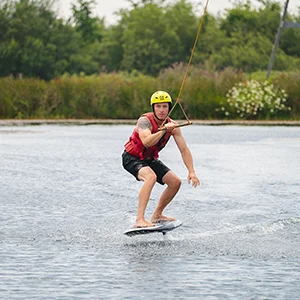
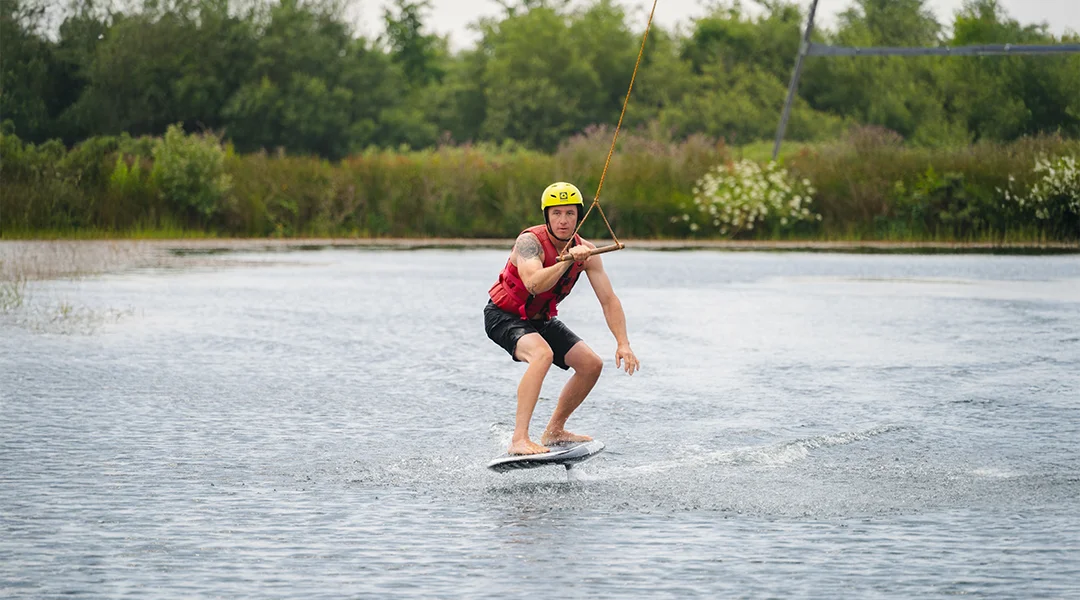
Cable park foiling is hydrofoiling at a watersports cable park, where you ride a foil board while being pulled by an overhead, electrically driven cable system instead of a boat tow or a tow boogie. The rider holds a tow handle connected to the moving cable, so you get a steady pull across a flat, controlled body of water.
It is also used as an easier starting method for flat-water pumping, rather than a dock start or a beach start.
Cable park hydrofoiling trades open water freedom for predictable speed, pull, and a defined riding lane. This makes it useful for learning towing starts, foil height control, and building confidence without waves.
Who is into cable park foiling?
If you are into cable park foiling, make sure to drop your pin on the Foilers Pin Map and help cable park foiling claim the leaderboard. Check the pin map and leaderboard for how many people into cable park foiling have marked themselves on the map.
Be more than just a dot on the map. Join the Foiling Freaks community and create your own foiling profile with a custom handle, rider photos, videos, disciplines, bio, and more.
How it Works
All foiling works because a wing moving through water generates lift. In cable park foiling, the power source is the cable system. An electric motor drives the cable, and your handle and rope are pulled by the moving line.
A typical session flow looks like this
- Start from a designated dock or launch area and take a handle when it comes through.
- Let the cable pull you up to speed smoothly. Keep your board pointed forward, and as you feel the lift, focus on standing tall and balanced. This helps you rise onto the foil with control.
- Ride the circuit at the park’s set speed. Cable parks can detach and attach tow ropes without stopping the main cable, which is part of how they keep riders cycling through efficiently.
After you are stable on the foil and feel in control, you may want to try letting go of the handle and pumping. Always check park rules and make sure it is safe and allowed before trying this, especially if others are riding.
What Makes it Different
Cable park foiling differs from boat tow foiling and tow boogie foiling in a few fundamental ways.
- The tow path is fixed. You ride where the cable goes, including corners, so your line choices and spacing are constrained by the system layout.
- The pull angle is higher than that of a boat. The cable is suspended well above the water, which changes the feel compared to a low tow point and alters the pull through turns.
- The water is usually flatter than open water conditions. Instead of chasing swells or wakes, you use steady tow power for systematic hydrofoil practice.
- The environment may include features built for wake sports. Many cable parks feature ramps and sliders for wakeboarding, which underscores the need for strict lane discipline and equipment awareness when hydrofoiling.
Safety and Etiquette
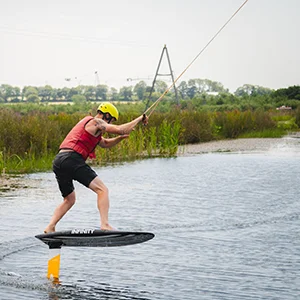
Cable park foiling combines the hazards of hydrofoiling with those of a busy tow lane.
Safety priorities
- Wear the required protective equipment. Many cable parks require a buoyancy aid or impact jacket and a helmet.
- If you fall, let go of the handle. This reduces the risk of being dragged or tangled and clears the line for the next rider.
- Treat a loose handle as a projectile. If a free handle is coming toward you, get out of its path or duck under the water if you cannot move in time.
- Never wrap the rope around any part of your body or put any part of your body through the handle.
- Stay away from shallow water. A hydrofoil striking the bottom can stop instantly and throw you forward. Cable park rules commonly prohibit riding into the start area or shallow zones.
Etiquette that keeps everyone safe
- Ride predictably and keep spacing. In a cable system, everyone is moving in the same direction, and unexpected stops create chain-reaction hazards.
- Give riders in the water a wide buffer and take avoiding action early.
- Respect park equipment rules. Many parks restrict what equipment can be used on obstacles and where different gear types can ride. Ask before you bring a foil into the rotation.
Starter Guide
Minimum gear list
- A foil board and hydrofoil suitable for towing starts and stable cruising.
- A tow handle and rope compatible with the cable system, often provided by the park.
- Helmet and buoyancy aid or impact vest, because these are commonly mandatory at cable parks.
- Basic safety habits: quick-release mindset, clear communication with staff, and strict awareness of other riders and loose handles.
Cost ranges
- Cable park foiling costs depend on the park’s pricing model, whether you rent gear, and whether you add coaching.
Difficulty ranking and learning curve
- If you can already start from a tow, cable park foiling will feel straightforward because the pull is steady and the water is controlled. This consistency makes it easier for beginners to adapt.
- If you are new to foiling, cable parks make it easier to learn because the steady tow helps you lift off. Focus on practicing foil height control, falling safely, and paying attention to other riders.
How to get started efficiently
- Start in the quietest session you can book, with the fewest riders on the water.
- Tell the staff you are on a hydrofoil and confirm where you are allowed to ride and whether releasing the handle to pump is permitted.
- Focus your first runs on steady takeoff, stable cruising height, and safe falls with immediate handle release.
Gear Selection
Foil board
Cable park foiling uses the same general board category as tow-based wake foiling: compact, stiff boards built to handle towing loads. A common beginner-friendly length range for tow-style foil boards is about 4’4" to 4’10", with more advanced riders often moving down to about 3’6" to 4’2" for lower swing weight and quicker handling.
Front wing and stabilizer
Cable systems typically run at a fairly consistent speed of about 19 mph (30-31 km/h), designed for wakeboards and wakeskates; some parks offer slower beginner sessions. Check with your park on the speed ranges used for foil boards.
That matters because foil size is a speed match. Bigger wings lift earlier and tolerate slower speeds, while smaller wings ride faster and carve tighter. Typical boat-towed foiling is in the 10-12mph range.
A practical sizing approach for cable park hydrofoiling is to start with the larger end of the tow-foil range for your weight, then step down as control improves. For example, one tow-foil guideline lists:
- 1,000 to 1,500 cm² for lighter riders
- 1,500 to 2,000 cm² for mid-weight riders
- 2,000 cm² and up for heavier riders
If you want a more performance-oriented feel at cable speeds, a broad wake-foil range commonly used across weights is roughly 900 to 1,600 cm², with beginners trending larger and advanced riders trending smaller.
Stabilizers are typically chosen to maintain a stable, predictable pitch. A larger stabilizer generally feels steadier; a smaller stabilizer generally feels faster and more reactive.
Mast length
Cable parks are flat-water environments, but you still want enough mast to handle chop, corner load changes, and occasional wake rollers. A common mast height range for tow foiling is 60-90 cm.
If your park has shallow zones, choose a mast that provides safe clearance without bottoming out.
Tow handles and line
You ride a standard tow handle setup, usually supplied by the park. The important part is clean handling and clean releases. Cable parks generally require you to let go of the handle when you fall, and to avoid getting tangled in rope or handle hardware.
Protective equipment
Many parks require a buoyancy aid or impact vest and a helmet. Plan on wearing both for cable park foiling.
Conditions
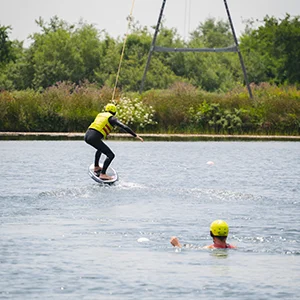
Cable park foiling thrives on the controlled environment: flat water, consistent pull, and a defined riding lane. The cable speed is typically around 19 mph (about 30-31 km/h), which gives you repeatable starts and repeatable foil trim.
Good conditions
- Light wind and minimal chop, so you can hold steady height without constant corrections.
- Clear water and good visibility so you can spot floating hazards early.
- Low rider density so you have time and space to fall, recover, and get out of the lane safely. Parks explicitly require riders to take avoiding action around people in the water.
Bad conditions
- Crowded sessions where spacing gets tight and loose handles become a real hazard.
- Strong wind that stacks chop across the tow line, increasing breach risk.
- Parks with heavy obstacle layouts are not ideal when you are learning, because cable parks commonly include ramps and sliders built for board sports, and those features add collision and entanglement hazards.
Where to Go
Cable park hydrofoiling works anywhere you can ride a cable system that allows hydrofoils.
Best general venue types
- Beginner-friendly parks that offer slower-speed sessions (or a coaching lane) so you can learn starts and foil height control without being forced to ride at full course speed.
- Two-tower or straight-line cable systems for first sessions, because the pull is consistent and you are not dealing with full-size corner dynamics. Two-tower cable systems are designed to run a range of speeds and are commonly used for teaching tow sports.
- Full-size loop cable systems, once you can manage corners and traffic flow. Full-size cables are widely used in cable skiing and wake parks and are designed for continuous laps with many riders.
Find a cable park near you, confirm that hydrofoils are permitted, and find out where you are allowed to ride.
Setup and Tuning
Cable park foiling is speed-locked compared with boat tow. Tune to ride comfortably at the park’s operating speed.
Wing size matches the cable speed
- If you are learning, choose a wing that gives calm lift at slower speeds and does not demand aggressive edging. Larger wings make starts easier and keep you flying with less effort.
- If you are advanced and the park runs full speed most of the time, you can step down in wing size to reduce drag and increase carving responsiveness.
Mast position
Mast position changes lift feel, stability, and how the board behaves in turns.
For cable park foiling, the target is neutral trim at the park’s set speed. If the foil wants to climb constantly at cable speed, move toward a setup that reduces that tendency. If it feels glued down and hard to lift, move toward a setup that increases lift and balance.
Tail shims and stabilizer tuning
Shims adjust the stabilizer’s angle, affecting pitch stability and speed. Small changes can feel big.
For learning, prioritize pitch stability so the foil holds height through small speed changes and corner load shifts. As control improves, reduce stability gradually if you want a looser, faster feel.
Cable-specific tuning mindset
The tow point is high. Cable systems are commonly suspended well above the water, which changes the pull angle versus a boat.
That higher pull can make it easier to stay light on the board, but it also punishes over-trimming. Keep your foil height conservative until your corner handling is automatic.
Tips and Tricks
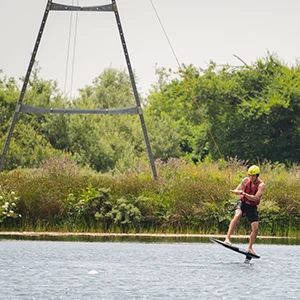
- Start with pure towing fundamentals. Point the board straight, stay relaxed, and let speed build before you try to climb.
- Run the “safe fall” rule like muscle memory: if you fall, let go of the handle, then get yourself and your equipment out of the lane fast.
- Ride lower at first. Breaches happen fast at cable speeds, and a low, steady ride gives you room to absorb speed changes.
- Learn how to pull through the corners. The pull direction changes, and that can spike line tension. Keep the board flat, keep your stance quiet, and focus on exit control rather than aggressive edging.
- If your goal is pump practice, dial in starts and smooth riding first. First, get consistent laps with clean height control. Then choose a quiet session and only attempt to handle releases if the park explicitly allows it and you have clear space.
Skills Ladder
Beginner
You learn to treat the cable like a perfectly consistent tow boat. Your first goal is not carving. Your goal is clean flight, steady height, and safe falls in a shared tow lane.
- Launch and get stable behind the handle without oscillating. A simple rule is board flat, knees soft, and let the pull create speed before you ask the foil to fly.
- Hold a low, conservative ride height. Cable systems commonly run around 19 mph (31 km/h), which can lift you quickly and punish over-trim.
- Fall correctly. When you go down, you let go of the handle immediately and clear the lane.
Gear changes that help at this stage
- Use a larger, lower-speed front wing and a more pitch-stable tail so the foil does not feel twitchy at the park’s set speed.
- Use a moderate mast length in the common tow range, roughly 60 to 90 cm, unless the park’s depth constraints demand shorter.
Intermediate
Now you stop learning and start riding the cable line with intention.
- Corner management becomes a skill. The tow path is fixed, and the pull direction changes through corners, so you learn to keep the board quiet and your foil height stable as line tension shifts.
- You maintain spacing and ride predictably with other riders on the system. Full-size systems can accommodate multiple riders simultaneously and handle continuous cycling.
- You restart efficiently. Falls happen. You get clear, reset, and take the next handle as it comes by.
Gear progression
- Step down in front wing size only after you can ride corners without breaching. Smaller wings reduce drag and feel sharper at cable speeds, but they demand better control.
- Tune for neutral trim at the park speed so you are not fighting front-foot or back-foot pressure all lap.
Advanced
At the advanced level, cable park foiling becomes a precision tool for performance riding and, in the right context, pump practice.
- You can hold exact height through corners, cross rollers cleanly, and carve tight lines without ventilation or breaches.
- You can use the tow to get up, and then, when the park rules and traffic allow, you can release the handle and attempt to pump for a short glide segment. Pumping is the technique that lets a foil continue without external pull, but it requires clear space and strict safety discipline.
- You operate like a high-skill rider in a shared system: you anticipate loose handles, avoid riders in the water early, and choose lines that keep everyone safe.
Niche Specific
Cable park hydrofoiling is tow-based foiling with a fixed course. You do not pick your route. The cable decides the route, including corners, and you ride inside that constraint.
Speed is standardized. Many parks run at a “normal” speed of around 30 km/h (19 mph), so your foil choice and tuning must match that speed rather than the variable and lower speeds you get behind a boat.
The tow point is overhead, not low like a boat rope. That changes body position and how you manage line tension, especially when the pull angle shifts through corners.
The environment is controlled but not empty. Cable parks commonly include floating features and obstacles for board sports. A hydrofoil adds sharp hardware to a park environment designed around close passes and frequent falls, so lane discipline matters more than almost any other foiling niche.
Common Problems
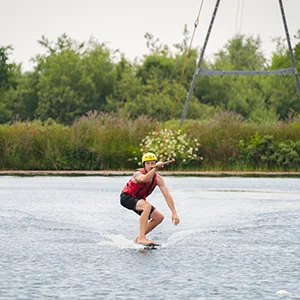
Breaching from over-speed or over-trim
- Problem: At a steady cable speed, you climb too high, breach, and crash hard.
- Fix: ride lower, keep pumps small, and tune the foil so it flies neutral at the park’s operating speed.
Getting spiked in corners
- Problem: line tension changes through corners, and you get pulled off balance.
- Fix: enter corners with a stable stance, keep the handle close, and prioritize a quiet board over aggressive edging until corner timing is automatic.
Loose handle hazards
- Problem: A released handle can return quickly, becoming a strike hazard.
- Fix: stay alert for returning handles, avoid lingering in the handle path, and follow the park’s safety rules for falls and recovery.
Not clearing the lane after a fall
- Problem: You fall and stay in the tow line, creating a chain-reaction hazard.
- Fix: let go immediately, swim to the nearest safe exit, and get yourself and equipment out of the riding line.
Feature and obstacle risk
- Problem: You drift toward features or fall in a landing zone.
- Fix: treat features as no-go zones unless the park has explicit foil rules for them, and always swim away from feature landing areas before you handle your gear.
Depth mistakes near the dock
- Problem: You ride into shallow areas, risking bottom strikes.
- Fix: respect the park’s shallow-water boundaries and keep your foil out of the start and exit zones.
World Records
There are no recorded world records for Cable Park Foiling in our database yet. If you know of one, or you hold that epic distinction, submit it for inclusion.
World Firsts
- First cable park hydrofoil ride: First cable park hydrofoil ride. Holder: Wesley Mark Jacobsen
Know about a broken record, an update needed to an existing world first, or a brand new world first that deserves to be in the public record? Submit it.
History
Cable towing sports were pioneered by German inventor Bruno Rixen in the early 1960s, creating cable waterskiing and the foundation of modern cable parks.
Cable parks expanded internationally over subsequent decades. In the United States, Ski Rixen USA is considered the first water ski cable park, opening in 1983.
Hydrofoiling at cable parks is a newer layer on top of that infrastructure. By 2019, foiling instruction material explicitly listed being towed by a cable system or wakepark as a practical way to get started on a foil.
FAQs
Is cable park foiling the same as wake foiling behind a boat?
It is the same idea as being towed by a boat on a foil, but the tow path is fixed, the tow point is overhead, and the speed is usually standardized at 19 mph (31 km/h), which is faster than boat tow speeds and changes how you tune your gear and ride corners.
What is the hardest skill unique to cable park hydrofoiling?
Corners. The pull direction changes every lap, so you must manage line tension shifts while keeping foil height stable. Loss of line tension can cause the foil to stall.
Can I let go of the handle and pump once I am up?
Pumping is the technique that can keep a foil moving without external power, so the concept works. Whether you can do it at a cable park depends on the park’s rules and traffic, because letting go creates a loose handle hazard, and you must keep the lane safe.
What safety rule matters most in a cable park setting?
If you fall, let go of the handle immediately and clear the riding line. That single habit prevents most multi-rider incidents.
Do cable parks usually have obstacles, and does that matter for foiling?
Many cable parks include floating features and obstacles. With a hydrofoil, those features raise the consequence of a mistake, so you need stricter spacing, stricter lane discipline, and clear park permission about where foils may ride.
Which Foiling Freaks are into Cable Park Foiling
-
 Riffi Katz
Cable park chaos with nine lives of style. Checkout Riffi Katz's merch page.
Riffi Katz
Cable park chaos with nine lives of style. Checkout Riffi Katz's merch page.
Wake Park Foil Surfing and Hydrofoil
This video showcases riders hydrofoiling behind a cable system at Urban Wake Park, highlighting the speed, carving, and smooth glide of cable park foil riding.
If you know this discipline inside and out and want to help review and or edit the info on this page, drop us a line. We will credit you as a reviewer or editor and set you up with a proper bio page with links back to your site.