Pump Foiling
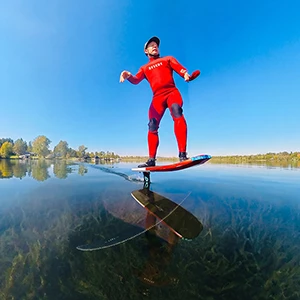
What is Pump Foiling or Dockstarting?
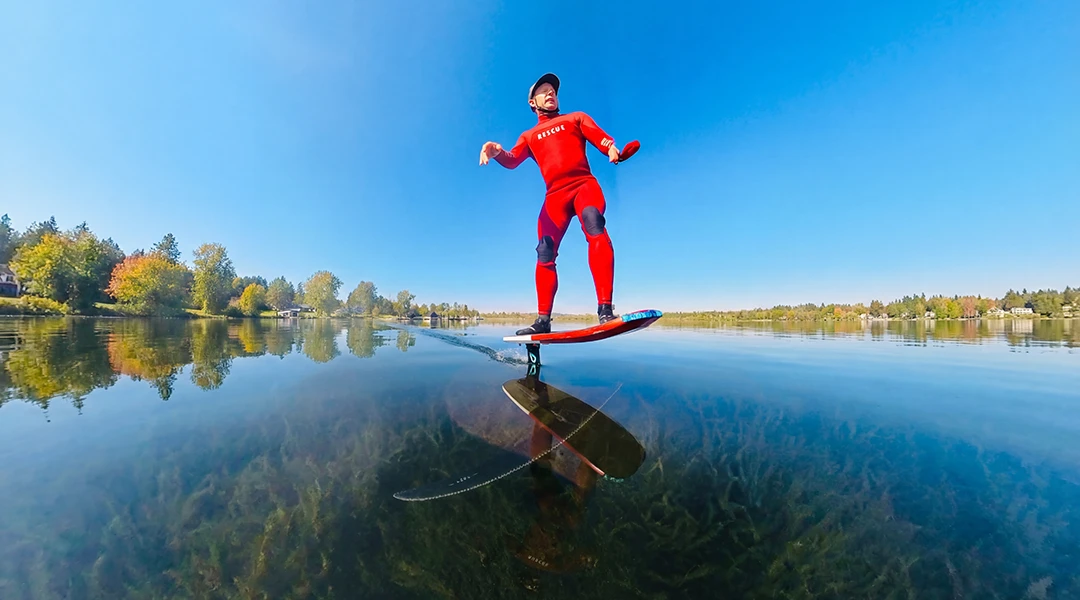
Pump foiling, also called dockstarting, is hydrofoiling powered entirely by the rider. You launch from a fixed platform, land on a small foil board, and keep the foil flying by pumping. There is no wind, wave, boat, or motor, just your legs and timing.
The “dock start” is one way to launch, and “pump foiling” is the act of keeping the foil flying. Other launch types include beach starting, hopping off rocks, ladders, or any number of contraptions. Whatever your style of starting, “dockstarting” and “pump foiling” are the most common ways it is referred to.
Pump foiling includes several start styles because platforms and water conditions vary. A running dock start is common when you need extra speed. A dead start removes the run-up and starts from a simple hop off the dock. A drop start launches from a higher platform. Some riders also use trick and specialty starts, such as a tomahawk start or other variations, when the dock shape and foil size allow it.
At its core, pumpfoiling is a balance-and-efficiency sport. You are learning foil control, timing, foil stability, and energy management. The better your technique, the farther you can fly.
Dock starting can also crossover into other disciplines, using it as a starting technique to then pump out and ride ocean waves, boat wakes, go freefoiling, or deploy a parawing.
Bolt a handlebar onto your dock-start foil, and you wind up with a scoot pump, which is another discipline of pump foiling.
At advanced levels, pumpfoiling crosses over into freestyle trick riding and competition riding, both freestyle and speed.
Who is into pump foiling?
If you are into pump foiling, make sure to drop your pin on the Foilers Pin Map and help pump foiling claim the leaderboard. Check the pin map and leaderboard for how many people into pump foiling have marked themselves on the map.
Be more than just a dot on the map. Join the Foiling Freaks community and create your own foiling profile with a custom handle, rider photos, videos, disciplines, bio, and more.
How it Works
The power source is human. You generate forward speed at the start, then maintain that speed by cycling the foil between periods when you actively pump it to generate lift and when you let it glide.
A key part of the start is getting the wing moving faster than its stall speed on the launch. This may necessitate a running start. Wings with a very low stall speed, such as large high-volume wings, can be started at speeds slow enough to simply hop on without a running start.
A typical dockstarting sequence looks like this
- Set the foil in the water: The board sits on the dock with the foil hanging into the water, positioned so the wings have clean depth and will not strike bottom.
- Launch: You either run and step on, hop on, or drop on, depending on the dock height and your dock start technique.
- Once you land, focus on keeping the board level and accelerating just enough to keep the wing flying.
- Pump and glide: Once airborne, you use foil pumping. Done correctly, the foil stays loaded and efficient, and your pump size decreases as your glide improves.
- The start style changes the problem you are solving. A running dock start gives you an extra boost of speed. A dead start or rock start demands cleaner timing and faster stabilization because you have less initial momentum.
What Makes it Different
Dock starting is different from every other foil discipline because you have no external energy source. In wing foiling, the wind powers the ride. In prone surf foiling, the wave provides the energy. In boat wake foiling, the boat wake supplies the energy. With a pump hydrofoil, the only fuel is your body.
That changes the equipment priorities
- Efficiency is more important than peak speed: Pump foiling favors glide, low drag, and stable pitch over top speed.
- Smaller, purpose-built boards: Dockstarting boards are typically very short, with a compact standing area, often around 80 to 100 cm long and roughly 40 to 46 cm wide, and have a low volume of 10 to 20 liters.
- Mid-length masts for pump efficiency and practicality: Many dockstart setups favor mast lengths of 70 to 80 cm because they reduce drag, improve acceleration, and work with common dock heights while still providing usable clearance. 60cm masts may be used for beach starts or in shallower waters.
- Wings sized for early lift and glide: Beginners commonly start with larger front wings to make lift easier and give more time to stabilize. Complete pump foil packages often include front wings in the mid- to high-1000 cm² range and can extend into the low-2000 cm² range for easy lift and low-speed stability.
The skill demand is also unique. Pump foiling is a coordination task first, then a fitness task. If your foil control is sloppy, you burn energy instantly, and the ride ends. Dock starting requires split-second timing, balance, and coordination.
Safety and Etiquette
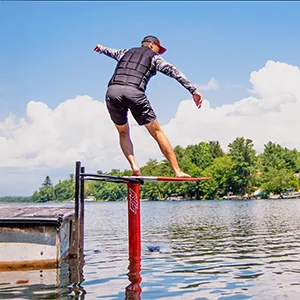
Dockstarting has a higher impact risk than many foil sports because you are launching near a hard structure and falling around a sharp, rigid hydrofoil.
Primary hazards
- Impact with the foil or board: The foil is sharp, and the board is hard. Falls happen close to the equipment, especially early on.
- Impact with the dock or platform: Missed steps and slips can result in injuries to the feet, shins, hips, and shoulders.
- Shallow water strikes: A mast or wing hitting bottom can stop you instantly and throw you forward.
Mitigation
- Wear a helmet and impact vest when learning, and consider wetsuit coverage and footwear for dock contact and foot protection.
- Use a spotter or train with a friend, especially at busy docks.
- Choose deep, clear water with no submerged hazards.
- Practice away from swimmers, anglers, and paddlecraft. A pumping foil has a limited ability to stop quickly and can travel in a crash.
Etiquette
- Do not monopolize a public dock. Rotate attempts and keep the launch area clear between runs.
- Avoid practicing in swim zones, narrow channels, or high-traffic boat ramps.
- If people are in the water nearby, you are too close to them. Foil safety starts with giving space.
Starter Guide
Dock start beginner progress is fastest when you keep the gear simple and the environment forgiving.
Minimum gear list
- A pumpfoil board with a compact deck and foil mount.
- A complete foil system with mast, fuselage, front wing, and stabilizer.
- Protective gear: helmet and impact vest at a minimum.
- Basic tools for tightening hardware and making small foil setup adjustments.
Gear sizing in general terms
- Board: compact boards commonly measure 80 to 100 cm in length and 40 to 46 cm wide, often with low volume.
- Mast: many riders use 70-80 cm for pump foiling and dock starting.
- Front wing: larger wings make the first phase easier by lowering stall speed and increasing stability. New rider setups commonly cluster from the mid- to high-1000 cm² range and can reach into the low-2000 cm² range depending on rider weight and goals. Surface area is only part of what makes a wing good for dock starting; they also need to have a low stall speed.
Cost ranges
Retail pricing varies widely by materials and whether you buy used. New complete pump foil packages commonly land in the $1,800-$3,000+ range, with higher-end setups above that. At the higher end, a top-of-the-line freefoil can run $6000-$7000.
Difficulty and learning curve
Dockstarting’s learning curve is steep. Focus first on repeatable starts, then on distance. Progress: stable step-offs, short glides, touchdowns, then longer pumps. Dockstarting may be one of the most difficult foiling disciplines to learn, with thousands of attempts needed to build the muscle memory for launching, landing on the board, getting it flying, and keeping it flying.
How to get started
- Pick a spot with deep water, minimal traffic, and a safe downwind drift area.
- Start with a low-consequence launch. A low dock or step-off is usually easier to repeat than a high drop when building foil balance.
- Film your attempts. The dock start technique improves quickly when you can see foot placement, body angle, and timing.
- If you have the flexibility, holding the board while taking a couple of steps along the dock and hopping on while still holding it is one of the easier ways to learn.
- Watch instructional videos focused on dock start tips and foil pumping, then test one change at a time.
- Find other local foilers through general local water sports communities. Pump foiling is safer and progresses faster when you can get immediate feedback.
Gear Selection
Dock starting is equipment-sensitive because you have no outside power. Everything is optimized for low-speed lift, low drag, and precise foil control.
Board
- Length: A dedicated pumpfoiling board is typically short. A practical working range is about 80 to 130 cm, with 80 cm often treated as the lower bound for most riders and 130 cm a reasonable upper limit before the board starts touching down too easily during foil pumping. 90-100cm is a good length to start with when you are learning and buying your first board.
- Width: Many riders land best on boards in the neighborhood of 34 to 50 cm wide. Narrower reduces foot travel from the dock to the board center and makes the step-on cleaner. Wider can feel easier to stand on and gives a bigger target to hit on the landing, but it adds swing weight and can increase unwanted touchdowns.
- Volume: Pump boards are usually low volume. In this case, volume refers to the amount of water the board displaces, measured in liters. A common functional range is about 10 to 15 liters, enough to be manageable without feeling like a brick.
- Stiffness: Stiffer boards transmit your pumping inputs more directly. Excess flex wastes energy and makes the ride feel loose. The stiffer the better. Boards with flex will absorb your pumping energy and eventually break.
Mast
- Length: For pump foiling and dockstarting, typical mast lengths range from 60 to 90 cm, with many riders settling into the 70 to low-80 cm range once they are past the first balance stage. Shorter feels more direct, longer gives more clearance and forgiveness before the board touches down. Most pump foils are more efficient the closer they are to the surface. A too-long mast means having to ride high off the water to gain that efficiency.
Front wing
- Area and span: Beginners usually start on larger wings to lower stall speed and give more time to stabilize right after the step-off. For many average-weight riders, high-aspect pump wings commonly land in the 1700-2100 cm² range, scaling up with rider weight and skill goals.
- High aspect versus lower aspect: Higher aspect wings have a high aspect ratio, meaning they are longer and narrower for their size. This shape tends to glide longer and reward efficiency. Lower aspect wings are shorter and wider, making them feel easier to roll and yaw at very low speeds.
- Sizing confusion to avoid: Foil specs are not always labeled consistently across manufacturers. Some emphasize span while others emphasize area, so you must confirm what measurement you are comparing. The best way to determine which wing may be best for you is to ask questions in the dock start forums and include your experience level, goals, and weight.
Fuselage and stabilizer
- Fuselage length: Shorter fuselages are more reactive and can make pump shots feel snappier, but they are also more pitch sensitive. A short fuselage around 60 cm is a common choice for most pump foiling. More advanced riders will move down in size from there.
- Stabilizer: For efficient hydrofoil pumping, the rear wing is often kept as small as practical to reduce drag, then increased only if you need more pitch stability while learning.
Accessories that actually matter
- Helmet and impact vest for foil safety near hard docks.
- Foil covers and board rail protection for handling on rough dock surfaces.
- A basic tool kit for fast foil setup tweaks, plus spare hardware.
- A launch aid or platform can make practice more repeatable when you do not have an ideal dock shape. Planks can be attached to docks, ladders can be erected in shallow water, and inflatable launchers can be put at the end of a dock.
Conditions
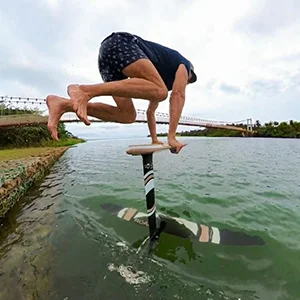
Dock start foiling is easiest when you remove variables. You want to spend your energy on technique.
Good conditions
- Calm, flat water is the gold standard. It lets you focus on foil balance and cadence without surprise touchdowns.
- Light wind or wind that is aligned with your run-up and landing zone. A mild breeze is manageable, but a strong crosswind or headwind increases the risk of missed steps and makes retrieving gear harder.
- Clean, deep water under the dock. You need depth well beyond your mast length with extra margin for mistakes and for the foil to swing during the launch and recovery.
- A weed-free riding area is critical. Riding in weeds is almost impossible.
Challenging conditions
- Chop and boat wake: increase touchdowns and make early pump foil practice far more frustrating.
- Current: can either help or sabotage you. It can give you free water speed if aligned with your direction, but it also drifts your board and changes the timing of your step-on.
- Traffic: Swimmers, paddlers, anglers, and tight marina corridors are high-risk. Dockstarting needs a clear run and a wide, predictable fall zone.
- Strong winds: pumping against a strong headwind takes a lot of energy and will limit how long you can pump. Winds also increase waves, which can be difficult to pump through.
Where to Go
Great dockstarting locations are defined less by geography and more by infrastructure.
What are you looking for
- A stable platform with enough run-up space for your preferred dock start technique.
- An undercut dock will allow different starting techniques than a piling dock.
- Clear water depth right at the edge.
- A safe downwind or down-current drift area where you can recover without hazards.
- Low congestion, especially during practice hours.
- A riding area free of weeds, debris, and underwater hazards.
- For freefoiling a shoreline with multiple exit and launch points.
Typical best environments
- Inland lakes and reservoirs with calm coves and public docks are ideal because you can often find flat water and predictable access.
- Sheltered marinas and protected bays can work well when boat traffic is light, and there is a safe buffer zone away from slips and swimmers.
- Large rivers can be excellent on quiet sections, but you must manage current and commercial traffic carefully.
Notable hotspots
- Pump foiling is common at major foil hubs like Hood River, Oregon, and Dana Point, California, where foilers regularly use docks for pumpfoil training when conditions suit.
- Lake Garda, Italy, is also widely recognized as a major foiling destination and is commonly used for many foil disciplines, including dock-based practice when the right platforms are available.
Setup and Tuning
Pumpfoiling rewards small, disciplined adjustments. Change one variable at a time and re-test.
Mast length choice
- Shorter masts feel more direct and can simplify early foil control.
- Longer masts give more clearance and more time before a touchdown, but they can feel less immediate. Typical pump-foiling mast lengths range from 60 to 90 cm, with many riders favoring 70 to low-80 cm as they progress.
Fuselage length
- Longer generally increases pitch stability and makes the foil feel calmer, which can help a beginner dock start.
- Shorter increases responsiveness and can make pumping feel more dynamic, but it demands cleaner balance. A short fuselage around 60 cm is a common “reactive” tuning choice.
Stabilizer selection
- Larger or higher-lift tail setups can steady the ride while learning, especially during the first few pumps after takeoff.
- Smaller tails reduce drag and extend glide once your foil stability is solid.
Shims and tail angle
- More tail lift makes it easier to stay flying at low speed, but it usually adds drag and can make the foil feel like it wants to climb.
- Less tail lift reduces drag and can increase glide efficiency, but it demands tighter foil control and cleaner cadence.
Board and mast position
- Moving the mast position changes your pitch balance point. If the foil feels like it wants to wheelie up, you shift balance toward more front-foot control. If it feels like it wants to dive and stick, you shift toward more lift and easier takeoff. The exact adjustment range depends on your mounting system, but the principle remains the same across pump foil setups.
Tips and Tricks
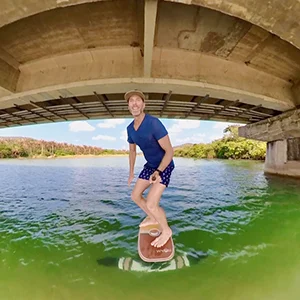
- Nail the landing: The ride is decided at touchdown on the board. Land centered, knees soft, eyes forward, and commit. If you land stiff, fully extended, or off-center, you’ll send the board off-axis and crash.
- Start low and fast: Early success comes from low, fast flight. Low keeps the foil engaged and reduces breach mistakes. Efficiency and flying high on the mast will come with experience.
- Pump smaller than you think: Big, vertical bounces waste energy and cause touchdowns and stalls. Efficient hydrofoil pumping is a smooth cycle: load, glide, reload.
- Use a repeatable launch: If your dock allows it, standardize your run-up distance and your step-on rhythm. The dock start technique improves the fastest when every attempt is comparable. Make incremental changes to dial in your launch and keep repeating when it works.
- Match the start style to the setup: Larger wings and stable setups allow slower step-offs. Smaller, faster setups often demand a more committed running start to clear stall speed.
- Make only one change at a time: If you change mast length, fuselage length, and stabilizer together, you learn nothing. Tune like an engineer: one variable at a time.
Skills Ladder
Beginner
Your goal is to make dock starting repeatable and controlled, then progress into short, stable flights one pump at a time.
Core skills
- Clean step-on or hop-on, with a low center of gravity and immediate foil balance.
- The first two pumps after landing. If you lose cadence or let speed bleed off, the run ends fast.
- Basic foil control: staying low, flying low, and managing touchdowns.
Typical gear choices
- Larger, lower-stall front wing for easy lift and more time to stabilize.
- A more pitch-stable setup (a longer fuselage or a larger stabilizer, if your system allows) to widen the margin for error.
- A mast length in the common pump foiling range (many riders use roughly 60 to 90 cm overall), so the foil feels direct and predictable. Standard mast length for most pump foiling is around 70cm.
- A compact, stiff board so your pumping effort goes into the foil instead of flex.
Intermediate
Your goal is to move from “I can start” to “I can stay flying and steer.”
Core skills
- Consistent dock start technique: repeatable foot placement, quiet upper body, smooth transition from gliding off the launch into foil pumping.
- Longer flights with efficient cadence, then controlled turns without stalling.
- Touchdown recovery: You can bounce off the water and keep going rather than ending the run.
Typical gear evolution
- Slightly smaller or faster front wing once starts are consistent, so you gain glide speed and efficiency.
- Smaller stabilizer or less tail lift as your foil stability improves, reducing drag and extending distance.
- Board size trends smaller as your landing accuracy improves, because a lighter swing weight helps cadence and turning.
Advanced
Your goal is to own the full session: launch, fly, turn, return, repeat.
Core skills
- Dock-to-dock runs with consistent turns, speed management, and efficient hydrofoil pumping.
- Higher-skill starts (dead starts, drop-start variations) when the platform and conditions demand them.
- Race-style pacing and line choice if you train for events.
- Freestyle trick riding and competitions.
Typical gear evolution
- More efficiency-focused front wings and tighter tuning, balancing lift, glide, and turning.
- A small quiver becomes useful: a bigger “easy start” wing for low-speed sessions and a smaller “faster glide” wing for fitness, distance, or racing.
Niche Specific
Dock starting is the purest form of human-powered foiling. There is no wind, no wave energy, no tow, and no motor. Everything depends on your ability to maintain and increase speed, and to improve foil and hydrofoil pumping efficiency throughout the entire run.
Dock starting overlaps with other disciplines as a way to start an ocean wave-riding session, poach passing boat wakes, or deploy a parawing for a downwind run.
One of the biggest differentiators in dock starting and pump foiling is that the engine is you. There is no kite, no wing, no boat, no motor, no river current doing the heavy lifting. Once you lift off, every extra second on foil is paid for by your body. That makes pump foiling both aerobic and anaerobic, and the line between those two energy systems is the line that separates a short victory lap from real endurance flight.
Most riders hit a wall around the two-minute mark because the effort quickly races past their lactate threshold. The first minute often feels controlled, then cadence tightens, breathing spikes, and the legs start to flood. That is the switch from primarily aerobic work to an anaerobic state, and once you are there, the clock runs fast. The foil starts to feel heavier, micro-corrections get sloppier, and the “pump to glide” rhythm slows down. Two minutes becomes the common ceiling, not because the technique is impossible, but because the body cannot sustain that intensity for long in an aerobic state, or lactate is building up faster than it can be cleared.
Breaking past that mark is less about grit and more about staying aerobic. High aerobic capacity lets you maintain a sustainable cadence, keep the pumps smaller, and give the foil time to glide rather than forcing it to stay alive. The pro is obvious: pump foiling becomes true endurance foiling, where long glides and efficient rhythm turn a dock start into a real journey. The con is just as real: it demands fitness and recovery like a serious sport. External-power disciplines let you ride longer while coasting on wind, wake, or watts. Pump foiling makes you earn every second, and that is exactly why crossing that two-minute barrier feels like a rite of passage.
Train for pump foiling like you would for a marathon if you are aiming for those long runs. Once you can pump foil at an aerobic pace, you can unlock those 5-minute, 10-minute, or even hours-long runs.
Pump foiling is also the only foiling discipline where you can get your official hat from Wake Thief once you have broken the one-minute pump foiling barrier.
Two things make this niche uniquely demanding and uniquely rewarding
- The launch is part of the sport. In most foil disciplines, you can reset with a tow, a paddle stroke, or a wind gust. In dockstarting, the start determines the entire run. The launch must be precise and balanced.
- Efficiency is the real skill. Strong legs and lungs help, but technique is critical as well. Once you learn to pump with less vertical bounce and more forward drive, your distance increases without needing more effort.
Dockstarting is also unusually portable as a discipline. Once you have a safe platform and depth, you can pump foil on lakes, rivers, and the ocean.
Common Problems
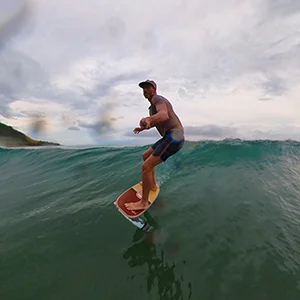
Missing the step-on or landing crooked
- What it looks like: board shoots out, you land too far back or too far forward, immediate stall or breach.
- Fix: simplify the start. Train a “commit and glide” attempt, focusing only on landing and a clean glide before adding pumping. Build consistency before you add intensity.
Stalling in the first couple of pumps
- What it looks like: you land, get one pump, then the foil drops and you stop.
- Fix: treat the first two pumps as a single movement: land low, keep speed, then pump with cadence immediately. This is the hardest part of dock starting for most riders.
Over-pumping and porpoising
- What it looks like: big vertical bounces, repeated touchdowns, rapid fatigue.
- Fix: pump smaller and smoother. Your goal is to keep the foil loaded and gliding, not to jump. Use controlled flex and extension, then recover into the next pump without rushing.
Breaching and ventilation
- What it looks like: you fly too high, the foil loses clean water, and then drops.
- Fix: fly lower, keep the foil submerged, and avoid sudden weight shifts. If your setup feels too pitch sensitive, tune for more stability before you chase distance.
Turns kill the run
- What it looks like: you start pumping well, then the first carve bleeds speed, and you drop.
- Fix: do not “steer hard.” Make wider arcs, keep your cadence through the turn, and maintain enough speed margin before you initiate the carve. The wing will lose lift in a turn, so compensate by pumping through it.
World Records
Longest freefoil continuous duration
- Current record: Nicolas Iten 4:02 hour freefoil duration record - 4 hours 2 minutes. Holder: Nicolas Iten
- Previous record: Jérôme Baudoux credited as first over 3 hours - Over 3 hours. Holder: Jérôme Baudoux
- Previous record: Beta Freefoil 2.5-hour endurance milestone - 2.5 hours. Holder: Todd Reichert
Longest freefoil distance
- Current record: Nicolas Iten 54.8 km freefoil distance record - 54.8 km in 4:02 hours. Holder: Nicolas Iten
- Previous record: Jérôme Baudoux 44 km pump foil record - 44 km in 3:26 hours. Holder: Jérôme Baudoux
- Previous record: Nicolas Iten 36 km pump foil record - 36 km in 2:39 hours. Holder: Nicolas Iten
Longest flatwater paddle-up pump foil distance
- Current record: Longest flatwater paddle-up pump foil distance. Holder: Michael Kihn
Know about a broken record, an update needed to an existing world record, or a brand new world record that deserves to be in the public record? Submit it.
World Firsts
First four-hour freefoil flight
- World first: First public four-hour freefoil flight found. Holder: Nicolas Iten
First freefoil circumnavigation of a named lake
- World first: First pumpfoil circumnavigation of Lake Brienz - about 36 km with 8 or 9 shore pauses. Holder: Pascal Hiltbrand
- World first: First freefoil circumnavigation of Lake Union. Holder: Eric Kamila, Warren McAndrew
- World first: First pumpfoil circumnavigation of Lake Thun - about 41 to 42 km with 9 stops. Holder: Pascal Hiltbrand
- World first: First freefoil lap around Green Lake - 5 km or about 3 miles. Holder: Eric Kamila, Warren McAndrew
First 20-minute pump foil run
- World first: First documented 20-minute pump foil run. Holder: Will Culberson
First men's SFT Pump Foil World Champion
- World first: First men's SFT Pump Foil World Champion. Holder: Edan Fiander
First women's SFT Pump Foil World Champion
- World first: First women's SFT Pump Foil World Champion. Holder: Viola Lippitsch

Know about a broken record, an update needed to an existing world first, or a brand new world first that deserves to be in the public record? Submit it.
History
Early dock starting started around 2018 and relied on mechanical assistance rather than rider power. Riders experimented with loaded bungee cords anchored to a dock or shoreline to sling a board forward, providing initial speed for the foil to lift. Others built battery-powered winches to reel a rider forward and reach takeoff speed. These setups worked, but were cumbersome and required equipment, setup time, and sometimes a helper.
As foil, board, and wing designs improved, especially with larger, more efficient low-speed pump foils, riders generated enough lift by simply jumping onto the board and pumping.
Modern dock starting has evolved into this minimalist approach: a rider jumps from a dock onto the board, then uses rapid pumping to build lift and transition into sustained flight without external assistance.
- Dockstarting and pumpfoiling were clearly established enough to have detailed instructional material by December 2019.
- By May 2024, pump foiling had grown into its own community in some regions, and “first official competitions” had already taken place in Berlin.
- By 2025, organized competitive circuits existed. A Pump Foil World Cup season culminated with overall champions crowned at Lakeventure on Lake Traunsee, reported as the first overall champion year of that tour.
- The Surf Foil World Tour also reported crowning inaugural Pump Foil World Champions, listing champions including Edan Fiander and Viola Lippitsch, with the finale at Lake Traunsee.
FAQs
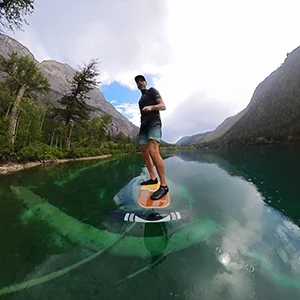
Is dockstarting the same thing as pumpfoiling?
Dockstarting is the most common start method for pump foiling, but pump foiling is the broader discipline. You can pump foil from docks, rocks, beaches, or other creative starts if you can safely generate the initial speed. The term is used interchangeably, as when someone says they are dockstarting, they are essentially pump foiling.
How deep does the water need to be?
Deeper than your mast length, plus margin. You need enough depth that the front wing and mast never touch bottom during launch, touchdown recovery, or turns.
How long does it take to learn dock start foiling?
It varies widely, but most riders need repeated sessions over days, weeks, or months to establish a consistent start, then additional time to build a sustainable cadence and distance. The learning curve is steep because the start and the first pumps are unforgiving and take many repeated attempts to train the muscle memory and learn the split-second timing required.
Does pump foil practice help other foil disciplines?
Yes. Pump foiling builds foil balance, foil control, and an efficient pumping rhythm that transfers to wave linking and general foiling skill. Learning those skills first in other disciplines also helps shorten the learning curve.
What is the single best tip for a pump foil beginner?
Land low, centered, and stable, then transition immediately into a smooth cadence. If the landing and first two pumps are clean, everything else becomes possible. Consistent practice over time is the key to unlocking pump foiling.
Which Foiling Freaks are into Pump Foiling
-
 Nixie Finley
Queen of the dock-start. Mayor of the splash zone. Checkout Nixie Finley's merch page.
Nixie Finley
Queen of the dock-start. Mayor of the splash zone. Checkout Nixie Finley's merch page.
-
 Jinx Loghopper
If the swamp has a path, I will find it. Checkout Jinx Loghopper's merch page.
Jinx Loghopper
If the swamp has a path, I will find it. Checkout Jinx Loghopper's merch page.
-
 Frosty
The Scoot-Pump Yeti of the Ice Floes. Checkout Frosty's merch page.
Frosty
The Scoot-Pump Yeti of the Ice Floes. Checkout Frosty's merch page.
-
 Mara Quillhart
Runs the shoreline, steals the swell. Checkout Mara Quillhart's merch page.
Mara Quillhart
Runs the shoreline, steals the swell. Checkout Mara Quillhart's merch page.
-
 Glitch Bluewater
He did not plan any of this. Checkout Glitch Bluewater's merch page.
Glitch Bluewater
He did not plan any of this. Checkout Glitch Bluewater's merch page.
-
 Brash Boulderbrew
Pumps first. Checks depth eventually. Checkout Brash Boulderbrew's merch page.
Brash Boulderbrew
Pumps first. Checks depth eventually. Checkout Brash Boulderbrew's merch page.
-
 Gritch Spindlewick
He always draws the short straw. Checkout Gritch Spindlewick's merch page.
Gritch Spindlewick
He always draws the short straw. Checkout Gritch Spindlewick's merch page.
Easy Dock Starting for Hydrofoils
This video demonstrates a dock-start foil launcher designed to make pump foiling starts easier and more repeatable. It explains why traditional dock starting can be difficult to learn, then walks through how to use the launcher and provides clear build details so viewers can construct the setup themselves.
If you know this discipline inside and out and want to help review and or edit the info on this page, drop us a line. We will credit you as a reviewer or editor and set you up with a proper bio page with links back to your site.