The Aquaskipper
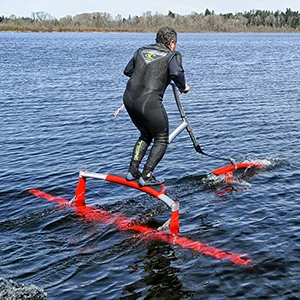
What is the Aquaskipper?
The Aquaskipper is a human-powered hydrofoil that you ride standing on a small platform while holding handlebars. By bouncing in a steady rhythm, you generate both speed and lift, creating a unique experience similar to a hydrofoil pogo stick or water scooter. The Aquaskipper predates modern scoot pump hydrofoils.
It is not a modern “foil board plus mast and foil” system. It is a purpose-built frame with hydrofoil wings and a spring mechanism that converts your up-and-down motion into forward motion across the water, with very little drag once it is flying.
The Aquaskipper is still sold today in limited channels, including direct retail in Germany. Inventist is not currently actively selling them.
Who is into the aquaskipper?
If you are into the aquaskipper, make sure to drop your pin on the Foilers Pin Map and help the aquaskipper claim the leaderboard. Check the pin map and leaderboard for how many people into the aquaskipper have marked themselves on the map.
How it Works
All hydrofoils work because a wing moving through water generates lift. The Aquaskipper’s power source is entirely human-powered. You start from a raised launch like a dock or boat, push off, then immediately begin hopping.
As you bounce, the hydrofoils and spring mechanism change the wing’s angle through the stroke. Your jump drives the wing downward, then as it rises, the foil generates lift and forward motion. The spring amplifies your rhythm so each hop carries farther.
This device has a clear operating constraint: you must keep the pumping going. If you stop hopping, you slow down, lose lift, and end up in the water.
Practical operating limits are also straightforward
- Launch in deep water. The manual specifies at least 2 meters of water to avoid bottom strikes.
- Expect speed once it is flying. The Aquaskipper can reach speeds up to 17 mph.
- It can be ridden in small waves as well as flatwater hydrofoiling.
What Makes it Different
The Aquaskipper is an early, highly specialized branch of self-powered hydrofoil design. It is part of the same family as the Swedish Trampofoil, which predates modern board-style hydrofoiling.
Key differences versus modern foil boards
- On the Aquaskipper, you ride a dedicated hydrofoil platform instead of a board. Steering is handled via handlebars, and propulsion is fully generated by your legs rather than glide-based pumping, emphasizing its uniquely interactive design.
- Propulsion on the Aquaskipper is integrated into its mechanism: your bouncing drives a spring-linked hydrofoil cycle, rather than pumping a board for glide. This unique system defines its identity among hydrofoils.
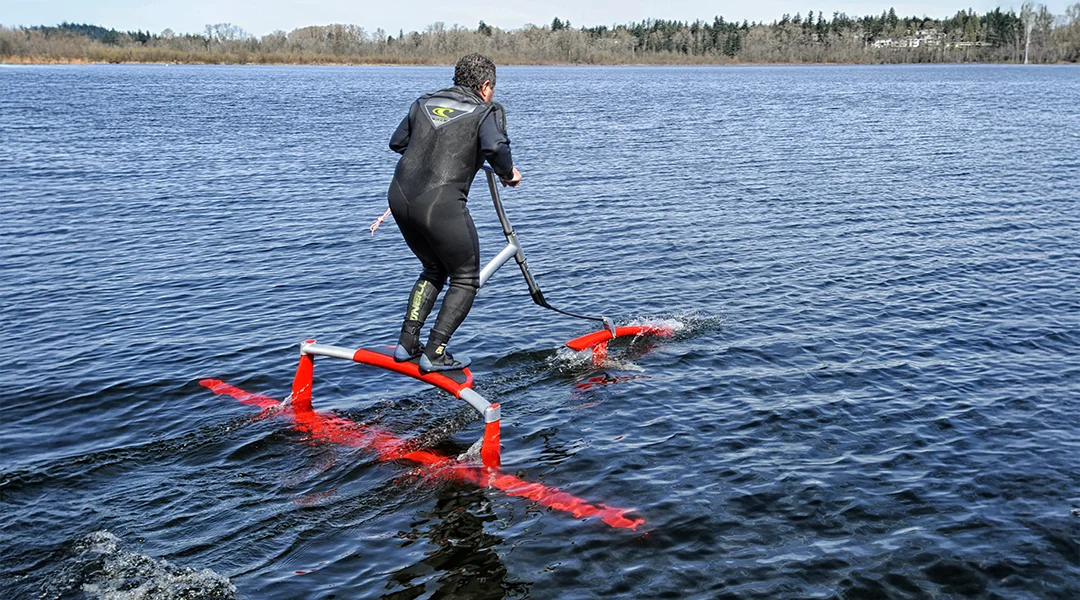
- It is physically large for a “personal toy.” The Aquaskipper has a wingspan of about 7 ft, a length of 6 ft, and a weight of 24 lb, reflecting its long-span, lift-first design.
- It is made to be portable. It is designed for easy disassembly for transport.
- It boasts an impressively wide, high-aspect front wing at 280cm with an Aspect Ratio of 23.3.
Safety and Etiquette
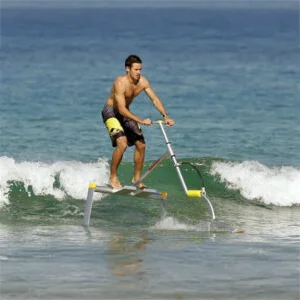
Aquaskipper riding is cardio exercise, hardware, and speed, so treat it like a serious watercraft.
Safety basics
- Always wear a life jacket.
- Wear water shoes.
- Do not use it if you cannot swim.
- Do not go so far that you cannot swim back, and watch for strong currents or waves that can carry you farther than expected.
- Use a buddy system. Go with another person who can help if needed.
- Stay away from boats, people, and other objects.
- Do not tow it behind a boat or other watercraft.
- Do not attempt to “dock land” onto a pier. Landing directly at a dock is dangerous and not recommended.
Etiquette
- Do not ride through swim zones, crowded beaches, or tight marina channels. You need a clear corridor because you cannot stop instantly without falling in.
- Give wide berth to paddlers and swimmers. The wingspan and speed mean your margin needs to be bigger than it looks.
Starter Guide
Minimum gear list
- Aquaskipper device.
- Life jacket and water shoes.
- A suitable launch: a dock or boat in at least 2 meters of water, with calm water preferred.
Fit and setup that matter
- Spring tension is adjustable by rider weight. The manual lists weight ranges (32 to 45 kg, 45 to 64 kg, 64 to 86 kg, 86 to 114 kg). It also recommends beginners set one level lighter than their range while learning.
- A small float accessory is optional and can help keep the front higher, making it easier for beginners to manage recovery and swim-back.
Cost ranges
- Direct retail in Germany lists 999 EUR for Version 3.0 (including German sales tax and shipping).
- Inventist lists it at $1,495 USD.
- Used pricing varies widely.
Difficulty and learning curve
- You should expect to fall during the first few sessions. Like any pump foiling activity, it takes time to learn the balance and timing.
- The device is easy to learn relative to other foiling disciplines, but it still demands coordination and technique.
How to start efficiently
- Learn the launch first: strong push-off, immediate hopping, and staying forward.
- Train short runs close to the dock until you can hold speed, then extend distance.
- Keep the session environment simple: calm water, no traffic, and a clean swim-back line.
Gear Selection
Aquaskipper gear selection is much simpler than with modern modular foil sports because you are not choosing separate boards, masts, front wings, stabilizers, or fuselages. The platform, frame, spring system, and hydrofoils are all part of one integrated machine with no variation in parts such as different wings to choose from.
The first priority is rider fit. The spring setting matters more than anything else because it controls how efficiently your bodyweight and rhythm are converted into forward drive. If the spring is too stiff, the ride feels harsh and unproductive. If it is too soft, the device feels mushy and loses snap. Lighter riders need a lighter setting, heavier riders need more support, and beginners usually do best with a slightly softer setup that is easier to rhythmically compress.
The second priority is flotation and recovery. Some riders use an optional front float or buoyancy aid to keep the nose from diving as aggressively during failed launches and low-speed recoveries. That does not make the Aquaskipper ride for you, but it can make early sessions less punishing and reduce how much energy you waste resetting after each fall.
Footwear and safety gear matter more than many beginners expect. A well-fitted life jacket is standard because every missed rhythm ends in a swim. Water shoes help on slippery docks, rocky shorelines, rough boat decks, and when walking the machine in and out of the water. Gloves are optional, but some riders like them for repeated dock launches and carrying the frame.
The Aquaskipper is portable, but it is still long and awkward compared with a typical beach toy. A vehicle with enough room, soft padding for transport, and a simple way to protect the foil edges all make ownership easier. If you ride alone, a launch spot with a stable dock and easy re-entry matters just as much as the machine itself.
Unlike other board-foil disciplines, there is no real “small wing for high speed” versus “big wing for learning” quiver here. You are selecting a complete human-powered hydrofoil system, then adjusting spring tension, accessories, and environment to make it work for you.
Conditions
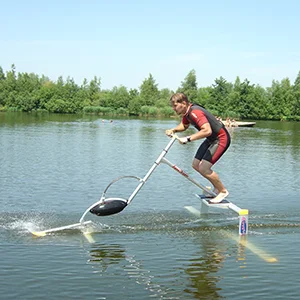
The best Aquaskipper conditions are calm, deep, protected water with minimal traffic. Flat water is ideal because the machine rewards clean rhythm and punishes disruption. Every bounce needs to feed directly into lift and glide. Chop, rebound, confused boat wake, and side current all interfere with that cycle.
Light wind is best. A little breeze is manageable, but strong wind quickly becomes a problem because the Aquaskipper sits high, has a large frame, and does not have the passive stability of a large floating board underneath you. Headwinds make launches harder, crosswinds complicate balance and steering, and gusty conditions make every reset more tiring.
Current matters more than beginners think. The issue is not just whether you can ride in the current. The issue is whether you can recover from it. Since failed runs end in the water, the smart question is always: if I fall here, how annoying is the swim back? Mild current may be fine near shore or near a dock. Strong tidal flow, river current, or wind-driven drift can turn a short practice session into a long retrieval exercise.
Water depth is critical. You want real clearance under the hydrofoils, not marginal clearance. Deep water with no submerged rocks, pilings, kelp, cables, or abrupt bottom rises gives you room to launch, fly, and fall without constantly worrying about a strike.
The best practice conditions look like this
- Calm or lightly textured water.
- Light, steady wind.
- Deep water throughout the riding lane.
- Clear space with no swimmers, paddlers, or boat traffic.
- Easy swim-back and easy re-entry to the launch.
The worst conditions are steep chop, confused boat wake, gusty crosswinds, heavy traffic, strong current, and shallow water. The Aquaskipper can handle more than a beginner can, but the discipline becomes dramatically easier and more fun when the water is clean and predictable.
Where to Go
The best Aquaskipper locations are places with a clean raised launch into deep, protected water. That usually means docks, piers, floating swim platforms, marina edges with open water beyond them, or boats anchored in calm water. The ideal setup is simple: a stable launch point, enough depth immediately below, and a long, clear riding lane.
Inland lakes are often better than the open coast. Lakes usually give you flatter water, fewer breaking waves, less current, and easier logistics. A quiet cove, a protected shoreline, or a long dock on a calm morning is close to perfect. Reservoirs and sheltered freshwater marinas can also work very well as long as the water depth is adequate.
Sheltered ocean locations can be excellent, especially bays, lagoons, and protected harbors, where there is deep water without surf impact. Open-ocean beaches are usually a poor match because shorebreak, swell, and beach-launch logistics work against the Aquaskipper’s design. It wants a platform launch, not a wading start.
Small-wave locations can be fun for experienced riders, but that is a later-stage use case. For learning, flatwater wins. Once your launch and rhythm are automatic, small rollers in protected coastal water can add variety without making the session chaotic.
This is a niche sport, so the best spots are usually defined less by scene and more by local layout. A modest private dock on a calm lake can be better than a famous waterfront location with chop and traffic.
When scouting a spot, look for five things
- A stable raised launch.
- Deep water immediately off the launch.
- A long straight corridor to ride.
- Low traffic from swimmers and boats.
- A simple, safe route back if you fall.
If a place has those, it is probably a workable Aquaskipper spot.
Setup and Tuning
Aquaskipper tuning is much simpler than tuning a modular foil board, but the adjustments it does have are important. This is not a discipline where you fine-tune mast track position by millimeters or swap three stabilizers in a day. The main performance variable is the spring setting, followed by overall mechanical condition, straightness, and rider stance.
Spring tension is the core adjustment. That setting changes how the machine stores and returns energy through each bounce. Too much tension makes it feel like you are fighting the machine. Too little tension makes it feel dead and delayed. The goal is a setting that lets you compress the system cleanly, then get a lively rebound without feeling like the machine is kicking you off rhythm.
Beginner tuning should favor forgiveness over peak efficiency. A slightly easier spring feel makes it simpler to establish cadence, survive imperfect launches, and recover from small mistakes. As your technique improves, you can tune closer to your ideal support level and get more speed and cleaner glide from each cycle.
Mechanical alignment matters. Because this is an integrated frame-and-foil machine, any looseness or misalignment is immediately reflected in ride quality. The foils should track straight, the control linkage should feel solid, and the frame should not have slop that turns your pumping effort into wasted motion. Before every session, check that all fasteners are secure and that nothing has shifted in transport.
Stance position is effectively part of the tuning process. Small changes in where you place your weight can change how the Aquaskipper rides. Too far back and it drags, porpoises, or struggles to accelerate. Too far forward and it can feel twitchy or stuff the front during awkward recoveries. Most riders do best with a centered athletic stance and a slight forward commitment during the launch phase.
Optional flotation is also a tuning choice. Extra buoyancy can make low-speed handling and failed starts less punishing, especially for new riders. More neutral handling usually feels cleaner once you know what you are doing, but beginner-friendly flotation can shorten the learning curve.
Unlike modern foil setups, you are not usually changing wing sizes, fuselage lengths, tail shims, or mast lengths session to session. The Aquaskipper is closer to tuning a machine than building a foil quiver. The goal is to make the system feel balanced, efficient, and predictable for your body and your launch environment.
Tips and Tricks
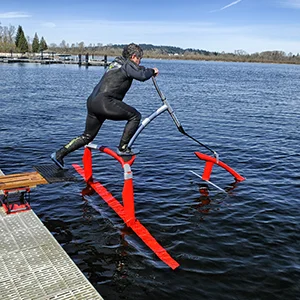
The biggest beginner mistake is trying to jump too much. The Aquaskipper does not reward huge pogo-stick explosions. It rewards rhythm. Think quick, smooth, connected hops rather than big, dramatic leaps. You are trying to keep the machine alive underneath you, not overpower it.
Commit to the launch. A hesitant push-off usually turns into an immediate stall. Start with purpose, get your first few cycles going right away, and stay mentally ahead of the machine. The first seconds matter more than anything else in the run.
Stay tall, but not stiff. Keep your upper body relaxed, your knees soft, and your eyes forward. Riders who stare down at the foil or hunch over the bars usually get behind the timing. Looking ahead helps your body settle into a cleaner cadence.
Do your early practice in short laps near the dock. That keeps the swim-back short and lets you get more repetitions without wasting energy. Aquaskipper progress comes from stacking many clean attempts, not from one heroic long run.
Choose calm mornings whenever possible. Even experienced riders enjoy the machine more in clean water, and beginners improve much faster when the surface is not interfering with the feedback they are trying to learn.
If the ride feels brutally hard, do not immediately assume you need better fitness. First, check your spring setting, your launch quality, and whether you are over-jumping. A properly tuned Aquaskipper still gives you a workout, but it should feel springy and efficient, not like doing vertical jumps into a headwind.
When you fall, reset methodically. Bring the machine back to the launch, take a breath, and repeat the same launch pattern. Random experimentation slows learning. Repetition builds timing.
A few habits make a big difference
- Start with a strong push and the first hop already loaded.
- Keep the bounce cadence quick and even.
- Stay slightly forward rather than hanging back.
- Practice steering gently instead of yanking the bars.
- End the run early if fatigue is wrecking your rhythm.
- Always leave enough energy for the swim back.
One of the best tricks for faster progress is to stop chasing distance and chase smoothness instead. The rider who can do ten short, clean, repeatable runs is much closer to mastery than the rider who flails through one long survival run.
Skills Ladder
Beginner
You learn two things at once: the launch and the rhythm. The Aquaskipper only works when you keep pumping continuously, so your first goal is simply staying up long enough to stabilize.
Key skills
- Safe setup and environment: wear a life jacket and water shoes, launch from a raised spot, and only ride where you can swim back.
- Clean launch: push off from a dock or boat and start hopping immediately.
- Continuous Aquaskipper technique: bounce smoothly so the hydrofoils keep producing lift and forward speed. If you stop hopping, you slow down and end up in the water.
Gear adjustments at this stage
- Spring setting: match the spring position to your weight range, and as a beginner, set it one level lighter than your range while learning.
- Optional float: the manual describes an optional float that can help beginners with recovery and handling.
Intermediate
You can launch reliably and stay up. Now you build efficiency and control.
Key skills
- Longer, steadier runs: maintain speed with smaller, more economical hops.
- Directional control: steer smoothly using the handlebars without killing speed.
- Water management: handle light texture and small ripples without losing rhythm.
Gear adjustments
- Fine spring tuning: if you feel like you are overworking for little glide, revisit the spring setting within the manual’s guidance.
Advanced
You use the Aquaskipper as a true stand-up hydrofoil platform, not just a novelty.
Key skills
- Small-wave riding: the Aquaskipper is described as capable of riding small waves, which demands better timing and stability than flatwater.
- Tricks and racing: You can use the Aquaskipper for both, which require consistent speed control and confident recovery. The platform's stability allows for complex tricks on the handlebars, including handstands while riding.
Niche Specific
- The Aquaskipper is a purpose-built, self-powered hydrofoil. It converts your up-and-down motion into lift and forward motion, with a spring amplifying your jumping rhythm.
- It is a handlebar hydrofoil and platform hydrofoil, not a modern foil board with a mast and modular foil parts. You steer and stabilize from a handlebar while your legs provide propulsion.
- Its scale is unusual: with a wingspan of about 7 feet, a length of 6 feet, and a weight of 24 pounds, reflecting an efficiency-first “hydrofoil glider” layout rather than a compact board.
- It is designed to launch from a raised spot, such as a dock or boat, which makes it closer to dock-start hydrofoil play than to free-standing waterstarts.
Common Problems
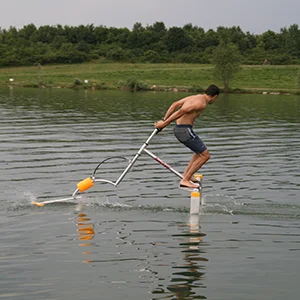
You keep stalling and sinking
- What’s happening: your hopping rhythm breaks, and the foil loses lift.
- Fix: switch from big “jumps” to a smoother, more continuous cadence so the spring and hydrofoils can do their job.
The ride feels brutally hard or goes nowhere
- What’s happening: the spring tension is wrong for your weight.
- Fix: Set the spring position to your weight range, and as a beginner, use the manual’s recommendation to set it one level lighter while learning.
You keep hitting bottom, or fear you will
- What’s happening: you launched into water that is too shallow for the foil span and draft.
- Fix: only ride where you have safe depth, and choose a launch that avoids submerged hazards.
You drift too far, and the swim back becomes the session
- What’s happening: fatigue plus wind, current, or waves carries you farther than expected.
- Fix: never go so far that you cannot swim back, and pay attention to currents and waves that can move you.
Dangerous habits around docks and boats
- What’s happening: trying to “dock land,” riding near traffic, or experimenting with towing.
- Fix: do not try to boat tow the Aquaskipper and stay away from other objects, such as boats and people, and do not attempt dock landings.
History
- The Aquaskipper is credited to inventor Shane Chen of Inventist.
- Biographical summaries of Shane Chen’s work state that the AquaSkipper entered the retail marketplace around 2003.
- In 2007, the AquaSkipper appeared in “top inventions of 2007” coverage, with Shane Chen listed as the inventor, and was highlighted as a user-powered flapping-wing watercraft.
- In the broader human-powered hydrofoil timeline, it is often discussed alongside earlier flapping-foil concepts such as the Swedish Trampofoil.
- A small production run of the AQ-2 model (illustrated here in red) was introduced in 2010.
FAQs
Is the Aquaskipper “pump foiling” like modern pump foil boards?
It is human-powered hydrofoiling, but the mechanism is different. The Aquaskipper uses a spring-amplified hopping motion and moving hydrofoils rather than the modern board-and-foil glide-pumping style.
Where do I launch it from?
From a raised spot like a dock or boat, you hop continuously to stay flying.
How fast can it go?
The Aquaskipper can reach speeds up to 17 mph.
What is the most important setup adjustment?
Spring tension. The manual provides weight ranges for spring positions and recommends that beginners set one level lighter while learning.
Is it still sold today?
Yes. Aquaskipper is sold in Germany. While it is listed on the Inventist web site, they are not actively selling them at this time.
Which Foiling Freaks are into The Aquaskipper
-
 Brash Boulderbrew
Pumps first. Checks depth eventually. Checkout Brash Boulderbrew's merch page.
Brash Boulderbrew
Pumps first. Checks depth eventually. Checkout Brash Boulderbrew's merch page.
World's Best AquaSkipper TRICKS with Ron Stack, Mike Murphy & Tony Klarich
There's always new moves when these riders take to the water. Watch as Ron, Mike, and Tony continue their innovative ways on their Aquaskippers.
If you know this discipline inside and out and want to help review and or edit the info on this page, drop us a line. We will credit you as a reviewer or editor and set you up with a proper bio page with links back to your site.