Scootpump Foiling

What is Scoot Pump Foiling?
Scoot Pump Foiling is pump foiling done on a foil board with handlebars, essentially a hydrofoil scooter. You start and ride on a hydrofoil in the same way any pump foiler does, but the handlebar gives you a stable handhold so you can control the board during the start and early pumps without needing the same jump timing and balance demands as traditional dock starts.
These types of foils are referred to as scoot pump, foil scoot, and pump foil scooter, referring to the same core idea: a foil board with handlebars used for dock-start launches and foil pumping.
A key feature of commercial designs is that the handlebars can be removed, letting you use the same board as a regular pump foil board once you no longer need the extra support.
Who is into scootpump foiling?

If you are into scootpump foiling, make sure to drop your pin on the Foilers Pin Map and help scootpump foiling claim the leaderboard. Check the pin map and leaderboard for how many people into scootpump foiling have marked themselves on the map.
Be more than just a dot on the map. Join the Foiling Freaks community and create your own foiling profile with a custom handle, rider photos, videos, disciplines, bio, and more.
How it Works
The power source is human-powered. You generate speed by launching from a dock or platform, then sustain flight by foil pumping and cycling your weight to create lift and forward drive.
A typical start looks like this
- Set the foil in the water at the dock edge so the board is aligned and stable.
- Hold the handlebars to keep the board from yawing and rolling during the initial movement.
- Step or hop onto the board with forward intent, then immediately transition into smooth foil pumping to lift and stay flying. The handlebar reduces the need to jump onto an unstable board, as you can keep the board under control with your hands as you commit to the start.
- Depending on the front wing's stall speed, you may need a running start, in which case an undercut dock or platform with sufficient clearance is required. Larger wings with enough low-speed lift can be started by stepping off the dock onto the board.
Once you are on foil, the handlebar continues to act as a stabilizer and reference point. As your foil pumping improves, you can rely on it less, or remove it entirely if your equipment supports that.
What Makes it Different
A rigid handlebar foil board can shorten the learning curve. Traditional dock starting forces you to solve board control, jump timing, and the first pump simultaneously. A pump foiling scooter separates those tasks by giving you a stable handhold, so you can focus on building speed and learning the pump rhythm sooner.
Scoot Pump Foiling also changes how forces enter the system. With no handlebars, most of your input goes through your feet. With a foil board with handlebars, you can add upper-body input. That is useful for stability, but it also creates larger leverage loads through the board, tracks, mast, and mast-to-fuselage connections if you pull aggressively or twist the bar while the foil is loaded. Due to this extra leverage, scoot pump foil boards require more rigid construction to avoid breaking. This extra leverage can also impact mast-to-wing connections.
In terms of equipment style, commercial scooter-style pump boards are very compact and low volume. Board sizes cluster around 95 to 96 cm in length, 32 to 40 cm in width, and 9 to 13 liters in volume.
Foil scoot boards give foilers from wind-powered disciplines a way to keep riding when the weather does not cooperate. When the wind dies down, and kite foiling or wing foiling is no longer an option, a foil scoot lets riders still get out on flat water and spend meaningful time on the foil. It becomes a practical crossover tool for building cardio, refining pump cadence, and improving balance and foil control without needing wind or waves. For many riders, that turns dead-weather days into productive sessions instead of lost time.
Safety and Etiquette
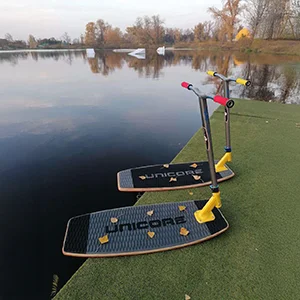
Primary hazards and how you mitigate them
- Foil impact risk: Pump foiling occurs near docks and hard structures. Wear a helmet and an impact vest, and keep your launch zone clear of people in the water.
- Dock proximity: You are starting on and near ladders, pilings, rocks, and seawalls. Only start where you have a clean run-out and deep enough water for your mast.
- Handlebar strike risk: A rigid handlebar adds another hard object near your body. Keep your arms slightly bent; do not lock out. You will typically hold onto the handlebars during a crash, which can be safer; however, striking an underwater object at speed can make the handlebars themselves an extra impact hazard.
- Equipment overload: the handlebar is a lever. Avoid using it to muscle the foil through breaches or touchdowns. Let your feet and trim do the work, and treat the bar as balance support, not a pry bar. Overuse of the handlebar adds extra stress to all connection points of the board, from the handlebar connection to the board to the mast and wing interface.
Etiquette
- Do not scoot pump in crowded launch areas, swim zones, or narrow channels. Your turning radius and stopping distance are bigger than they look when you are learning.
- Treat dock start scooter foil sessions like a shared training lane. One rider at a time in the start corridor, and keep observers out of the bailout zone. Failed launches can send your board in unexpected directions.
- If you are pumping near other foilers, maintain clear passing rules and give extra space. A falling rider plus a flying foil is unpredictable.
Starter Guide
Minimum gear list
- A pump-capable hydrofoil setup (board, mast, front wing, stabilizer).
- A handlebar system designed for Scoot Pump Foiling with a solid, non-wobbly connection.
- Helmet and impact vest.
- A simple dock or platform with safe depth and a clear run-out.
Cost ranges you can plan around
- Scooter-style pump boards with handlebars are commonly in the mid four figures or below, depending on construction and what is included. A common price range is $ 1,500 to $ 2,000.
- Foils vary widely in materials and performance.
Difficulty and learning curve
- A beginner scoot pump is typically easier than a pure dock-start pump foil because the handlebar improves balance and control at the start.
- You still need time to learn efficient foil pumping. The handlebar helps you get repetitions sooner, but it does not remove the conditioning and technique required for long flights.
How to get started
- Watch technique videos focused on starts, early pumps, and safe falling habits, then practice in short sessions with lots of repetitions.
- Start in calm water with minimal current and no traffic.
- Set a progression: consistent starts first, then 10-second flights, then controlled turns, then longer link-ups.
- Find local pump foiling or dock-start riders through general social media search and local watersports communities, then learn which docks are tolerated and which are off-limits.
Assessibility
- Scoot pump foils are more accessible to a wider range of people as they do not require the flexibility you may need for a traditional dock start. You can start by standing up more, rather than bending over deeply to hold the board while jumping on it.
- Older foilers lacking the conditioning and athletic ability to perform traditional dock starts can more easily manage short, controlled flights on a foil scooter board.
Gear Selection
Board and handlebar system
Scoot Pump Foiling uses an ultra-compact pump board with a rigid, no-wobble handlebar. Typical hydrofoil scooter boards sold for this purpose are roughly 95 to 96 cm long, 32 to 40 cm wide, and 9 to 13 liters in volume.
The handlebars matter as much as the board. It needs a solid connection to stabilize yaw and roll rather than flex. Many scooter-style systems use an adjustable handlebar height, and all commercial boards are designed so the bar can be removed later to ride the board like a standard pump foil board.
Track length is a feature to consider when choosing a board. Some scooter boards use long tracks and “open rail” connections so you can slide and reposition the mast and the handlebars more easily and quickly, which is useful because scoot pump riders often tune mast position and handlebar position to fit their size.
Foil mast length
For pump foiling and dock-start style riding, mast length typically falls in the 70-80 cm range, with 70 cm a standard beginner choice. A longer mast can be useful if your dock is higher, but it also changes the pumping feel and demands more precision. Pump foiling is more efficient the closer the wing is to the surface; too long a mast can be too tippy and the high end.
Front wing surface area and wingspan
Scoot Pump Foiling still runs on the same pumping physics as any other foiling: bigger, higher-lift wings make early sessions easier, and you typically size up compared with other foil disciplines.
A practical reference for pump foiling is
- For a rider around 70 kg on a lower-aspect learning wing, about 1900 cm2 is a minimum to learn comfortably.
- For higher-aspect pump wings, riders around 70 kg commonly use about 1700 cm2 with roughly 105 to 115 cm wingspan, while heavier riders move toward about 2000 cm2 and wingspans around 130 cm.
Scoot Pump is forgiving enough that you can often make a wider range of wings work than with traditional dock-start pump foiling, but starting with generous lift and glide makes the learning curve smoother.
Fuselage length and stabilizer choices
Longer fuselages generally feel calmer and more stable in pitch, while shorter fuselages feel more agile and demand cleaner control.
Stabilizer size and angle are major levers for how stable the setup feels while you learn the pumping rhythm. If your foil supports shims, small angle changes can shift the setup toward “slower and more pitch stable” or “faster and looser.”
Accessories
- Helmet and impact vest, because you are pumping near docks and hard edges.
- Grippy deck traction and shoes that can handle wet dock surfaces.
- The hardware kit because the bolts loosen up. Check mast, fuselage, and track bolts often. The handlebar foil board provides extra leverage, and the bolts can loosen more easily while riding.
Conditions
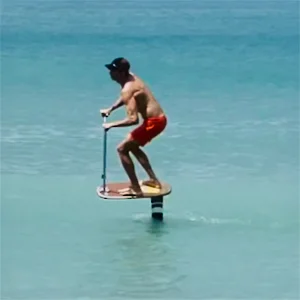
Scoot Pump Foiling is human-powered, so you do not need wind. The best conditions are simple: flat water, minimal current, clear visibility, and a wide empty buffer zone to fall safely.
Good conditions
- Lightly rippled water, so you can focus on a clean foil-pumping cadence and have good depth perception.
- Deep enough water for your mast and a clear start corridor so the foil cannot clip anything solid.
- Low traffic. Scoot Pump sessions can lead to unpredictable falls, and the foil can travel farther than people expect when a start fails.
Bad conditions
- Strong current that drifts the board away between attempts.
- Heavy chop that forces frequent touchdowns and makes the first pumps inconsistent.
- Crowded docks, swimmers, fishing lines, or narrow channels. Pump foiling scooter sessions need space.
- Weeds close to the surface that can snag the wing and mast.
Where to Go
Scoot Pump Foiling works anywhere you have calm water plus a safe dock or platform with enough depth. Lakes, protected bays, and slow-moving river edges can all work if there is room and permission to use the dock.
What makes a spot good
- A low-to-moderate height dock so stepping on is controlled.
- Deep water immediately off the edge.
- A clear 10 to 30 m run-out with no boats, ladders, pilings, or rocks.
- A culture and rule set that allows foiling. Some public docks are not appropriate, even if the water looks perfect.
Setup and Tuning
Mast position in the tracks
Track position is your primary tuning tool because it changes balance and how the board behaves in turns and during pumping.
Use these behaviors to tune
- If the foil is too far back, the board can pitch the nose down in hard carves and feel harder to keep flying through turns.
- If the foil is too far forward, the setup can “foil out” too easily, especially when you get aggressive.
Tune in small steps. Moving the mast 5 to 10 mm can be a meaningful change.
A conservative starting point for beginners is keeping the foil farther back, then sliding forward as control improves.
Mast length versus dock height
A 70-80 cm mast range is a common pump-foiling baseline, and dock height can push you toward slightly longer options.
Shorter masts reduce drag and can feel snappier to pump, but they can breach sooner in chop.
Shims, stabilizers, and fuselage choices
- Use positive-style stability tuning when you want easier early pumping and calmer pitch.
- Use negative-style “looser and faster” tuning only after your cadence is consistent.
- If the foil feels twitchy under you, add stability first with a longer fuselage before chasing ultra-tight turning.
Handlebar-specific tuning mindset
The handlebar is for stability and reference, not for muscling the foil. If you find yourself pulling hard on the bar to stay flying, your tune is off. Add lift, add stability, or slow down your cadence before you add force.
Tips and Tricks
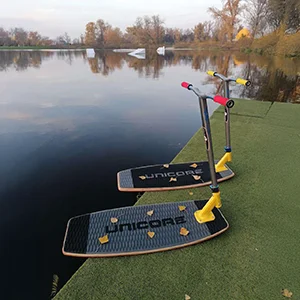
- Set the handlebar height so your elbows stay slightly bent when you are centered over the board. Locked arms encourage you to lever the system rather than pump efficiently.
- Commit to smooth starts. The bar helps you control yaw, but the foil still needs a clean speed build before you demand lift.
- Pump with your legs and hips, not your arms. Use the handlebars to steady the board, then drive the foil with a consistent up-down rhythm.
- Protect your equipment. Avoid twisting the handlebar under load, especially with wide-span wings, because the bar magnifies torque through the mast and mast-to-fuselage connection.
- Tune for repetitions. A beginner scoot pump setup should feel stable enough that you can repeat 20 starts without changing anything.
- When your starts are easy, start progressing: move the mast slightly, reduce the stabilizer slightly, try a smaller wing, or remove the handlebars for a session if your system allows it.
Skills Ladder
Beginner
You are learning two things at once: a reliable dock-start launch and an efficient foil-pumping rhythm. The handlebar foil board makes the first phase more repeatable because you can keep the board under control without committing to a full jump onto an unstable deck.
Skills to lock in
- Board control at the dock edge: keep the board straight, keep it from rolling, step on cleanly.
- First lift: accelerate, then pump smoothly into flight without yanking on the bar.
- Height control: avoid breaching and avoid deep touchdowns that stall the foil.
- Safe bails: fall away from the board and the dock, or keep hands on the handlebars throughout a controlled stop.
Gear that helps
- High-lift, low-stall-speed pump wings so takeoff speed is lower, and the pump cadence is slower and more forgiving. Bigger front wings provide more support for staying airborne while pumping.
- Mast lengths in the 70-80 cm range are a common sweet spot for pump-foiling efficiency and control.
Intermediate
Now your beginner scoot pump starts are consistent. The focus shifts from “get up” to “stay up and steer.”
Skills to build
- Cadence efficiency: you keep speed through turns and through small errors without chaotic pumping.
- Controlled turns: carve without losing height, then reconnect into a stable pumping line.
- Handlebar discipline: hands steady the system, legs drive the foil. You are no longer pulling your way around the lake.
- Dock management: You can quickly recover from a failed attempt, reset, and repeat without drifting into hazards.
Gear progression
- More glide-oriented front wings once takeoffs are easy, especially if your goal is longer flatwater links.
- More responsive tail and shorter fuselage, only after your pitch control is automatic. This is how you unlock tighter turning and a livelier feel, but it raises the skill requirement.
- Use the handlebars when trying new wings and more advanced wings to get a feel for how they start and pump before using them with a traditional dock start without the handlebars.
Advanced
At the advanced level, a pump foiling scooter becomes a performance tool, not just a learning aid.
Skills to build
- High-speed carving and clean cutbacks without porpoising.
- Linking long distances with minimal cadence and minimal height variation.
- Handlebar reduction or removal when your system supports it, so you can ride the same board like a traditional pump foil setup when you want.
- Precision around touchdowns: you can skim the surface, recover, and keep flying without a full reset.
- Pumping out to waves and boat wakes for unpowered riding.
Gear progression
- Smaller, faster wings for higher speed and tighter arcs, matched to your weight and the water state.
- Tighter tuning: smaller stabilizers and more neutral trim, because you are no longer relying on raw lift to stay airborne.
Niche Specific
The defining feature of a scooter pump foil is a rigid handlebar connected to a foil board. That solid connection gives you a stable handhold for starts, pumping, and balance correction.
Scoot pump foiling changes the learning curve. Traditional dock starting demands board control, jump timing, and the first pump all at once. The scoot pump makes it easier to keep the board under control at the start, so you get more clean repetitions sooner.
Many scooter hydrofoil designs are built around fast mast adjustment. Open rails and long tracks let you slide the foil and handlebar in and out quickly and give a wider adjustment range, which matters because mast position has an outsized effect on starts and pumping feel.
The handlebar is also a lever. If you twist or wrench on it under load, you can drive unusually high torque through the mast, tracks, and mast-to-fuselage connection. This requires stronger connection points than traditional foil setups.
Common Problems
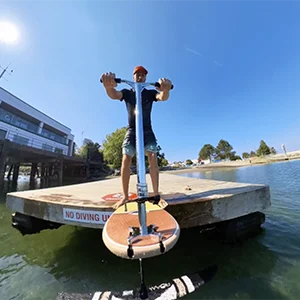
Handlebar wobble or flex
- What happens: the board feels unstable during the start, even though you “have a bar.”
- Fix: the handlebars must be rigidly mounted. Any play turns the bar into a delayed steering input, making the start harder, not easier.
Overpulling with the arms
- What happens: you muscle the bar to force lift, then you stall, breach, or fatigue fast.
- Fix: drive the foil with legs and hips. Use the bar for stability and direction, not for generating lift. If you feel forced to pull hard, increase lift and stability in the foil setup instead of increasing arm input.
Foil too small for your current fitness and cadence
- What happens: you get up briefly, then drop because the wing needs more speed than you can maintain.
- Fix: size up the front wing for early sessions. Pump foiling is strongly influenced by front wing size and span, and bigger wings increase support and time-on-foil while you learn rhythm.
Mast too long or too short for your dock and water depth
- What happens: too short and you breach constantly, too long and the start feels tippy, or you risk bottom strikes.
- Fix: keep mast length in the common pump range and match it to dock height and depth. A 70-80 cm mast is a widely used baseline for pump foiling.
Hardware loosening and track creep
- What happens: the foil shifts in the tracks, or bolts back out after a few sessions.
- Fix: Treat continual bolt checks as part of the session.
Falls too close to hard structures
- What happens: most injuries in dock-start scooter foil attempts come from the dock, ladders, pilings, or landing near the foil.
- Fix: choose a dock with deep water and a clear run-out, wear a helmet and impact protection, and keep the launch corridor empty. Keep both hands on the handlebars when crashing for more predictable falls near the board and wings.
World Records
- Smallest Board Ridden on a Scootpump Foil: Smallest Board Ridden on a Scootpump Foil. Holder: Ian Lauder
- Oldest male Scootpump rider: Oldest male Scootpump rider - Hans Glanzmann - age 89. Holder: Hans Glanzmann

Know about a broken record, an update needed to an existing world record, or a brand new world record that deserves to be in the public record? Submit it.
World Firsts
- First ScootFoil beach start: First Scoot Pump Foil beach start. Holder: Toni Muendel

Know about a broken record, an update needed to an existing world first, or a brand new world first that deserves to be in the public record? Submit it.
History
Scoot pump foiling does not have a single universal name; however, each term usually includes the word scoot or scooter and always refers to a human-powered foil board with a handlebar.
The term “ScootPump” first appeared in conjunction with Strizy Boards in 2021.
By 2024, the idea of a pump foil scooter had received mainstream coverage, with media describing a scooter-handlebar prototype and the goal of making pump foiling easier and more accessible.
ScootPump-style boards were shown at major watersports trade events, including Interboot 2024, where Strizy’s ScootPump foil boards were presented and demoed.
By 2025, a small number of companies were producing scooter handlebar foil boards, which had become a recognized niche of pump foiling.
FAQs
Is Scoot Pump Foiling easier than traditional dock starting?
Yes. The handlebar keeps the board under control at the start and eliminates the need to jump onto the board, cutting out one of the hardest parts of classic dock starts.
Do I keep the handlebars forever, or is it a learning tool?
Both are valid. Many scooter hydrofoil systems are designed so the handlebars can be removed, letting you transition to a more traditional pump-foil feel when you are ready. Adding the handlebars is a good way to get new or more challenging wings to get a feel for how they ride.
What foil wing size works best for a beginner scoot pump?
Start with a low-stall speed and high-lift pump wing that gives you time and stability. For example, about 1900 cm2 is a comfortable minimum around a 70 kg rider on lower-aspect learning wings, with larger sizes for heavier riders and smaller sizes as skill increases.
What mast length should I use for a dock start scooter foil setup?
A 70-80 cm mast is a common pump-foiling baseline because it balances drag, clearance, and control.
Does the handlebar make it safer?
It can reduce certain risks by adding stability and keeping your hands on a consistent reference point, but it does not eliminate the main hazards of hydrofoiling. You still need protective gear, a clear launch corridor, and a disciplined falling technique.

Which Foiling Freaks are into Scootpump Foiling
-
 Frosty
The Scoot-Pump Yeti of the Ice Floes. Checkout Frosty's merch page.
Frosty
The Scoot-Pump Yeti of the Ice Floes. Checkout Frosty's merch page.
The Foilscoot pump foil scooter.
The Foilscoot is a scooter-style pump foil that redefines the way beginners approach pump foiling. This video shares the inspiration behind its creation, highlights how it tackles challenges in learning balance, rhythm, and foil control, and explores the enthusiasm it has sparked within the foiling community.
If you know this discipline inside and out and want to help review and or edit the info on this page, drop us a line. We will credit you as a reviewer or editor and set you up with a proper bio page with links back to your site.