Tow Boogie Foiling
What is Tow Boogie Foiling?
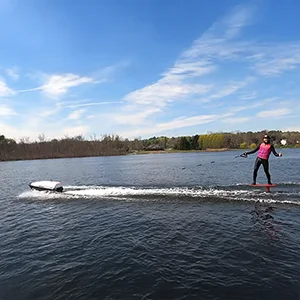
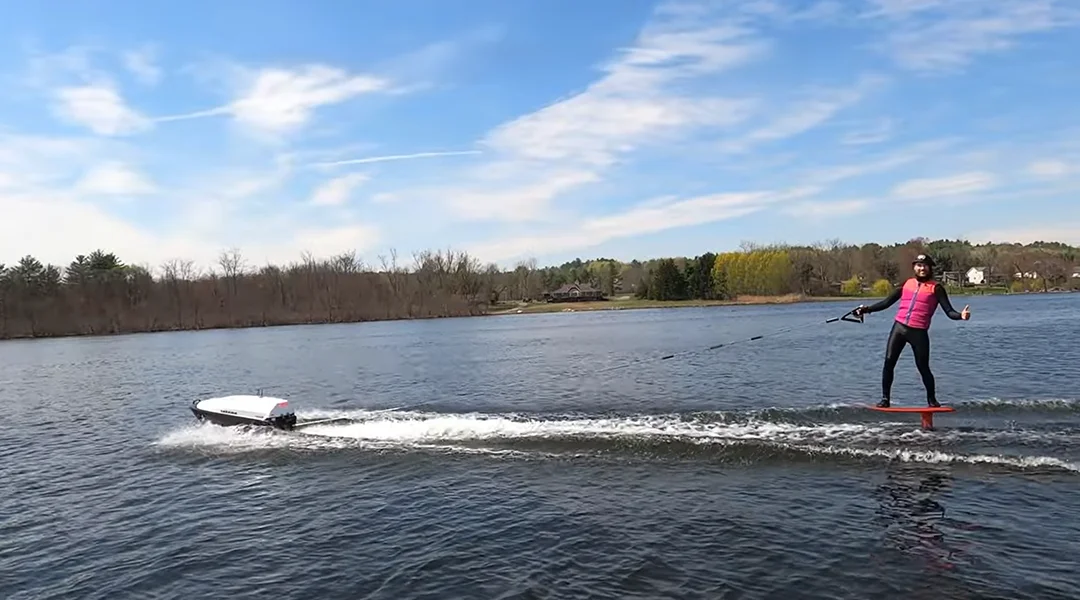
Tow boogie foiling is a type of foiling tow where an unmanned, motorized tow craft (a small powered device) pulls a rider up onto a hydrofoil (a surfboard with an underwater wing that lifts the board above the water) using a tow rope and handle. The tow boogie is a small, buoyant platform with electric propulsion (battery-powered motor) and steering, typically controlled by the rider via a wireless remote.
An electric tow boogie eliminates the need for a boat, a jet ski, or an extra driver. You control the speed, direction, and stop functions yourself, running wave-tow sessions or flatwater laps. Some use it for the tow ride, others to tow into a wave, drop the rope, and continue unpowered.
Tow boogies range from DIY builds made from converted eFoil components to purpose-built systems that add features like GPS data logging and GPS-based steering modes.
Who is into tow boogie foiling?
If you are into tow boogie foiling, make sure to drop your pin on the Foilers Pin Map and help tow boogie foiling claim the leaderboard. Check the pin map and leaderboard for how many people into tow boogie foiling have marked themselves on the map.
How it Works
The power source is the tow boogie's motorized propulsion. A typical tow boogie uses at least one electric motor with a propulsor or jet drive to push the craft through the water, while the rider is pulled by a tow rope attached at the rear of the platform. Speed commands are sent via a wireless remote control.
A standard start looks like this
- Deploy the tow boogie in the water with the rope clear and the propulsor kept away from the line.
- The rider starts in the water with the tow handle and boards, then uses a gentle throttle to build speed.
- As speed builds, the rider shifts weight to lift onto the foil, then trims for steady flight.
- Direction control varies by design. Some systems steer via a rudder (a flat piece used to steer in water) or a steerable nozzle (an adjustable opening that guides water flow), and some designs can be influenced by rope tension and rider position relative to the tow craft.
For tow-in foiling style wave entries, the rider accelerates outside the break, uses the tow to match wave speed, then releases the handle and rides the wave. This creates hands-free tow only during the pull phase, followed by true wave riding once the rope is dropped.
What Makes it Different
Unmanned towing is key. In boat or PWC towing, a driver manages the vehicle. In tow boogie foiling, the rider manages both, shifting the skill requirements and risk profile.
Key differences versus other related disciplines
- Versus eFoiling: the rider is not standing on a powered board. Power is offboard via a tow rope, so the rider can use a standard tow-foil board and foil setup.
- Versus boat tow or jet ski tow: no onboard operator, typically less wake, and the session can be run solo if you can recover and retrieve the tow craft safely.
- Versus wind sports: Not dependent on wind, the tow boogie provides a continuous pull on flat water, serving as both a training and surf tool.
- Equipment bias: tow boogie foiling often pairs well with smaller surf-style foil boards because you do not need paddle power or wing power to get moving.
Safety and Etiquette
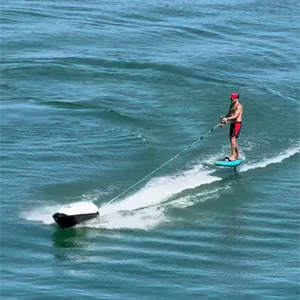
Tow boogie foiling introduces two key hazards: an exposed propulsor and an unmanned moving craft.
Primary hazards and mitigation
- For propulsor injury risk, always treat the tow boogie like any powered vessel. Use deadman-style controls that cut thrust when released, and keep the rope away from the propulsor. Engine cut-offs help reduce runaway-prop risks.
- Runaway craft risk: You need a reliable stop behavior. Some systems are designed so thrust requires holding a trigger, and loss of the trigger or control stops the boogie. Verify this behavior before towing up.
- Rope entanglement: Use a short, floating, highly visible rope. Practice keeping it clear of ankles, leashes, and the foil.
- Collision risk: Operate well away from swimmers and crowded areas. Avoid congested launches.
Etiquette rules that keep you out of trouble
- Do not run an electric tow boogie through a surf lineup or inside crowded breaks. Treat it like a powered craft because it is one, and it has no control of its own.
- Keep wide buffers. Your tow path is longer than your board path, and your tow craft has its own trajectory.
- If you are towing into waves, yield priority to surfers already riding the wave and to anyone paddling in the impact zone. A solo self-towing hydrofoil session is never an excuse to cut the queue.
Starter Guide
Minimum gear list
- Tow-capable foil board and hydrofoil setup.
- Tow ropes and a handle designed for water towing.
- Tow boogie with a wireless remote control and a proven stop behavior.
- Helmet and impact vest.
- A recovery plan: spare battery management, a way to retrieve the tow boogie if it loses power, and a safe down-current or downwind bailout zone.
Cost ranges you can plan around
- Lower-cost tow devices sold as tow boogie-style electric boards can be priced around $1000, depending on configuration.
- Purpose-built tow boogie systems with features such as GPS data logging and GPS-based steering modes can be priced around $10,000.
- Commercial self-tow systems can cost around $15,000.
- DIY builds can be more cost-effective.
Difficulty ranking and learning curve
- Difficulty: advanced if you are new to foiling, intermediate-to-advanced if you already foil confidently.
- The fastest path is to already be able to ride a foil cleanly behind a normal tow, then add the tow boogie control layer.
- Expect early sessions to focus on low-speed starts, stable trim, and safe stop-and-retrieval drills before you attempt releasing the craft and wave riding.
How to get started without naming specific brands, sites, or groups
- Watch a few towing fundamentals videos focused on body position, handle control, and safe rope drops.
- Start on flat water with no traffic and a simple shoreline for retrieval.
- Practice “stop and drift” repeatedly. Throttle up, settle on foil, then stop the tow boogie and confirm it behaves predictably.
- Once starts are easy and consistent, add gentle carving and then controlled handle releases.
- Find a local foiling community through a general social media search and ask where powered towing is tolerated and where it is not.
Gear Selection
Tow boogie
A tow boogie is the power plant for tow boogie foiling. The requirements are predictable throttle control, a reliable stop behavior, and a tow attachment that keeps the rope clear of the propulsor. A trigger-style deadman control that stops thrust when you release it is critical for hands-free tow control and self-towing with a hydrofoil.
Tow rope and handle
Use a purpose-built tow line rated for towing loads, with hardware and knots that will not slip under tension. Keep attachment points reinforced and avoid tying onto weak fittings.
For tow-in foiling style wave entries, a handle you can release instantly matters more than comfort, because clean releases prevent slack-line tangles around you or the foil.
Foil board volume and shape
Tow boogie foiling does not require paddle-driven starts, so you can ride much smaller boards than wind-powered beginners typically use. Tow-specific foil boards commonly go into very low volumes, including under 20 liters, because the tow provides the acceleration that buoyancy would normally help you generate.
Practical reference points for tow and surf foil boards include 28-34 liter boards in regular use and 30 liter boards marketed specifically for surf, wake, and tow riding. Your board will be dependent on your weight and how much power your tow boogie can provide during the pull-up.
Board shape for tow boogie sessions
- Compact length for quick starts and easy handling at speed.
- Enough width for stable deep-water starts if you are learning.
- Strap options for consistent foot placement during hard pulls and aggressive foil carving.
Front wing surface area and foil type
Tow boogie foiling spans two common modes, and wing area follows the mode.
- Training and low-speed stability: larger front wings (the main lifting part under the board) in the 1500 to 2000 cm2 range make takeoff slower, more forgiving, and easier to control while you learn tow starts and rope management.
- Faster riding and surf-style wave tow sessions: intermediate riders often land in the 1200 to 1300 cm2 zone, while advanced riders chasing speed and tighter turns can go down near 900 cm2.
Surface area is only one part of the equation, but it is still a useful way to frame a tow boogie quiver, especially when you want one wing that lifts early and another that stays composed at higher speeds.
Mast length
Hydrofoil masts commonly span 60-105 cm.
For tow boogie foiling, a mid-length mast is the usual starting point because it provides clearance from chop without feeling overly tall during deep-water starts. As water gets rougher, a longer mast helps you stay flying without breaching.
Fuselage length and stabilizer size
Longer fuselages increase pitch stability and slow reaction speed, making the foil calmer under tow. Shorter fuselages feel more agile and turn tighter, but demand better control when the tow accelerates.
Larger stabilizers generally feel more controlled and pitch-stable, while smaller stabilizers feel faster and livelier.
Safety accessories that matter more in this niche
- Helmet and impact vest for hydrofoil surfing and high-speed towing.
- A line cutter, because tow ropes plus foils create a real entanglement risk.
- A propeller protection strategy. Physical guards and alternative propulsion approaches exist to reduce prop strike risk.
Conditions
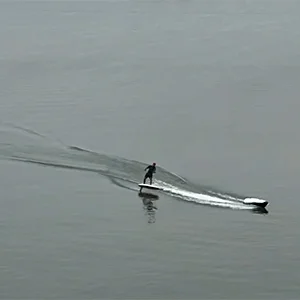
Tow boogie foiling is motor-powered, so wind is not the limiting factor, but water state and traffic absolutely are.
Good conditions for learning and skill-building
- Flat water or light ripple with clear visibility. This lets you focus on foil height, handle position, and speed control without fighting chop.
- Minimal boat traffic and no swimmers. You are towing at speeds where small mistakes cover big distances fast. A tow boogie is a smaller craft, less visible, and has no human spotter for collision avoidance when it is on its own.
- Light current. Strong current makes retrieval harder and increases the chance of the tow boogie drifting into hazards after a stop.
Good conditions for wave tow sessions
- Clean swell with a predictable peak and a deep-water channel for safe setup and exit.
- Enough open space outside the break to accelerate and align with the wave before release.
Bad conditions
- Crowded areas, tight surf lineups, and swim zones. Tow boogie foiling behaves like a powered tow craft plus a high-speed hydrofoil.
- Shallow water, floating debris, kelp mats, or anything that can snag a rope, clog a prop, or strike a foil at speed.
- Confused chop when you are learning. Breaches and slack-line events become much more likely.
Spacing discipline matters. A basic towing safety principle is to keep a generous distance from shore, docks, moored boats, and other obstructions because tow paths are long and stopping distance is not instant.
Where to Go
Tow boogie foiling works in two main location types.
Flatwater training venues
- Inland lakes, reservoirs, and large protected bays with open fetch and low traffic are ideal.
- Look for simple launches, easy exits, and room to run long straight lines while you learn throttle discipline and consistent takeoffs.
Wave venues for hydrofoil wave riding entries
- Ocean breaks with deep water, a safe channel, and room outside the impact zone for setup runs.
- Places where powered towing is accepted and where you can operate well away from other surfers and swimmers.
Setup and Tuning
Tow boogie foiling rewards stable trim and predictable behavior under acceleration. Tune for stability first, then for speed and looseness.
Mast position
Moving the mast forward tends to increase front-foot pressure and can make the foil feel more eager to lift, which can help with low-speed starts but can also feel twitchy under hard pulls. Moving it back can calm the ride and reduce the tendency to over-lift at speed.
Make changes in small steps. A centimeter is a meaningful adjustment.
Tail shims
Tail shims change stabilizer angle and can alter pitch stability, speed, and turning feel.
For tow boogie sessions, the goal is a trim that does not demand constant front-foot or back-foot fight at your normal tow speed, because you are also managing the rope and the remote.
Stabilizer size and fuselage length
- If your tow boogie technique is still developing, use a longer fuselage and a larger stabilizer for steadier pitch and fewer surprise stalls.
- If you are focused on foil carving, tighter arcs, and aggressive cutbacks after releasing into a wave, shorten and shrink cautiously, because tow speed amplifies every mistake.
The tow system setup that actually changes how it rides
- Remote behavior: verify that releasing the trigger stops thrust immediately before every session.
- Rope discipline: keep the towline clear, use robust attachment points, and set it up so it cannot tangle in the propulsor during slack moments.
- Steering style varies by design. Some tow boogies can be influenced by how you load the line while carving, effectively steering the tow craft through rider-driven rope tension.
Tips and Tricks
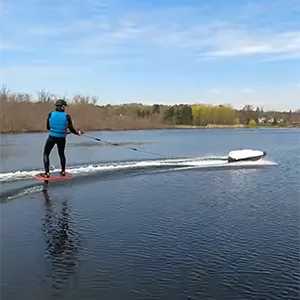
- Learn the throttle in stages. Start with low-power water starts and straight-line rides. Only add speed once your foil height stays steady without porpoising.
- Build a repeatable start. Keep the board flat, let the pull create speed, then lift onto foil smoothly. Most early crashes are caused by trying to pop up too hard at too steep an angle.
- Practice the full stop drill. Get on foil, then stop the tow boogie and confirm it behaves predictably every time. Your confidence in stopping is what makes solo sessions realistic.
- Treat the slack line as a safety hazard. Slack line is how ropes find props, ankles, and foil wings. Keep gentle tension, and when you fall, prioritize clearing the handle and rope away from you before you swim toward anything powered. Never wrap a tow line around hands or fingers.
- For wave tow sessions, plan the release before you accelerate. Decide where you will drop, where you will go on the wave, and where you will exit. A clean release sets you up for real foil surfing tow lines, carving, and cutbacks without the tow becoming a hazard.
- Use stability to gain progress. A longer fuselage and a more stable tail make it easier to learn clean starts and controlled speed changes, so you can tune looser as your tow boogie progression advances.
Skills Ladder
Beginner
You start by learning how to ride a foil under a steady pull, then you add the extra layer that makes tow boogie foiling unique: you are also the driver.
Core skills
- Deep-water starts and body position: stay compact, keep the board flat, let speed build before lifting onto foil.
- Straight-line flight control: stable height, no porpoising, and clean touchdowns without crashing the foil.
- One-hand systems management: holding the tow handle while operating a remote trigger smoothly and predictably.
- Safe stopping and retrieval habits: stopping thrust immediately when anything feels wrong, and keeping the rope clear of the tow boogie at all times.
Gear choices that help at this stage
- More stable foil configuration: larger front wing and a more pitch-stable tail, so the tow pull does not magnify mistakes.
- A board that is easy to start on: enough volume and width to make deep-water starts repeatable.
- A tow system with simple, reliable control and enough remote range for line-of-sight towing.
Intermediate
You can start consistently, ride both directions, and manage speed changes without breaching. Now you learn to run actual sessions instead of just getting up.
Core skills
- Speed control while carving: controlling the throttle so you can practice foil carving without getting yanked faster than your technique can handle.
- Steering and situational awareness: keeping the tow boogie on a safe line relative to shore, obstacles, and other water users.
- Quick relaunch loop: fall, clear the rope, re-grip, and tow back up efficiently.
- First wave entries: controlled tow-in foiling into small, clean waves, then releasing the handle and transitioning into hydrofoil wave riding.
Gear progression
- Smaller, faster front wings as you gain control and want more speed range and tighter turns.
- Smaller board volume once your deep-water starts are reliable, because towing removes the need for paddle or wing power.
- Better tow hardware: a rope and handle that stay manageable in the water and are easy to grab after falls.
Advanced
At the advanced level, you are running wave tow sessions confidently, managing the tow craft as a tool, and using it to unlock lines you cannot access any other way.
Core skills
- Precision wave entries: matching wave speed, dropping the handle cleanly, and immediately committing to foil cutbacks and link-ups without looking back.
- High-speed control: stable trim at faster tow speeds with clean recovery from touchdowns.
- Solo systems mastery: operating features like controlled return and multi-rider sharing when your tow boogie supports it.
- Risk management: choosing conditions, zones, and session plans that keep an unmanned powered craft from ever becoming a hazard.
Gear progression
- A true quiver approach: a larger wing for low-speed training and a smaller wing for fast carving and wave riding.
- Tighter, more responsive foil tuning: shorter fuselage, smaller tail, and faster wing profiles once your pitch control is automatic.
Niche Specific
Tow boogie foiling is self-towing hydrofoil riding. The defining feature is an unmanned towing device you control via a wireless remote while riding, so the rider manages the tow system rather than relying on a separate driver.
The tow craft is purpose-built around a buoyant platform, electric propulsion, and a tow rope mount near the rear. The rider’s remote commands power and, in some designs, also influence direction, return behavior, or tracking modes.
Many modern tow boogie systems add GPS-based functions and software features that make solo use more practical, such as autosteer, ride logging, return modes, or summon-style retrieval behavior.
The DIY culture is part of the discipline. Builds often used simple buoyant boards, battery boxes, radio control components, and adapted electric propulsion systems. That experimental mindset still defines a lot of the niche.
The discipline crosses directly into tow-in foiling. A tow boogie can be used purely for towing laps on flat water, or as a tool to pull into a wave and then release for clean, unpowered hydrofoil wave riding.
Common Problems
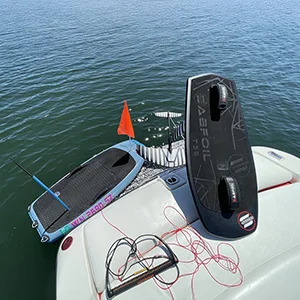
Rope management failures
- Problem: The slack line can snag the propulsor, wrap around a rider, or tangle.
- Fix: ride with disciplined line tension, practice clean handle drops, and never let the rope drift toward the tow craft. Rope management is a critical skill.
Remote range and signal loss
- Problem: You lose control at the exact moment you need to stop.
- Fix: stay within a reliable line-of-sight range, keep the remote high and dry when possible, and run a stop test before towing up each session.
Runaway tow craft behavior
- Problem: the tow boogie continues moving after a crash or keeps drifting into unsafe water.
- Fix: use systems that stop thrust immediately when you stop commanding it, and if available, use return-style retrieval features to bring the craft back instead of letting it drift uncontrolled.
Nose-diving and instability in rough water
- Problem: the tow craft pearls or submarines when they hit chop, especially at higher speeds.
- Fix: slow down before turns, keep a conservative tow speed in rough water, and use a hull design intended to stay level and resist nose-diving if you ride in mixed conditions.
Handle and rope that sink or are hard to grab
- Problem: After a fall, you waste energy hunting the handle underwater while the tow boogie moves away.
- Fix: use floating handles and a floating towline that stays near the surface so you can re-grab quickly and restart without a long swim.
Saltwater wear and corrosion
- Problem: Powered hardware lives in the worst possible environment.
- Fix: rinse after every session, inspect seals and hardware regularly, and use corrosion-resistant components wherever possible. Electrical reliability matters as much as ride performance in this niche.
History
- The tow boogie idea grew out of DIY experimentation, as riders sought a way to replace a manned boat or PWC with a small, self-powered tow platform that could be operated solo.
- The term “tow boogie” emerged from the foiling community itself, where builders and riders began sharing early concepts, prototypes, and testing videos online.
- By around 2020, community discussion around electric tow boogies was active enough that the concept had clearly moved beyond one-off garage experiments and into a recognizable subcategory of foiling.
- Patent filings and formal product development followed, showing that the idea had commercial potential as a dedicated self-tow hydrofoil platform rather than just a DIY hack.
- By the mid-2020s, tow boogie foiling had become an established niche with commercial products, repeated design iterations, GPS-enabled feature sets, and a clear identity as both a training tool and a tow-in surf tool.
FAQs
Is tow boogie foiling the same as eFoiling?
No. In eFoiling, the power unit is built into the board you stand on. In tow boogie foiling, the power stays off-board and pulls you by rope, so you ride a normal foil board while managing the tow craft separately. eFoils have been modified by DIY’ers to serve as unmanned tow boogies.
Can I use any foil board and foil setup?
A tow boogie can pull a wide range of setups, but low-drag boards and efficient foil combinations make starts easier and reduce the power needed. Smaller boards also become practical because the tow provides acceleration rather than paddle or wind power. It comes down to how much power your tow boogie has to pull you up.
How do I get the tow boogie back after I drop the handle to surf a wave?
You need a retrieval plan before you start. Some systems have return or tracking features, but many sessions still depend on a conservative setup, a predictable drift zone, and operating in a place where the craft can be recovered safely after the release. This is the difference between a low-cost DIY project and a $15k purpose built machine.
What is the biggest safety difference compared with boat or jet ski tow-in foiling?
The tow craft is unmanned. That means you must treat it like a powered vessel at all times, keep it away from other water users, and rely on predictable stop behavior, self-retrieval, plus disciplined rope management to prevent it from becoming a hazard.
What kind of range and power is realistic for an electric tow boogie?
That depends on battery size, rider weight, water conditions, and towing speed. In real use, range is always a tradeoff between pull strength and session length. Faster towing and heavier riders drain batteries much faster, so realistic planning matters more than marketing specifications.
Which Foiling Freaks are into Tow Boogie Foiling
-
 Gnar Brinehowl
Just one more lap. Checkout Gnar Brinehowl's merch page.
Gnar Brinehowl
Just one more lap. Checkout Gnar Brinehowl's merch page.
TOW FOIL Secret Outer Reef with Larry + Beava + Tow Boogie
Larry and Beava score a dream tow foil session on the outer reefs.
If you know this discipline inside and out and want to help review and or edit the info on this page, drop us a line. We will credit you as a reviewer or editor and set you up with a proper bio page with links back to your site.