Tow-In Foiling
What is Tow-In Foiling?
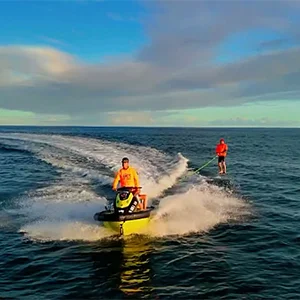
Tow-in foiling is surf foiling where you enter a wave under motorized tow, then release the rope and ride the wave on a hydrofoil. The tow positions you at the right speed and spot for waves too fast, steep, or large to paddle into reliably.
Most tow-in foiling uses a personal watercraft or small boat as the tow vehicle; an efoil can also be used in smaller surf conditions. Higher-end tow boogies, which can follow you to a pickup point, are also an option. The tow team also serves as your safety crew, positioning you, managing recovery, and providing rapid rescue if needed. It is most common in ocean settings, but any body of water with rideable swell, safe depth, access, and rescue plans can support it.
Jetski vs efoil or Tow Boogie
Not all tow-in foiling happens behind a dedicated jet ski crew running into outer-reef surf. eFoils that can tow a rider and modern unmanned tow boogies fill a different niche. They are not replacements for a true big-wave foiling tow-in setup. They are smaller-scale tools used in smaller surf, mellower conditions, and more controlled environments.
A full jet ski tow-in rig is built for speed, power, and rescue capability. That matters in consequential ocean surf where the waves are large, fast, and often breaking far from shore on reefs, points, or outer bars. In those conditions, the ski is not just the tow vehicle. It is also the safety platform, the recovery vehicle, and the machine that can punch through whitewater, reposition quickly, and extract a rider from a dangerous zone. Big-wave tow-in demands instant acceleration, long tow lines, precise driving, and a second person acting as spotter or rescuer. That is why regulated personal watercraft dominate serious ocean tow-in.
eFoil towing and tow boogies are used in a much smaller and less intense part of the spectrum. They are most useful in small to mid-sized waves, soft rollers, crumbling peelers, inside reforms, and days when the goal is simply to get into a wave early without paddling. These setups work best where the wave face is manageable, the consequences are lower, and the rider does not need a rescue machine nearby at all times. They are more about access and repetition than survival capability.
An eFoil tow setup is especially useful in cleaner, less chaotic water, where the rider can be brought up to speed in a controlled way and released onto a wave. Because the eFoil itself is already designed to fly efficiently, it can operate in places where noise, size, and wake are better kept to a minimum. The trade-off is that it lacks the brute thrust, towing capability, or rescue utility of a full ski. It is better suited to small surf, less turbulent water, and sessions where the objective is wave entry rather than confronting heavy surf.
Tow boogies sit in a similar lane, but for a slightly different purpose. A high-end tow boogie is often used when riders want a compact, purpose-built tow source without the size and complexity of a manned watercraft. They are useful for repeated starts, small surf sessions, and controlled pull-ins where portability and simplicity matter. They shine when the rider wants something smaller, quieter, and easier to deploy than a full ski. They are not ideal in large surf, strong currents, or places where instant recovery and heavy-water rescue are required.
The wave choice usually makes the difference obvious. Full jet ski tow-in rigs are used for powerful ocean swells, steep drops, fast-breaking faces, and spots where the wave is large and fast enough to justify mechanized entry in the first place. eFoils and tow boogies are more at home on shoulder-high to moderate surf, softer open-ocean swell, rolling point waves, playful reef runners, and locations where the rider wants a boost into the wave rather than a high-speed slingshot into a critical ledge.
Water state matters too. A jet ski rig handles chop, wind, current, and broken water far better. It can tow hard through turbulence, circle back quickly, and recover a fallen rider in conditions that would overwhelm a smaller or unmanned platform. eFoils and tow boogies work best when the surface is cleaner, the lineup is less violent, and the margin for error is wider. The rougher and more consequential the conditions become, the more the advantage shifts to a real ski crew.
There is also a major difference in session style. Big-wave jet ski tow-in is a team operation with a driver, a rider, a rescue plan, and usually a very narrow weather-and-swell window. eFoil towing and tow boogies are more flexible and experimental. They can be used for lower-consequence surf sessions, for training, for getting repetitions on wave entries, and for expanding access to waves that are too weak or inconsistent to justify a full ski operation.
In practical terms, jet ski tow-in belongs to the heavy-water end of the sport. eFoils and tow boogies belong to the lighter, more accessible end. One is built for large, fast, regulated ocean surf where power and rescue are important factors. The other is built for smaller waves, cleaner conditions, and a more compact version of assisted wave entry. They may all fall under the umbrella of tow-assisted foiling, but they serve very different conditions and very different levels of consequence.
Who is into tow-in foiling?
If you are into tow-in foiling, make sure to drop your pin on the Foilers Pin Map and help tow-in foiling claim the leaderboard. Check the pin map and leaderboard for how many people into tow-in foiling have marked themselves on the map.
How it Works
Tow-in foiling works because the hydrofoil lifts the board as water moves over it. The motorized tow gets you moving, but once you're on the wave, the wave carries you. You control your height and direction by shifting your balance.
A typical tow-in foil sequence looks like this
- Positioning and tow-in: The tow boat or jet ski speeds up until the board lifts out of the water. The rider holds the rope and remains balanced as they prepare to catch the wave. This is similar to being pulled up when boat wake foiling.
- Wave entry and rope release: When you're at the right spot on the wave, you let go of the rope and start surfing. The main skill is matching your speed with the wave and keeping the foil steady and in the smooth part of the water during the steep drop.
- Riding the wave: After you let go of the rope, you ride the wave on the foil. Keep your speed and balance so the foil keeps lift, and try to stay close to the part of the wave with the most power.
- Exit and pickup: After the ride, you either kick out to a safe zone for pickup or move to a defined recovery lane so the tow team can collect you and reset.
What Makes it Different
Tow-in foiling is different from paddle-in surf foiling because you do not rely on paddling acceleration and timing to catch the wave. You arrive on foil at a controlled speed, allowing you to enter faster, steeper waves where paddling can be unrealistic or dangerous. That is the same core reason tow-in surfing exists in big-wave contexts.
Tow-in foiling differs from wake foiling because you don’t ride the boat’s wake. The tow only launches you; after rope release, the wave provides power and requires surf skills at speed in moving ocean water.
Unlike wing foiling or kite foiling, tow-in surf foiling removes wind power altogether. You don’t need wind to start or keep moving, but you require a capable tow team, reliable communication, and enough open water for a safe tow pattern.
Safety and Etiquette
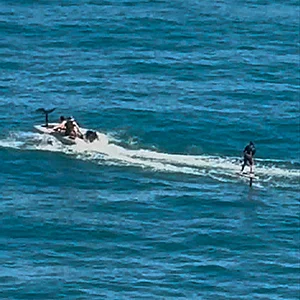
Tow-in safety is a system, not a single piece of gear. The biggest hazards are high speed, hard falls near a sharp foil, being in the impact zone during a set, and rescue complications in heavy surf.
Core safety requirements and practices
- Rope release: You need a reliable release plan every time, and the tow team needs procedures for slack line, tangles, and emergency cutaway. In some jurisdictions, tow-in operations require quick-release tow-rope systems.
- Rescue capability is part of the sport: In Hawaii, tow-in operations require specific rescue equipment on the tow craft, including a rescue sled, a two-way communication device, fins, and a knife, along with minimum tow-rope requirements.
- Clear lanes matter: You need a defined tow lane, a defined wave entry lane, and a defined pickup lane so you are never towing through the same space where people are paddling, swimming, or drifting.
- Wear impact protection: A helmet and impact vest are the most straightforward ways to reduce injury from foil strikes and high-speed tumbles.
- Certification: Tow vehicle drivers may need to be certified. Appropriate first aid certification may also be required.
Etiquette
- Do not tow through a paddle lineup: Tow-in and paddle surfing do not mix safely in the same takeoff zone. If there are people paddling, the default is no towing in that area, and tow crews wait their turn like everyone else.
- Hold your line and keep it predictable: The tow vehicle should run consistent patterns, and the rider should exit into the pre-planned channel so rescues do not cut across active riders.
- Respect priority and local rules: Standard surf right-of-way still applies once you are on the wave.
Starter Guide
Tow-in foiling is not a beginner entry point. Start by becoming competent in surf foiling fundamentals, then add tow-in as an access tool.
Minimum gear list
- A tow-in hydrofoil board and foil suitable for higher-speed stability.
- Tow system: tow rope handle, rope, and a reliable rope release plan.
- Tow vehicle and a team: a capable driver plus a spotter, and a defined rescue plan.
- Safety gear: helmet, impact vest, and appropriate exposure protection for your water temperature and conditions.
Difficulty ranking
- Tow-in surf foiling is hard. It’s faster, the water moves in more complicated ways, and teamwork is needed for safe rescue.
Learning curve
- Learn stable surf foiling first: takeoffs, riding the pocket, controlled touchdowns, and safe falling.
- First, practice starting on flat water behind a boat or jet ski. Focus on keeping the rope tight, keeping your body balanced, and letting go of the rope smoothly at the right time.
- Move to small, uncrowded waves where you can practice wave entry and safe exits with a conservative tow-in safety plan.
- Progress only when wave entry, rope release, and pickup are consistent.
Cost ranges
Costs vary widely depending on the equipment used and whether a boat or a personal watercraft is used. The tow vehicle, fuel, maintenance, and required safety equipment can often exceed the cost of the foil setup itself. Hiring a professional operator can cost hundreds of dollars to over a thousand dollars for a multi-hour session.
How to get started
- Watch tow-in foiling and tow-in surfing technique videos to learn driver patterns, entry angles, and how teams manage pickups.
- Connect with experienced riders in your local foiling and surf communities. Learn the local rules, hazards, and accepted tow zones before attempting a tow-in wave.
- Treat rescue practice as mandatory: communication, pickup drills, and rope management are skills that require practice. In places like Hawaii, tow-in operations are regulated by specific equipment requirements, which serve as a useful benchmark for what “serious” tow-in safety looks like.
Gear Selection
Tow-in foiling gear is built for one thing: controlled entry onto a fast-moving wave, then stable hydrofoiling at speed.
Tow vehicle and a team
- A personal watercraft or small boat is the most common tow platform because it can position the rider precisely and execute fast pickups. The tow craft is part of the tow-in safety system, not just a taxi.
- In places with formal tow-in rules, a tow team is expected to carry rescue and communication equipment and tow only one rider at a time.
Tow rope handle and release
- Use a tow rope handle you can grip securely with wet hands and a rope setup that supports a fast, clean rope release.
- A practical baseline for quick-release tow-rope length is about 30 feet, and dedicated tow setups include a separate bow tow line used for vehicle recovery, mooring, and rafting up.
Board
- Tow-in foil boards are typically low volume and compact because you do not need paddle power to catch the wave. Smaller boards reduce wind resistance, reduce swing weight, and make high-speed touchdowns less likely to trip you.
- Typical tow boards often fall in the 4-foot class and can be very low-volume. Boards in the teens to a few tens of liters are common in tow-and-wake contexts.
Foil mast
- A tow-in foil setup often favors longer masts as waves get bigger and faster, because you want the foil deeper and less prone to skipping out on surface bumps at speed. In big-wave tow foiling, 95 cm class masts are a common reference point.
Front wing, stabilizer, and fuselage
- Tow-in surf foiling generally uses smaller front wings than paddle-in surf foiling because you are entering with speed, and you need lower drag and better top-end control.
- In big-wave foiling, front wings in the 500-700 cm² range are a commonly used size range.
- Fuselage length and stabilizer choice are tuned for stability at speed. Longer fuselages and calmer tail settings make high-speed line changes and steep wave drop control more predictable, while shorter setups feel looser but demand more precision.
Conditions
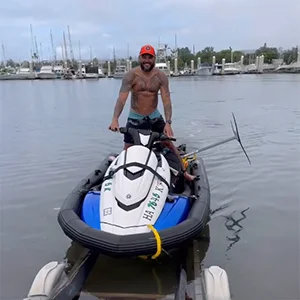
Tow-in foiling works best when the wave is fast enough to carry the foil and the approach zone is clean enough to tow safely.
Good conditions
- A defined, predictable wave that lets you set a clean tow line, commit to a drop, then settle into foil in the pocket.
- Adequate depth through the tow line, takeoff zone, and recovery lane.
- Manageable wind. Light to moderate wind is fine, but strong offshore winds can destabilize the stance and reduce control during the steep wave drop by pushing against the rider and board.
- A clear channel and low crowd density so the tow craft can run a consistent pattern without crossing swimmers or paddlers.
Bad conditions
- Heavy traffic, mixed lineups, or anywhere a tow craft would have to pass through paddlers to reach the takeoff zone.
- Shallow reefs or sandbars with variable depth, especially if you are using a longer mast.
- Chaotic chop that forces repeated breaches and touchdowns at high speed.
Where to Go
Tow-in foiling is most practical at ocean venues that have big, fast waves and enough watercraft access to run safe towing and pickups.
General location traits
- Open-ocean swell with a consistent takeoff zone.
- A defined channel or safe escape route for both rider and tow craft.
- Enough room to separate tow lines from any paddle lineup.
Well-known big-wave and tow-in venues
- Nazaré (Praia do Norte), Pe’ahi (Jaws) on Maui, Mavericks at Half Moon Bay, and Teahupo’o in Tahiti are widely recognized waves associated with tow-in operations and extreme surf conditions.
- Some regions also have established big-wave zones where tow teams train and operate, including major South African big-wave venues such as Dungeons.
Tow-in is not limited to the ocean, but most real-world tow-in surf foiling is ocean-based because you need long, powerful wave energy and enough room to run safe tow patterns.
Setup and Tuning
Tow-in foil setup tuning is about controlling lift at speed and staying attached to the water through bumps.
Mast position
- Move the mast forward when the foil feels like it wants to climb uncontrollably at speed.
- Move it back when you need more lift support at lower speeds or during slower wave sections.
- The goal is neutral pitch so you can ride low without fighting constant nose-up or nose-down behavior.
Tail shims and stabilizer lift
- Reduce the tail lift at higher speeds so the foil does not try to climb as the wave accelerates.
- Add tail lift only when you need more low-speed support, knowing it usually adds drag and can make the foil feel more “eager” to rise.
Front wing size
- Bigger wings make wave entry easier, but cap speed and increase the chance of lift spikes.
- Smaller wings reduce drag and handle speed better, which is why big wave hydrofoil setups commonly shrink wing area dramatically compared to standard surf foiling.
Mast length
- Longer masts give you more margin over surface texture and let you keep the foil deeper in turbulent water, which becomes important as speed and wave size rise.
Tips and Tricks
- The tow-in training starts on flat water first: Learn stable acceleration, low flight, and clean rope release before you add waves.
- Fly low on approach: Height feels safe until it is not. At tow speeds, a small rise can become a breach fast.
- Make the rope release consistent: Practice releasing under load and in slight slack so you are not surprised when the foil picks up the wave energy and changes line tension.
- Run a lane system: One line for towing in, one line for wave entry, one line for pickup. That predictability prevents collisions.
- Keep the tow craft rescue-ready: A serious tow-in safety kit includes fast communication and rescue capability, such as a rescue sled and quick-release tow rope, and tow teams often formalize this as standard procedure.
- Do not tow through a paddle lineup: If the zone is crowded, it is not a tow zone. Tow operations and paddlers only coexist safely when space and conditions make separation obvious and consistent.
Skills Ladder
Beginner
Tow-in foiling is not a beginner entry point. The starting line is being competent at surf foiling and comfortable riding a hydrofoil at speed first.
Prerequisite skills
- Stable, low flight at speed without breaching.
- Clean touchdowns and recoveries in turbulent water.
- Confident wave positioning so you can stay on the power source and keep the foil in the wave's power zone.
First tow-in skills
- Controlled tow starts in flat water: you learn to accelerate, fly low, and track straight under consistent line tension.
- Clean rope release: you let go instantly and predictably without changing body position or pitching the foil.
- Small-wave entries: You practice the steep wave drop feeling on manageable waves so the mechanics become automatic.
Gear evolution
- A calmer, higher-speed tow-in foil setup with stability tuned for speed and turbulent water rather than slow-speed lift.
Intermediate
This is where tow-in surf foiling becomes natural.
Core skills
- Wave entry timing: You match the wave speed, release, and settle immediately into a controlled line.
- Speed management: you stay low, keep the foil engaged, and avoid ventilation through surface texture.
- Team choreography: driver line, rider line, pickup lane, and communication are consistent every run.
Gear evolution
- Smaller, faster wings and more speed-oriented tuning become practical as your control improves. Bigger-wave tow foiling commonly moves to very small front wings compared to typical surf foiling.
- Advanced tow-in foiling is about making high-speed wave riding look calm.
Core skills
- Committing to fast, steep wave faces with precise control through acceleration zones.
- Tight pocket riding at high speed without over-lifting.
- Managing multiple hazards at once: turbulence, aerated water, high-consequence falls, and complex rescues.
Gear evolution
- The tow-in foil setup becomes highly speed-specific, often using long-mast stability and small-wing control for the hydrofoil at speed.
Niche Specific
Tow-in foiling is defined by access, not by the trick list or the riding style. The tow vehicle places you in the exact spot you need, at the exact speed you need, for waves that are too fast or too steep to catch safely by paddling. That is the same fundamental reason tow-in surfing exists.
The niche is also inherently team-based. Tow-in safety is part of the experience. The tow craft is a rescue platform, and in regulated environments, the safety kit and operating procedures are treated as part of the activity itself, including requirements like two-way communication, fins, a knife, a rescue sled, and a quick-release tow rope.
Common Problems
Rope release mistakes
- What happens: the rider holds too long, releases late, or releases while off-balance, which causes an immediate pitch error and a crash.
- Fix: treat rope release as a technical skill. Train it in flat water first, then in small waves. The goal is zero body movement when you let go.
Over-flying and ventilation at speed
- What happens: the foil rises too high in turbulence, the wing ventilates, and lift drops suddenly.
- Fix: ride lower than you think you need, especially through bumps and aerated sections. Tune the setup for speed, stability, and predictable pitch.
Getting worked in the impact zone
- What happens: a fall puts you and the board in the wrong place at the wrong time, and the set closes out your recovery window.
- Fix: define lanes before you start. Tow lane, wave entry lane, exit lane, pickup lane. Your tow team must know exactly where to look and exactly where to meet you.
Unsafe mixing with paddle surfers
- What happens: a tow craft crosses a paddle lineup or recovery path, intersecting other surfers.
- Fix: do not tow through a paddle lineup. If you cannot keep towing operations completely separated from paddlers and swimmers, it is not a tow zone.
Set up a mismatch for speed
- What happens: a surf-optimized, slower-speed foil feels unstable or over-lifty when towed fast, leading to breaches, skips, and harsh touchdowns.
- Fix: move toward a tow-specific configuration. Big-wave tow-in foiling often uses very small front wings compared to paddle-in surf foiling, as speed control and reduced drag take priority.
History
Tow-in foiling comes from tow-in surfing. Modern tow-in surfing was popularized in the early 1990s, and documented early sessions include Laird Hamilton, Buzzy Kerbox, and Darrick Doerner being towed into large waves in winter 1992.
Tow-in practices also became regulated in some regions. Hawaii, for example, has specific tow-in surfing rules and required equipment and conduct standards for thrill craft tow-in operations, including quick-release tow rope requirements and right-of-way separation rules.
FAQs
Is tow-in foiling the same as tow foiling behind a boat?
No. Tow foiling can mean being towed for the entire ride behind a boat or PWC. Tow-in surf foiling uses the tow only to enter the wave, then you release and ride the wave energy.
What is the most common tow vehicle for tow-in foiling?
A personal watercraft or small boat is the standard because it can accelerate quickly, position precisely, and execute fast pickups. Efoils and tow boogies can be used in some less-risky or exposed waves, such as small waves close to shore.
How important is rope release?
It is critical. Rope release marks the transition from motor power to wave power, and in some jurisdictions, tow-in operations explicitly require quick-release tow-rope systems as part of safe practice.
Do you only tow-in on huge waves?
No. Tow-in can be used on smaller waves for training and control work because the tow lets you enter with speed and repetition, even when paddling would be inefficient.
Is tow-in foiling legal everywhere?
Rules vary by location. Some places regulate tow-in operations and require certifications, operating rules, and safety equipment. Hawaii is one clear example with defined tow-in surfing requirements for thrill craft operators and equipment.
Which Foiling Freaks are into Tow-In Foiling
-
 Koa Breakerhorn
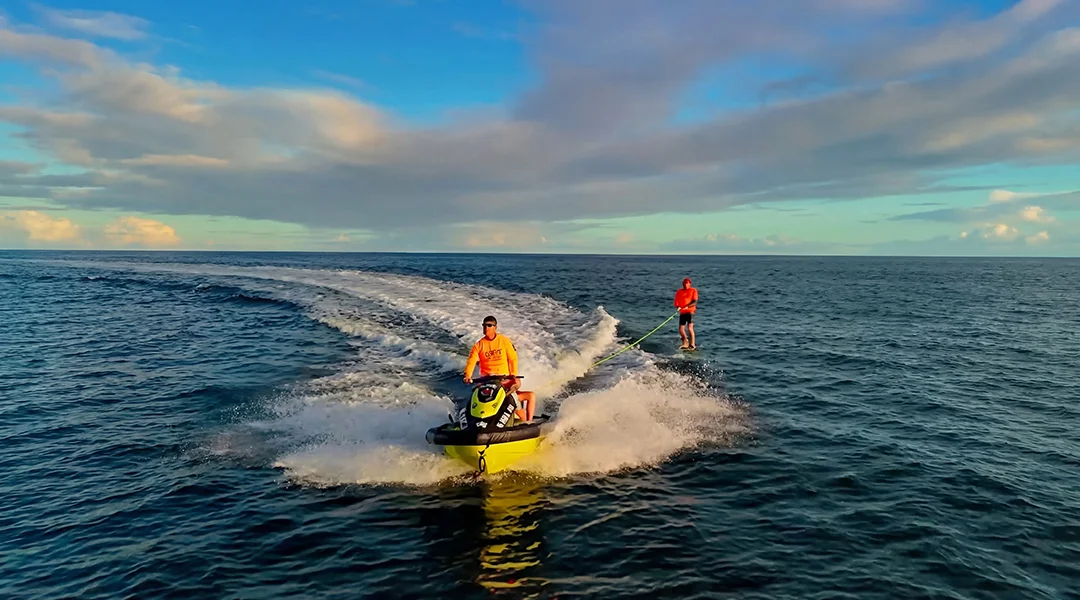
The big-wave tow-in specialist of the Foiling Freaks crew. Checkout Koa Breakerhorn's merch page.
Koa Breakerhorn
The big-wave tow-in specialist of the Foiling Freaks crew. Checkout Koa Breakerhorn's merch page.
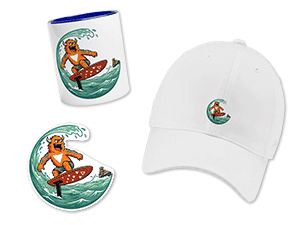
Tow foiling in Jupiter, Florida with Harry the LEGEND!
What an incredible day tow foiling with the LEGEND Harry Andrews, the LEGEND junior Matt Andrews, Gwen, and Damo! Tow foiling is a great way to improve your foiling, wing-foiling, or kite-foiling skills.
If you know this discipline inside and out and want to help review and or edit the info on this page, drop us a line. We will credit you as a reviewer or editor and set you up with a proper bio page with links back to your site.
We could use a few more high-quality images to illustrate this discipline. If you have shots you own and are willing to share, contact us for where to send them. Bonus if you also credit the rider and give us a URL to link back to you.