Kite Foiling
What is Kite Foiling?
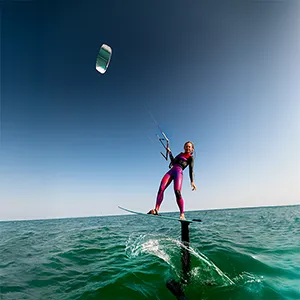
Kite foiling is hydrofoil kitesurfing: you ride a kiteboard with a hydrofoil bolted underneath, using a kite for power. Once the board accelerates, the underwater wing generates lift, raising the board above the surface and reducing drag, letting you glide efficiently. Because drag is so low on a kite hydrofoil, riders can often cruise in lighter wind than a typical twin-tip session would allow.
Kite foiling is still kiting at heart. You are flying a kite on long lines and controlling power with a bar, harness, and safety systems. The foil changes how the board interacts with the water, but the kite and lines are what create the pull, speed, and potential for big kite foil jumps. Kite lines are commonly in the 20 to 24 meter range, and longer sets can be used in lighter wind.
Who is into kite foiling?
If you are into kite foiling, make sure to drop your pin on the Foilers Pin Map and help kite foiling claim the leaderboard. Check the pin map and leaderboard for how many people into kite foiling have marked themselves on the map.
Be more than just a dot on the map. Join the Foiling Freaks community and create your own foiling profile with a custom handle, rider photos, videos, disciplines, bio, and more.
How it Works
All foiling relies on lift from an underwater wing moving through water. In kite foiling, the power source is wind, captured by the kite. The rider converts kite pull into board speed, then the hydrofoil wing lifts the board to reduce drag and increase foil efficiency.
A typical start looks like this
- Launch the kite in a clear area with safe wind and enough downwind space.
- Waterstart like normal kitesurfing, but stay low and ride the board flat first.
- Build speed, then gently shift to controlled lift so the board rises onto foil.
- Once flying, manage height with small weight shifts and smooth kite power to avoid breaching or slamming down.
Beginner-focused kite foil technique often favors a larger front wing and a shorter mast so the lift comes earlier and mistakes are less punishing.
What Makes it Different
Kite foiling differs from “regular” kiting because the hydrofoil replaces planing on the water with flying above it. That changes everything about speed, efficiency, and how the board feels in chop. A key practical difference is wind range: with a kite foil setup, riders can often ride at speed with a smaller kite than they would use on a twin tip in the same wind.
The long kite lines are also a defining feature. Typical line lengths are commonly 20 to 24 meters, with longer lines sometimes used in light wind, which increases the size of the kite’s sweep through the wind window. This affects power delivery and can affect the timing of boosts and loops.
Gear differences are significant too
- Kite foil boards are typically shorter and more compact than surf-style kiteboards, and for beginners, a length range of 120 to 140 cm is a good starting point.
- Foil wing sizes for kite and wing use commonly fall in the hundreds to low thousands of square centimeters, depending on rider weight and goals, with beginners generally choosing the larger end of their appropriate range for easier lift and stability.
- Mast length is often shorter for learning. 60 to 70 cm is a good beginner range, with longer masts becoming useful as skills develop and conditions get rougher.
Safety and Etiquette
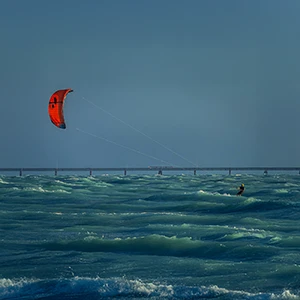
Kite foiling adds the standard kiting risks to foil-specific hazards. The foil itself is hard and sharp enough to injure you in a fall, and kite foiling can involve higher-speed crashes. Protective equipment, such as a helmet and an impact vest, is especially important during learning.
The long lines and powered kite add unique hazards around obstacles
- Stay clear of power lines and overhead obstructions, and use a launch area with a safe downwind buffer zone.
- Always have a functioning quick-release and kite leash, and avoid launching or landing in crowded areas.
- Keep a wide safety zone. A clear zone of about two kite-line lengths around swimmers and other users is recommended.
On-water right of way and kite position etiquette matter more with long lines
- Starboard tack has right of way over port tack, and when passing in opposite directions, the upwind rider flies the kite high while the downwind rider flies it low.
- Do not jump or boost near other riders. Look before you turn or jump, and avoid running lines across anyone’s path.
Starter Guide
If you are a kite foil beginner, the safest path is to learn solid kite control first, then add the foil. Experienced community guidance commonly recommends starting on a standard board to build kite skills before moving to a foil, because kite-handling errors are the main cause of most serious incidents.
Minimum gear list
- Traction kite appropriate for your wind range
- Control bar and lines
- Harness
- Kiteboard hydrofoil setup (board plus mast, fuselage, front wing, stabilizer)
- Helmet and impact vest
- Safety leash systems, plus a cutting tool for line emergencies
Costs vary widely by new vs. used and by construction type, and there is no single universal price.
Current retail listings provide a rough reality check
- Kite foil boards often list in the mid-hundreds to low thousands USD.
- Complete foil setups and foil packages commonly span roughly the high hundreds into a few thousand USD.
- Control bars are commonly several hundred USD.
- Lessons are commonly priced per hour, and published ranges put instruction at roughly $50 to $250 per hour, with multi-hour beginner courses often priced at a few hundred to over a thousand, depending on location and format.
Expected learning curve
- If you already kiteboard confidently, your first kite foil sessions are usually about learning foil balance and managing lift without overcorrecting.
- If you are new to kiting, do not try to self-teach foil kiteboarding. Take lessons first, then progress to a foil once your kite-handling and self-rescue are consistent.
To get started without naming specific sites or groups
- Watch technique videos focused on kite foil progression, waterstarts, and controlling lift.
- Find a local community through social media and talk to experienced riders about safe launch zones and local rules.
- Start in steady wind, warm water, and a wide open area with no obstacles downwind. Avoid trees, buildings, and power lines until your launches and landings are routine.
Gear Selection
Kite foiling uses the same kite, bar, and harness as regular kitesurfing, but swaps the normal finned board for a kite foil board with a hydrofoil mast, fuselage, front wing, and stabilizer.
Kite and lines
- Standard kite line lengths are commonly 20 to 24 m, and longer lines in the high 20s up to about 30 m are sometimes used in lighter wind to give the kite a larger sweep through the wind window.
- Many riders keep a “quiver” of kites in different sizes for different wind strengths. A general breakdown is light-wind kites around 13 to 17 m, mid-range kites around 9 to 12 m, and strong-wind kites around 4 to 8 m.
- Because a kite hydrofoil is efficient, foil riders often use smaller kites than twin-tip riders at the same wind speed. For a 75 to 85 kg rider at 20 to 24 knots, a common match is 7 to 9 m on a foil versus 9 to 10 m on a twin tip.
Board
- Beginner kite foil board lengths of 120 to 140 cm are recommended for easier water starts and greater stability.
- As riders progress, many move to shorter “pocket” style boards. Kite foil boards are commonly around 110 to 145 cm.
Mast length
- Shorter masts, around 60-70 cm, are recommended for beginners because they keep you closer to the water and make early falls less severe.
- Intermediate riders often move into the 70-85 cm range for more clearance in chop and more carving room.
- Longer masts 90 cm and up are often more advanced and more common in kite and wing use when chasing speed and handling rougher water.
Foil wings
- Hydrofoil wing size is usually discussed in square centimeters (cm2), and bigger wings generally lift earlier and feel calmer, while smaller wings are faster and more reactive.
- Kite and wing use ranges (by rider weight) are roughly from 500 to 1,600 cm2.
- A beginner kite foil setup for many learners does well starting around 1,300 to 1,700 cm2, paired with a shorter mast and a longer fuselage for stability.
Fuselage and stabilizer
- In general, longer fuselages add pitch stability and smoother tracking, while shorter fuselages increase maneuverability. Shortening a fuselage by 50 mm can reduce stability and increase maneuverability.
- Stabilizer size and angle influence pitch stability versus looseness. Shimming is a common tuning method when your brand supports it.
Accessories commonly used
- A helmet and impact or flotation vest are recommended while learning, especially because foils are hard and sharp compared to a normal board.
- A hook knife is recommended as a line-cutting tool for emergencies.
- Board leashes are strongly discouraged in kiteboarding due to the risk of injury.
Conditions
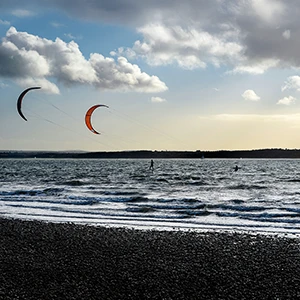
Kite foiling works in a wide range of wind and water states, but learning works best when conditions are calm, steady, and predictable.
Good conditions for learning
- It is recommended to learn in steady wind, not gusty wind.
- Learning in about 12 to 15 knots is ideal, aiming for a steady pull rather than aggressive kite movement.
- Flatter water generally makes early kite foil progression easier because it reduces random board touchdowns and allows you to focus on balance and foil control.
Harder conditions
- Strong gusts and turbulent wind near obstacles make kite control harder and increase the risk during launch and landing.
- Shallow water is a major hazard for foil riders, as striking the bottom can result in violent falls. A shallow-water bottom strike poses a serious injury risk, which is why depth awareness is considered critical.
- Busy launches and crowded water increase the risk because kite lines are long and riders can travel fast on a foil. Maintain a downwind buffer and avoid crowded areas.
Where to Go
Kite foiling can be done anywhere kitesurfing is allowed, but the best spots share a few traits: clean wind, room to launch and land, and enough depth to foil safely.
General location types
- Flatwater lagoons and protected bays are popular for learning because they reduce wave chaos and give you space for repeated waterstarts and short tacks.
- Large rivers and wind corridors can be excellent if they deliver consistent wind and have safe launches, but currents and traffic can add complexity.
- Open-coast beaches can be great once you are comfortable, especially if the wind direction is side-shore or side-onshore and the launch is clear of hazards.
Well-known hotspots
- Hood River and the Columbia River Gorge (USA) are major kiteboarding areas with multiple launches and strong seasonal winds.
- Tarifa (Spain) is a kiteboarding hub with multiple beaches and strong wind seasons, though access rules can vary by season and spot.
- La Ventana (Baja, Mexico) is known for its consistent seasonal winds, often cited as good for learning and training.
- Kanaha Beach Park (Maui, Hawaii) is Maui’s main kiteboarding area and supports foiling among other disciplines.
Setup and Tuning
Not every kite foil setup offers the same tuning options, but these are the main levers when you do.
Mast position in the track
- Moving the foil in the mast track changes the balance and how easily the board lifts. Setting the mast too far back can cause nose-pitch issues in turns, while too far forward can make the board lift too easily. Small adjustments like 5 to 10 mm can make a noticeable difference.
Tail shims
- Shims change the tail wing angle and can tune speed versus stability. Negative shims can make the foil faster and looser, while positive shims can make it slower and more pitch stable, depending on how the stabilizer is mounted.
- Shimming is a way to tune speed, stability, turning, pumping, and glide.
- The direction of shimming also depends on whether the wing is mounted to the top or bottom of the fuselage.
Fuselage length
- A shorter fuselage generally means quicker pitch response and tighter turning, while a longer fuselage generally means more pitch stability. Even a 50 mm change can shift stability and maneuverability.
Stabilizer size
- Bigger stabilizers generally feel more stable and track more; smaller stabilizers generally feel looser and faster. If you are learning kite foiling, stability usually beats looseness until your foil control is consistent.
Tips and Tricks
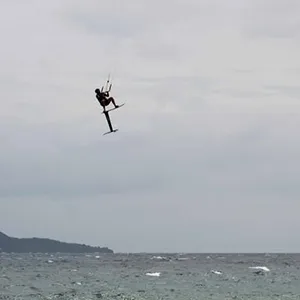
- Pick steady wind, not gusty wind, for early sessions: Steady wind is best for newer riders.
- Give yourself a depth margin: Bottom strikes can be severe on a hydrofoil. Err on the side of deeper water while learning.
- Keep your first foil sessions conservative: A common learning approach is a shorter mast and a stable wing to reduce the “too high, too fast” problem.
- Treat your launch zone like part of the sport: Choose open areas, avoid power lines and trees, and maintain a clear downwind buffer.
- Do not use a board leash: Learn body dragging to recover your board instead. Board leashes are not recommended due to the risk of injury.
- Carry a hook knife and know where it is: Line entanglements are rare but serious, and a kite knife is designed to cut lines under tension.
Skills Ladder
Beginner
- Prerequisites: You need reliable kite control, safe launching and landing habits, and self-rescue skills before adding a hydrofoil. A foil changes the board's behavior, but the kite still provides the power and most of the risk.
- First milestones: Waterstart and ride with the board on the water (not on foil) in both directions, holding ground upwind before trying to rise. Keep the kite higher than you would on a twin tip while learning, because low kite positions create more sideways pull that is harder to balance against on a foil. Short, controlled “touch-and-go” flights, learning to bring the foil back down without crashing.
- Typical gear direction: Shorter mast and more stable foil geometry for lower-speed lift and easier crash management.
Intermediate
- Core skills: Consistent foiling in both directions with stable height control in chop. Controlled transitions (carves and gybes) without dropping the kite or overpowering it. Learning to manage tip breaches and ventilation without immediate wipeouts.
- Typical gear direction: Moving from “maximum stability” gear toward faster, more efficient setups that better match your local wind and water state. Many riders also refine strap placement, mast position, and rear-wing tuning because small changes can make the setup easier to ride.
Advanced
- Core skills: High-wind kite foiling with controlled speed and confident recovery from errors. Consistent tacks, higher-speed racing-style angles, and riding in rougher conditions. Jumps on a foil are a distinct progression step. Working on kite foiling jump technique because foil landings and foil management add complexity compared to twin-tip boosting.
- Typical gear direction: More performance-focused foils and race-oriented setups are available, including beginner, freestyle, and racing categories.
Niche Specific
Kite foiling is unique because the kite and long lines create power and control from far above the rider, while the hydrofoil removes most of the board drag once flying. That combination lets riders cover distance efficiently, ride in lighter winds than typical planing boards, and point high upwind.
It also has a distinct competitive identity. Kitefoil racing evolved into the Formula Kite class managed by the International Kiteboarding Association, and it became part of the 2024 Olympic sailing program.
Finally, kite foiling has a special hazard profile due to long lines and high speeds. Launch and landing zones need more clearance, and obstacles downwind matter more than in many other foil disciplines.
Common Problems
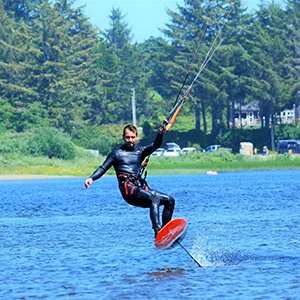
Breaching and ventilation
- What it looks like: A foil tip or wing section breaks the surface, air gets sucked down, and the foil can suddenly lose lift and crash.
- What helps: Keep a lower, controlled ride height while learning, avoid aggressive carving when overpowered, and practice controlled “surface piercing” technique if your foil and skills allow.
Trying to foil immediately after the waterstart
- What it looks like: You waterstart, and the board pops up onto foil before you are stable, leading to rapid overcorrections and crashes.
- What helps: Build the habit of riding on the water first, then rise deliberately once you are balanced and tracking.
Kite too low while foiling
- What it looks like: Excess sideways pull forces you into a “hanging off the kite” stance that is unstable on a foil, especially for new riders.
- What helps: Keep the kite high and use smaller steering inputs near the top of the wind window during early kite foil progression.
Shallow-water impacts
- What it looks like: Mast or wing strikes the bottom, and the crash can be violent. There are documented serious injury incidents tied to shallow-water foiling.
- What helps: Learn in deeper water, avoid jumping in shallow water, and plan your tacks, gybes, and exits so you do not drift into the shallows.
Launch and landing hazards with long lines
- What it looks like: Kite or lines catch on trees, poles, or power lines. Kite lines can conduct electricity, and utility safety guidance is explicit about staying away from overhead lines and not trying to retrieve a kite from them.
- What helps: Launch only in open areas with a clear downwind buffer, and choose spots with fewer obstacles.
World Records
Fastest female kite foil circumnavigation of the Isle of Wight
- Current record: Steph Bridge sets the women’s Isle of Wight kitefoiling mark. Holder: Steph Bridge
Fastest kite foil circumnavigation of the Isle of Wight
- Current record: Guy Bridge lowers the Isle of Wight kitefoiling record to 2:24:32 - 2 h 24 min 32 s. Holder: Guy Bridge
- Previous record: Guy Bridge sets the initial WSSRC Isle of Wight kitefoiling mark - 2 h 32 min 25 s. Holder: Guy Bridge
Highest publicly documented kite foil jump
- Current record: Hugo Wigglesworth becomes the first documented kitefoiler over 40 m - 40.0 meters. Holder: Hugo Wigglesworth
- Previous record: Charles Brodel records a 37.17 m kite foil jump - 37.17 meters. Holder: Charles Brodel
- Previous record: Baptiste Bourdoulous reaches 34.4 m on a hydrofoil - 34.4 meters. Holder: Baptiste Bourdoulous
- Previous record: Jamie Overbeek raises the kite foil jump mark to 33.2 m - 33.2 meters. Holder: Jamie Overbeek
- Previous record: Borja Vellon becomes the first foiler documented over 30 m - 30.6 meters. Holder: Borja Vellon
Longest documented kite foil distance in 12 hours
- Current record: Nick Levi covers 254.5 miles on a kite foil in 12 hours. Holder: Nick Levi
Know about a broken record, an update needed to an existing world record, or a brand new world record that deserves to be in the public record? Submit it.
World Firsts
- Negros to Mindanao by Kite Foil: Negros to Mindanao. Holder: Brian Krell
- First kitefoiler documented over 40 knots for a nautical-mile average: Nico Parlier documents the first kitefoil nautical-mile average over 40 knots. Holder: Nico Parlier
- First kitefoiler documented over 40 knots on a roughly 500 m speed run: Arthur Mathieu breaks the 40-knot foil barrier on a 501 m kitefoil run. Holder: Arthur Mathieu
- First Olympic Formula Kite men's gold medalist: Valentin Bontus wins the first Olympic men's Formula Kite gold. Holder: Valentin Bontus
- First Olympic Formula Kite women's gold medalist: Ellie Aldridge wins the first Olympic women's Formula Kite gold. Holder: Ellie Aldridge
- First board-off kiteloop landed on a kite foil: Charles Brodel lands the first board-off kiteloop on a foil. Holder: Charles Brodel
- First contra-loop front-roll board-off and back-roll kiteloop board-offs landed on hydrofoil in competition: Charles Brodel lands two competition firsts in Taiba. Holder: Charles Brodel
- First GKA Hydrofoil Freestyle Champion title: Fred Hope wins the first GKA Hydrofoil Freestyle Champion title. Holder: Fred Hope
- First GKA Big Air Hydrofoil World Champion: Charles Brodel becomes the first GKA Big Air Hydrofoil World Champion. Holder: Charles Brodel

Know about a broken record, an update needed to an existing world first, or a brand new world first that deserves to be in the public record? Submit it.
History
- Early roots: The use of hydrofoils in kitesurfing is commonly described as starting in the 2000s.
- Early experimentation and early products: Multiple non-academic histories credit Mango Carafino with making one of the first kiteboard hydrofoils, often dated to around 2004, and some accounts say early foil racing activity in France was happening by 2008.
- Organized class recognition: By March 2009, IKA governance materials referenced the KiteFoil Open Class Rules, indicating the discipline was formalizing within the World Sailing ecosystem by then.
- Racing era and rule changes: IKA Formula Kite documentation states that since 2012, only registered production equipment is eligible for Formula Kite events. Reporting from 2016 describes rule changes “at the beginning of the year” that altered class rules to accommodate hydrofoil boards, which aligns with the period when hydrofoil boards became central in top-level kite racing formats.
- Established global sport: Kite foiling reached mainstream visibility as Formula Kite in the 2024 Olympics as a high-performance hydrofoiling kite-racing class.
FAQs

Is kite foiling harder than regular kitesurfing?
For most riders, yes, at first. You are balancing on a hydrofoil that can amplify small mistakes. It is recommended to learn to ride the board on the water first, and only then rise onto the foil.
What wind range works for kite foiling?
It varies by rider weight, kite size, and foil setup. In the racing context, World Sailing lists a competition wind range of 5 to 40 knots for the Olympic Formula Kite equipment framework. Recreational riding does not always match that range, but it shows how wide the foiling kitesurfing envelope can be.
What is the biggest beginner mistake?
Two common ones are putting the kite too low and trying to rise onto the foil immediately. You should use a higher kite position and build control off the foil first.
Can you jump on a kite foil?
Yes, but it is an advanced skill because you must manage foil position on takeoff and especially on landing. There are dedicated how-to resources focused specifically on jumping a foilboard, which reflects the extra complexity. Some wings may not be strong enough to handle the forces of a hard landing. Read your manufacturer's guidance on whether it can be used for jumping.
What is the most important safety rule specific to kite foiling?
Give yourself room and avoid obstacles. Long lines plus wind power mean you must stay away from trees and overhead power lines, and if a kite gets caught in power lines, you should not attempt retrieval.
Which Foiling Freaks are into Kite Foiling
-
 Roxy Kincaid
Punk aquatic kiter. Air-time addict. Dolphin-approved chaos. Checkout Roxy Kincaid's merch page.
Roxy Kincaid
Punk aquatic kiter. Air-time addict. Dolphin-approved chaos. Checkout Roxy Kincaid's merch page.
Kitefoiling Gives You Freedom
The dream of every human being is flying. Kitefoiling gets close to that feeling. Being connected to the water, fresh air and the sun makes your mind and body feel free.
If you know this discipline inside and out and want to help review and or edit the info on this page, drop us a line. We will credit you as a reviewer or editor and set you up with a proper bio page with links back to your site.