The Proxyfoil
What is the Proxyfoil?
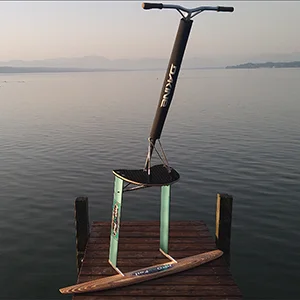
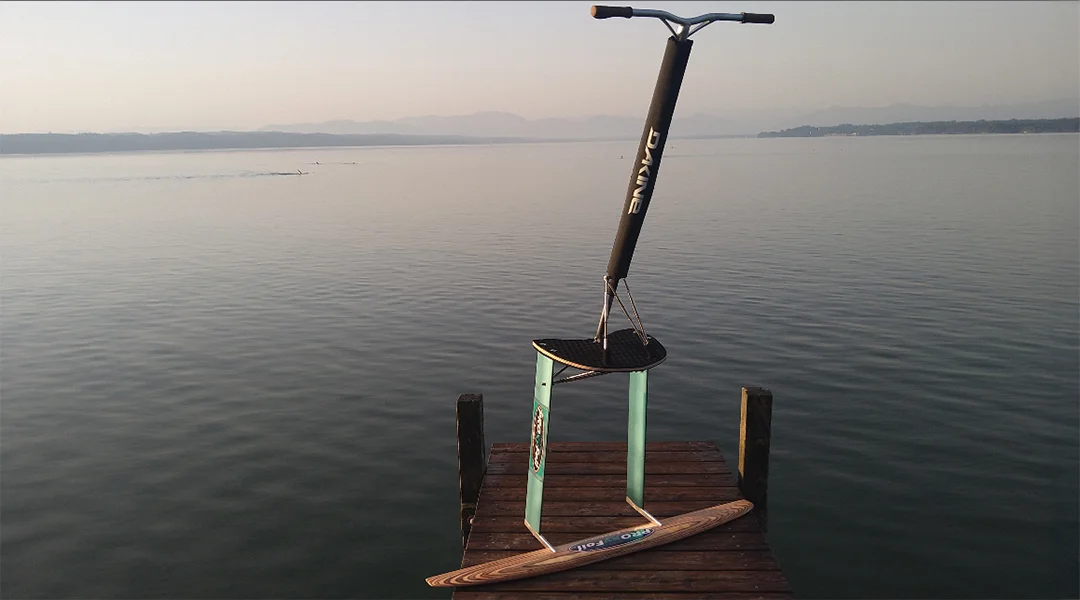
Proxyfoil is a commercial product that sits in the same neighborhood as pump foiling and hydrofoil scooter concepts, but it is built around a fixed handlebar, a dual-mast, monowing, and a stand-on platform that you drive purely with your body. It is a self-powered hydrofoil.
In use, it feels closer to scoot pump foiling than to traditional surf foiling. You create speed, then keep it by repeating an efficient pump into a glide rhythm, using the handlebars for turning, balance, and pitch control. Proxyfoils have a 1.4 m wingspan, weigh 9 kg, and average 17 km/h, with a stated max of 23 km/h.
A unique feature of a Proxyfoil is that its wings are handcrafted to match the rider's preferences, and extra features, such as footstraps, can be added.
Who is into the proxyfoil?

If you are into the proxyfoil, make sure to drop your pin on the Foilers Pin Map and help the proxyfoil claim the leaderboard. Check the pin map and leaderboard for how many people into the proxyfoil have marked themselves on the map.
How it Works
The power source is human power. You start from the dock or shore with a strong forward-pushing step, get the foil flying, then maintain lift and propulsion by cycling the system up and down. On the downstroke, you load and push; on the upstroke, you unload and let it rise. That repeating load-and-release is the pump foiling technique that keeps a low-speed foil moving.
The handlebar hydrofoil layout gives you an extra point of contact, helping you stabilize the platform as you learn timing, balance, and rhythm. Proxyfoil states the learning milestone for a first ride is about five sessions.
What Makes it Different
- Shore start focus: Proxyfoil is explicitly designed for trickier launch spots, making it a shore-start hydrofoil rather than a dock-only tool. The monowing design, without a fuselage or rear wing, means it will not hit rocks or docks that are not undercut, making launching easier in some locations.
- Handlebar-driven control: The handlebar is not an accessory. It is central to the control model and is presented as giving more control and access to radical maneuvers than a typical pump foil surfboard. In this sense, it is unlike more traditional scoot pump foils, which let you remove the handlebars to ride the board.
- Proxyfoil features a compact platform with a forward-leaning handlebar and dual-strut mast, creating a unique structure that distinguishes it from conventional hydrofoils.
Safety and Etiquette
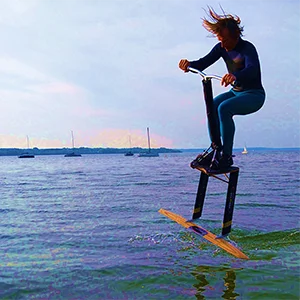
- Impact risk is higher than it looks: A handlebar and a rigid frame add strike points. Keep arms slightly bent, avoid locked elbows, and bail away from the device when you lose balance.
- Shallow-water awareness: A shore start means you are close to the bottom and close to hard shoreline objects. Choose a clean, sandy entry and enough depth to protect the foil and your body.
- Fatigue management: This is human-powered hydrofoiling. Fatigue changes your timing and increases fall frequency. Keep early sessions short and stay close to an easy exit.
- Shared-water etiquette: Do not ride through swim zones, congested launches, or narrow channels. Keep a wide buffer from paddlers and swimmers, and assume they cannot predict your line. They may also be confused by what they see when you go pumping by.
Starter Guide
Minimum gear list
- The Proxyfoil device.
- Helmet and impact vest.
- Thermal protection suitable for the water temperature.
- Footwear is necessary if you are launching on a rocky or slippery shore.
Cost range
- Proxyfoil’s shop page lists prices from 1999 to 2499 EUR, depending on the product’s complexity and customization options.
Difficulty ranking and learning curve
- Expect a real technique ramp. Proxyfoil’s published guidance says about 5 sessions are needed to reach the first-ride milestone.
- After the first ride, progress is mostly about consistency: smoother pumps, calmer balance, and longer glide phases.
How to start
- Train the first push step and immediate stabilization. A clean start matters more than power.
- Build a repeatable pump cadence at low height before you try carving or aggressive moves.
- Practice in flat water with no traffic, so every fall is low consequence.
- Find local pump foiling riders through general social media search and ask where shore starts are tolerated and safe.
Gear Selection
The core device
Proxyfoil is a self-powered hydrofoil built as a single, integrated unit with a handlebar hydrofoil control point and a compact stand-on platform. It is designed to be launched from shore.
Proxyfoil’s published key data include a 1.4 m wingspan, a weight of 9 kg, an average speed of 17 km/h, and a stated max of 23 km/h. However, wing dimensions can be adjusted, as they are custom-fitted to order.
What you can and cannot “choose.”
Proxyfoil is a single product. There are no premade options for selecting different foil sets, unlike in modular setups. Wings are custom-made to order.
Protective gear and add-ons
This rides like a scootpump foil, in the sense that you are balancing and pumping a rigid frame at speed, often starting close to shore.
- A helmet and an impact vest are high-value because falls tend to be abrupt, and the structure adds hard strike points.
- Foot protection matters if you are doing a shore start hydrofoil launch over rocks or slippery entries.
- A simple carry solution helps, since Proxyfoil is intended to be transported to the water, and it can be carried on your back.
Conditions
Proxyfoil is designed specifically for flatwater pump foiling and riding very small waves, including use on lakes and in conditions less suitable for most conventional surf or pump foils.
Good conditions
- Flat water or light texture where you can lock into the pump foiling technique and maintain foil balance and rhythm.
- A clean shoreline entry with enough depth to protect the foil during the first acceleration and lift phase, since the start is from shore.
Bad conditions
- Crowded swimming areas or tight launch corridors, because this is still a fast hydrofoil with sharp hardware and a large wingspan.
- Heavy shorebreak, strong cross-chop, or gusty wind that knocks you off rhythm during the pump-to-glide cycle.
- Shallow, rocky, or debris-filled water where a bottom strike is likely during takeoff.
Where to Go
Proxyfoil is built around shore-start hydrofoil use, so the best locations share the same profile as safe beach-starting and flatwater pumping, but with extra emphasis on wing clearance and room to fall safely.
Best general location types
- Sandy beaches with a gradual, predictable depth change so you can accelerate, step on, and lift without contacting the bottom.
- Sheltered bays and calm lakes with a wide, obstruction-free launch zone, especially if your goal is endurance-style flatwater pump foiling sessions.
Locations to avoid
- Rocky shorelines and unknown bottoms.
- Narrow channels, fishing areas, and any place where other water users cannot anticipate your line.
Setup and Tuning
Proxyfoil lacks a modular design; setup and tuning do not involve changing mast position, fuselage length, or shims. Your setup is determined by how you customize your wing during construction. You can order a smaller, more playful wing for turns and backflips, or a wing made for longer-distance runs.
What you do tune is the rider-system interaction
- Handlebar input: the bar is there to stabilize and steer the platform, not to muscle the platform up. Over-pulling wastes energy and destabilizes the pump foil pogo rhythm.
- Pump amplitude and cadence: efficient propulsion comes from a repeatable up-down cycle where the downstroke loads the foil and the upstroke unloads it, sustaining speed and lift.
- Ride height discipline: staying low and controlled reduces ventilation events and makes it easier to keep the foil engaged in imperfect water.
Tips and Tricks
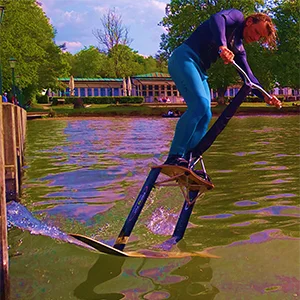
- Start with the intended launch. Proxyfoil’s described start is from the shore, with a strong forward-pushing step. Commit to the step, then transition immediately into a smooth pump to glide rhythm.
- Treat the handlebars as a stabilizer, not an engine. Your legs create the propulsion. Your hands keep the platform quiet.
- Pick easy and calm water first. Flat, clear water shortens the learning curve, allowing you to focus on timing rather than reacting to chop.
- Give yourself wingspan room. A wide wingspan demands more clearance around swimmers, docks, and shore hardware than most pump setups.
- Keep early sessions short. This is a full-body workout, and fatigue is when timing errors happen.
Skills Ladder
Beginner
- You learn the shore start hydrofoil sequence first: a strong forward-pushing step, immediate balance on the platform, then a steady pump to a glide rhythm.
- You build foil balance and rhythm with small, consistent up-and-down movements. The downstroke loads the foil, the upswing unloads it, and that cycle creates propulsion.
- You focus on straight-line control and safe bails close to shore. Proxyfoil is designed to be 100% body powered, so stopping your movement ends the run.
- Milestone: first sustained ride. Proxyfoil says that learning takes about 5 sessions before your first ride.
Intermediate
- You extend your runs by smoothing cadence. Your goal is efficiency, not power, so you spend more time gliding between pumps.
- You begin carving on a pump foil by keeping the platform stable while you steer the foil up and down through turns.
- You start using it as intended for flatwater pump foiling and carving.
Advanced
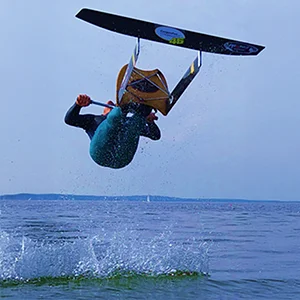
- You move into higher-energy riding: sharper turns, jumps, backflips, and more aggressive direction changes, while keeping the same pump-to-glide engine.
- You refine handlebar control so the bar stabilizes and steers without becoming a crutch.
Niche Specific
Proxyfoil is not a foiling discipline in the usual sense. It is a singular product, positioned as a self-powered hydrofoil you ride without towing, wind, or a motor. Due to its unique take on self-powered foils, we've given the Proxyfoil its own page. It fits in the same general discipline as scoot pump foiling.
It is a handlebar hydrofoil with a shore-start focus. The start method is a strong, forward-pushing step from shore.
It is built around a compact, integrated platform hydrofoil rather than a modular foil board plus separate foil parts.
Proxyfoil is described as “without a back wing” and still good-natured to ride, which aligns with the mono-wing idea, as it does not use a fuselage or a rear stabilizer.
Common Problems
Stalling after takeoff
- What happens: you get moving, then lose speed because your pump rhythm breaks.
- Fix: shrink the motion and make it continuous. Proxyfoil propulsion comes from the repeated load-and-release cycle, so consistency matters more than effort spikes.
Overusing your arms
- What happens: you pull on the handlebars to create lift, fatigue quickly, and destabilize the platform.
- Fix: legs drive the pump foil; hands stabilize and steer. Proxyfoil is meant to be moved up and down to create propulsion using the legs, not hauled upward by the arms.
Shore-start depth mistakes
- What happens: you start too shallow, risk striking bottom, or lose balance during the first step and hop.
- Fix: choose a clean entry with enough depth for immediate clearance, then commit to the forward pushing step and first pumps.
Not leaving enough clearance for the wing.
- What happens: you try to ride too close to swimmers, docks, or shoreline obstacles.
- Fix: give it room. A 1.4 m wingspan demands extra lateral clearance compared with many compact pump setups.
Expecting instant proficiency
- What happens: riders assume it will feel natural in one session and get frustrated.
- Fix: plan a short progression block. Proxyfoil expects roughly 5 sessions to reach the first-ride milestone.
History
- Proxyfoil is associated with Jan Grebe in Germany.
- Inventor Jan Grebe stated that the first idea emerged around 2004.
FAQs
Is Proxyfoil a real foiling discipline?
Proxyfoil is best understood as a brand and a single product concept, not a broad discipline with standardized gear categories. It fits within the scootpump foiling discipline.
Does it need wind, waves, or towing?
No. It is powered by your body. You use your legs to drive it forward.
How do you start it?
You start from the shore with a strong forward-pushing step, then immediately transition into a pump-to-glide rhythm.
How long does it take to learn?
Proxyfoil says that learning takes about 5 sessions before your first ride.
What speeds does it reach, and what does it cost?
The average speed is about 17 km/h with a maximum of about 23 km/h. The listed shop price range is 1999-2499 EUR, depending on the complexity of the custom build.
Which Foiling Freaks are into The Proxyfoil
-
 Gritch Spindlewick
He always draws the short straw. Checkout Gritch Spindlewick's merch page.
Gritch Spindlewick
He always draws the short straw. Checkout Gritch Spindlewick's merch page.
Flying Over Water With This Invention? Simply Brilliant.
Follow inventor Jan Grebe's human-powered hydrofoil concept, a steerable board designed to let riders glide across calm water using muscle power alone. It explores the design's long development history, how it compares with pump foiling, and how both experienced and first-time riders respond to it.
Got something to say about this foiling discipline? Tell us. We'll give it to Rocco to chew on. He likes insightful feedback based on facts and new ideas; personal opinions...