Windsurf Foiling
What is Windsurf Foiling (Windfoiling)?
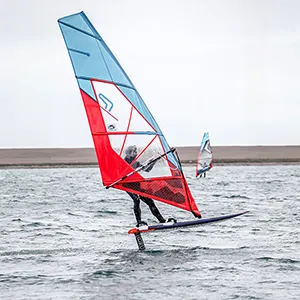
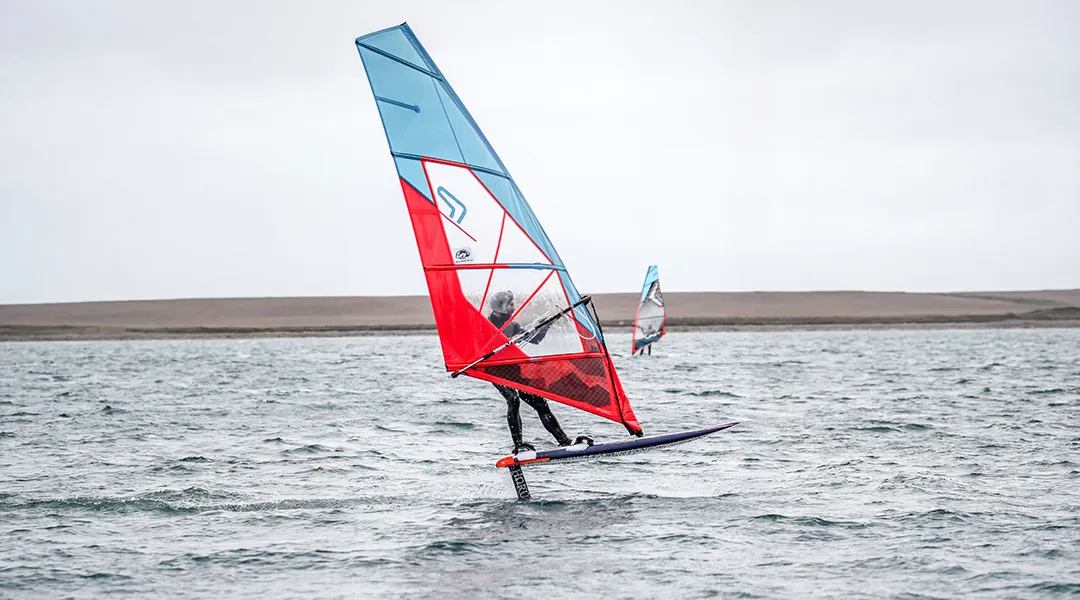
Windsurf foiling, also called windfoil or hydrofoil windsurfing, is windsurfing on a board fitted with a hydrofoil. Instead of skimming on the board’s hull, you ride above the water on a submerged wing. This lift reduces hull drag, allowing you to foil in lighter wind and maintain speed efficiently.
A windfoil uses the same board, mast base, rig, and harness lines as regular windsurfing, but with a foil below the board. The foil lifts as water flows across its front wing. You control height mainly by adjusting weight and rig power. Done well, wind foiling is silent, low-friction sailing with a broad wind range.
Windsurf foiling also has a deep competitive side. Foil racing is now an established part of windsurfing competition, including the iQFoil one-design class used at the Olympic level.
Who is into windsurf foiling?
If you are into windsurf foiling, make sure to drop your pin on the Foilers Pin Map and help windsurf foiling claim the leaderboard. Check the pin map and leaderboard for how many people into windsurf foiling have marked themselves on the map.
Be more than just a dot on the map. Join the Foiling Freaks community and create your own foiling profile with a custom handle, rider photos, videos, disciplines, bio, and more.
How it Works
The power source is wind. The sail acts as an airfoil, generating aerodynamic force that drives the board forward. Forward speed creates water flow over the hydrofoil wing, which generates lift. As the lift builds, the board rises until the hull clears the surface, and you are fully foiling.
A typical launch and ride sequence looks like this
- Launch and get moving: You start like standard windsurfing, either uphauling or waterstarting, depending on conditions and your skill. You sail off on a reach to build speed and stabilize the rig.
- Build speed and load the foil: Once you have steady board speed, you sheet in and use efficient rig handling to increase drive. Harness lines become important because they let you hold consistent sail power without exhausting your arms.
- Takeoff: As the lift approaches takeoff, you reduce unnecessary board drag by keeping the board flat and stable. Many riders use controlled sail pumping and subtle board pumping to accelerate through the takeoff threshold, then immediately shift to smooth pressure control to prevent over-lifting.
- Flight control: On foil, you steer mainly with sail trim, body position, and fine pressure changes through your feet. Height control is pitch control: more front-foot pressure generally settles the foil down, more back-foot pressure generally lifts it, and both require constant micro-adjustments, especially when foiling in chop.
- Transitions: A foil jibe and foil tack are direction changes performed while staying airborne. They demand steady speed, deliberate rig handling, and calm pitch control through the carve and rig flip.
What Makes it Different
In windsurf foiling, the focus shifts from “planing and edging” to “pitch management and flight stability.” Traditional fin sailing tolerates abrupt power shifts; foil windsurfing punishes them. Sudden movements can cause breaching or touchdown.
Compared with wing foiling, windsurf foiling uses a fixed rig on a mast base with a boom and harness lines. That gives you strong upwind angles and efficient long-distance cruising, and it lets you lock in consistent power with a very stable body position. It also changes how you handle gusts: you manage gusty wind foiling primarily through rig depower, stance, and flight height rather than by repositioning a handheld wing.
Equipment differences also matter
- Board design: A windfoil board is typically wider and more stable than many other foil boards because it needs to support a rig, footstraps, and repeated takeoff loads. Many are built around reinforced foil mounting systems.
- Foil mast length and stiffness: Windsurf foiling often uses longer masts than surf foiling because you need clearance to fly through surface chop while holding speed. Common windfoil mast lengths are typically in the 85-95 cm range.
- Sails and wind range: Windfoil sail choice depends on rider weight, wind strength, and goals. Competitive iQFoil racing uses standardized sail sizes, highlighting how standardized and performance-driven the discipline can be.
- Technique focus: Upwind foiling, smooth, stable foil jibe execution, and control in foiling in chop are central skills.
Safety and Etiquette
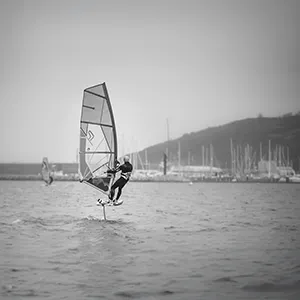
A windsurf foil adds speed and introduces a sharp, heavy underwater structure. Your biggest risks are foil contact, high-speed falls, and collisions with other water users.
Safety priorities
- Protective gear: A helmet and an impact vest are common-sense protection for foil windsurfing because falls can be sudden and the foil is unforgiving.
- Spacing: Give yourself far more room than you think you need, especially while learning. Beginners drift downwind more, make unpredictable turns, and crash more often.
- Shallow water management: Avoid shallow launches and unknown bottoms. A windfoil mast is long, and striking the bottom at speed can cause violent stops and damage to equipment.
- Fall strategy: When you crash, get away from the board and rig, protect your head, and surface carefully before retrieving gear.
Etiquette and right of way
- Follow established sailing right-of-way rules. In windsurfing practice, the key ideas are that a board on starboard tack as right of way over port tack, windward keeps clear of leeward when on the same tack, and overtaking riders keep clear.
- Do not foil through crowded swimming areas or tight launch zones. Foils and crowds do not mix.
- Be conservative around learners. If you are experienced, take the burden of avoidance. If you are learning, stay out of busy traffic lanes until your control is reliable.
Starter Guide
Windsurf foiling is easiest for someone who already windsurfs confidently. If you cannot yet sail upwind reliably, control your speed on a reach, and recover from common balance errors, learn those basics first. Foil windsurfing magnifies mistakes.
Minimum beginner gear list
- Foil-ready windsurf board suitable for stable starts
- Complete windsurf foil (mast, fuselage, front wing, rear wing, and mounting hardware)
- Windsurf rig (sail, mast, boom, extension, mast base)
- Harness and harness lines to manage sustained power
- Safety gear: helmet, impact vest, exposure protection appropriate to your water temperature
Cost ranges
- Complete foil sets typically cost from the low thousands to several thousand dollars, depending on construction and performance.
Difficulty and learning curve
- Difficulty: Moderate for an experienced windsurfer, high for a complete beginner to wind sports.
- Early progression: Many riders start with short flights, then learn to extend them by stabilizing pitch and reducing over-sheeting.
- Next milestones: Comfortable upwind foiling, controlled flight in chop, and a consistent foil jibe. A foil tack takes longer because it requires balance through the rig flip.
How to get started efficiently
- Choose forgiving conditions: flat water or small chop, steady wind, and plenty of open space.
- Practice short, repeatable drills: controlled takeoffs, stable low-altitude flight, touch-and-go without drama, then longer reaches.
- Study technique: watch how-to videos focused on windfoil technique, especially takeoff control, gust management, and foil jibe fundamentals.
- Find local knowledge: connect with a local wind sports community through social media or local sailing circles so you can learn site hazards, best launch areas, and common etiquette at your spot.
- Use forums wisely: join windsurfing forums and foiling discussion boards to troubleshoot setup and technique, but validate advice against your local conditions and your current skill level.
Gear Selection
A windfoil setup is built around three systems: the windfoil board, the rig, and the foil.
Boards
- Beginner-friendly windfoil boards are typically wide for leverage and stability. As a practical baseline, boards need to be over 70 cm wide, and 80 cm or more is generally better once you are using larger sails, because you can hold the foil down and control lift with less effort.
- Volume is chosen so you can uphaul reliably and stand comfortably while the board is not moving. Competitive race class boards can be very high-volume; for example, the iQFoil class board is listed at around 196 L with a width of 0.95 m.
Foils
- Mast length: windsurf foiling commonly uses 85 cm or 95 cm, and longer masts like 105 cm exist. Longer masts help in foiling in chop because you have more clearance before the wings ventilate.
- Front wing area: freeride learning foils are commonly in the 1450-1750 cm² range because they lift early and remain stable at slower speeds.
- Racing-oriented wings: are much smaller and faster, with iQFoil using 800- and 900-cm² front wings in its standard equipment lineup.
- Fuselage length: Many windsurf foil fuselages sit around 70 to 90 cm, while long race-style fuselages can reach about 115 cm. Longer fuselages add pitch stability and make upwind foiling easier, at the cost of more drag and slower turning.
- Stabilizers: larger stabilizers and longer fuselages are your stability tools for learning. Smaller stabilizers and shorter fuselages feel looser and turnier but demand a cleaner windfoil technique.
Sails and rigging
- Windsurf foiling uses the same rig types as windsurfing, but foil windsurfing rewards rigs that stay stable when you sheet in and out repeatedly.
- Sail size depends on wind strength, rider weight, and foil size. In iQFoil racing, the sail sizes are standardized, and US Sailing notes that in January 2025, the class moved to 8.0 m² for men and 7.3 m² for women.
- Harness lines are required for sustained wind foiling. They let you hold steady power, keep the rig quiet, and prevent arm fatigue from turning into control mistakes.
Common extras
- Impact vest and helmet.
- Foil covers for transport.
- A small tool kit for track bolts and shim changes.
- Uphaul line and mast base spares.
Conditions
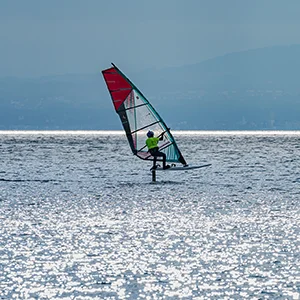
Windsurf foiling thrives when the wind is strong enough to create steady board speed and consistent lift, but not so violent that every gust spikes the foil out of the water.
Good conditions
- Steady wind with room to sail long reaches.
- Flat water to moderate chop while learning. Flat water makes takeoff, height control, and the first foil jibe far easier.
- Clean wind direction with predictable lulls and gusts. Gusty wind foiling is manageable, but it requires disciplined sheeting and height control.
Challenging conditions
- Heavy boat traffic and crowded launch zones. Windfoils move fast and need space.
- Steep, confused chop when you are still learning to control pitch. Longer masts help, but technique matters more.
- Very shallow water. A windfoil mast is long, and bottom strikes are expensive and dangerous.
Windfoil equipment and racing culture exist because the wind range can be huge. The iQFoil class covers speeds from 5 knots to 35 knots, using one board and one foil system in its race format.
Where to Go
Windsurf foiling works anywhere you can get clean wind, safe depth, and long reaches. The best locations typically fall into a few categories.
When choosing a spot, prioritize depth, safe downwind landing options, and enough space to focus on flight control rather than collision avoidance.
Inland lakes
- Thermal wind lakes can be outstanding because you get predictable daily wind cycles and relatively smooth water in the right areas. Lake Garda is famous for reliable thermal winds and is widely described as a “wind machine.”
Large rivers and estuaries
- Big rivers can offer strong wind corridors and long runs. The Columbia River Gorge around Hood River is widely known as a major windsurfing hub and has long been called a windsurfing capital.
- Expect current, swell lines, and heavy traffic in peak season.
Ocean bays and coastal venues
- The best ocean venues combine steady wind with manageable sea state and clear launch lanes. Maui is repeatedly cited for consistent trade winds and iconic windsurfing sites like Kanaha and Ho‘okipa.
Setup and Tuning
Windsurf foiling responds dramatically to small setup changes. Treat tuning as part of your windfoil technique.
Foil position in the tracks
- Foil forward: earlier lift and easier takeoff, but can feel more pitch sensitive at speed.
- Foil back: more control at higher speed and in high wind conditions, but requires more speed and a cleaner technique to take off.
Stabilizer angle with shims
- More “lift” in the tail setting makes takeoff easier and can calm stall-prone low-speed flight, but it usually adds drag and limits top speed.
- A less tail lift reduces drag and increases speed potential, but you must manage pitch actively and keep the foil flying efficiently through transitions like a foil tack.
Stabilizer size
- Bigger stabilizers give a wider stability envelope for learning, foiling in chop, and early foil jibe work.
- Smaller stabilizers loosen the feel and improve speed, but punish sloppy foot pressure.
Fuselage length
- Longer fuselages increase pitch stability and help lock in upwind foiling angles, but feel less playful. Typical fuselage lengths are 70 to 90 cm, with long-race options around 115 cm.
Rig tuning and harness lines
- Set harness lines so you can sail sheeted in without fighting the rig. If you are constantly pulling with your arms, you will overcorrect and bounce the foil.
- For gusty wind foiling, tune for controllable depower so you can sheet out slightly without the rig becoming unstable.
Tips and Tricks
- Learn to fly low first. Low altitude gives you a margin before a breach and forces you to control pitch instead of chasing height.
- Use speed as your stabilizer. Many beginners try to “float” slowly. A windsurf foil performs better when the water is calm and the flow is consistent.
- Sheeting discipline beats brute force. In gusts, ease the sail slightly and add front foot pressure to keep the foil from climbing. In lulls, keep the rig efficient and build speed before you work on height.
- Foot pressure is steering and suspension. Small front-foot inputs settle the foil and prevent porpoising. Small back-foot inputs create height but must be matched with sail control.
- Make your foil jibe a two-part goal. First, jibe with a controlled touchdown. Second, jibe while staying airborne. Trying to force a full flying jibe too early usually slows progress.
- Foil tack later than you think. A foil tack demands clean balance through the rig flip while maintaining speed. Build a reliable flying jibe and strong upwind foiling first.
- Commit to harness lines early. They stabilize your upper body, improve efficiency, and reduce the reflex to yank the rig when the foil starts to rise.
Skills Ladder
Beginner
- Prerequisites: You already sail confidently in the straps and harness, can waterstart in your usual range, and can control speed and direction without fighting the rig. Windsurf foiling punishes sloppy stance and uncontrolled power spikes.
- First flights: You learn to sheet in smoothly, build speed on a reach, then let the foil lift you with minimal effort. Your first success is not height, it is stable, low flight with controlled touchdowns.
- Core skills: stance quietness, micro front foot pressure for height control, and clean depower in gusts. Harness lines serve as a primary control tool because a steady rig load produces steady foil lift.
Intermediate
- Sustained flight: You can ride long reaches fully foiling, adjust height over chop, and stay comfortable while the water surface changes. This is where foiling in chop becomes a real skill.
- Upwind foiling: You learn to fly with a slightly lower, more efficient height, maintain speed, and point high without over-sheeting. The goal is lift management, not brute force.
- Transitions with touchdowns: You begin jibes by briefly touching down, staying controlled, and immediately lifting back onto foil.
- Gear evolution: You typically move from maximum stability toward more speed and maneuverability. That often means downsizing the front wing and stabilizer, and using tuning changes that reduce excessive lift and drag.
Advanced
- Foil jibe: You complete a foil jibe, staying airborne, carving smoothly, flipping the rig without losing speed, and exiting stably at low altitude.
- Foil tack: You complete a foil tack on foil with clean rig handling and balance through the switch. This is one of the highest coordination milestones in foil windsurfing.
- High wind windfoil control: You manage gusty wind foiling without breaching, keep the foil settled, and depower instantly while staying in control.
- Racing skills: Starts, lanes, and tactics become decisive. Foil racing is established at the pro level.
Niche Specific
Windsurf foiling is unique because the power source is a fixed sail rig anchored to the board, not a handheld wing. That changes everything about control. You lock into harness lines, sheet with precision, and use a stable stance to create a steady drive. When the rig is quiet, the foil is quiet.
The discipline is also uniquely strong at upwind foiling. A windfoil can fly at high angles to the wind because the rig and finless foil system can generate efficient lateral resistance while staying fast. This is a major reason windfoil racing took off quickly once modern racing foils became stable and efficient enough for a wide wind range.
Finally, windsurf foil competition has a defined, global pathway. iQFoil is the windsurf foiling class selected for Olympic windsurfing, and it was built specifically to meet a broad wind range and performance requirement for that level of racing.
Common Problems
Breaching in gusts
- What it is: the foil rises too high, the wing nears the surface, then ventilates and drops.
- Fix: fly lower, add front foot pressure early, and sheet out slightly instead of fighting the rig. In persistent overpower, reduce sail power or tune for less lift.
Porpoising and pitch oscillation
- What it is: repeated up and down bouncing caused by overcorrecting height.
- Fix: slow your inputs. Keep your hips steady, pressure changes small, and use the harness to keep rig load consistent. If the setup is too pitch-sensitive, tune for greater stability by adjusting fuselage length, stabilizer choice, or tail angle, if your system allows it.
Ventilation in chop
- What it is: air gets sucked down from the surface to the wings, often after a high ride height or a sudden breach in foiling in chop.
- Fix: keep the foil deeper, avoid carving too sharply while too high, and maintain speed so the foil stays loaded and stable.
Struggling to take off
- What it is: you have power but cannot generate the clean acceleration needed for lift.
- Fix: bear off to a fast reach, build speed first, then let the foil lift you. Many riders fail by trying to climb upwind too early or by pumping aggressively without stable board speed.
Foil jibe failure by stalling
- What it is: you enter the turn high or slow, lose speed mid-carve, then touch down hard.
- Fix: enter faster than you think you need to, fly low, keep the rig driving longer into the carve, and prioritize a smooth radius. Early success is a controlled touchdown jibe that lifts again, then you work toward a full foil jibe.
Foil tack failure by balance loss
- What it is: you run out of speed during the rig flip and fall off the foil.
- Fix: delay learning the foil tack until upwind foiling and foil jibe fundamentals are solid. When you do train it, keep the sail driving longer, keep the foil low, and treat the rig flip as a controlled sequence, not a jump.
World Records
Fastest officially timed 500 m windfoil speed (men)
- Current record: Nicolas Goyard posts 37.19 knots on the official Prince of Speed windfoil course. Holder: Nicolas Goyard
Fastest publicly reported 500 m windfoil speed (women)
- Current record: Justine Lemeteyer reaches 31.78 knots over 500 m in women's windfoil speed - 31.78 knots. Holder: Justine Lemeteyer
- Previous record: Blanca Alabau reports 31.66 knots over 500 m in women's windfoil speed - 31.66 knots. Holder: Blanca Alabau
Fastest solo windfoil crossing of the Baltic Sea from Sweden to Poland
- Current record: Maciek Rutkowski crosses the Baltic in 8 hours 28 minutes on windfoil. Holder: Maciek Rutkowski
Fastest windfoil circumnavigation of the Isle of Wight
- Current record: Ben Clothier records 5 hours 9 minutes around the Isle of Wight on windfoil. Holder: Ben Clothier
Greatest windfoil distance in a 24-hour challenge window
- Current record: Jean Le Gall completes a 561.6 km windfoil distance challenge in a 24-hour window - 561.6 km. Holder: Jean Le Gall
- Previous record: Frédéric Houdier reports 571 km in a windfoil distance challenge - 571 km. Holder: Frédéric Houdier
Highest one-second windfoil peak speed
- Current record: Nicolas Goyard claims a 42-knot one-second windfoil peak. Holder: Nicolas Goyard
Know about a broken record, an update needed to an existing world record, or a brand new world record that deserves to be in the public record? Submit it.
World Firsts
- First men's Foil PWA World Champion: Nicolas Goyard becomes the first men's Foil PWA World Champion. Holder: Nicolas Goyard
- First Olympic gold medalist in men's iQFOiL windsurfing: Tom Reuveny becomes the first Olympic men's iQFOiL windsurfing gold medalist. Holder: Tom Reuveny
- First Olympic gold medalist in women's iQFOiL windsurfing: Marta Maggetti becomes the first Olympic women's iQFOiL windsurfing gold medalist. Holder: Marta Maggetti
- First hydrofoil windsurfer: First hydrofoil windsurfer appears in 1979 - John Speer. Holder: John Speer
- First windfoil crossing of the Baltic Sea from Sweden to Poland: Maciek Rutkowski completes the Sweden-to-Poland Baltic Sea windfoil crossing. Holder: Maciek Rutkowski
- First windfoil run above 40 knots over 2 seconds: Nicolas Goyard crosses 40 knots over 2 seconds on a windfoil. Holder: Nicolas Goyard
- First solo windfoil circumnavigation of the Isle of Wight: Ben Clothier completes the first solo windfoil Isle of Wight circumnavigation. Holder: Ben Clothier
- First PWA foil World Cup event winner: Thomas Goyard wins the first PWA foil World Cup event. Holder: Thomas Goyard

Know about a broken record, an update needed to an existing world first, or a brand new world first that deserves to be in the public record? Submit it.
History
Hydrofoil windsurfing experiments go back decades. John Speer is “probably the first” to use a hydrofoil on a windsurfer in 1979, followed by other designs, including Joop Nederpelt in 1980, Peter Harken in 1985, and Rich Miller in 1997.
Modern windsurf foiling became established as a mainstream discipline when lighter composite foils, stronger board-mounting systems, and refined racing geometry made foiling reliable across a wide range of wind conditions. By 2018, foiling had a dedicated, top-level competitive format, with the PWA running the first official PWA Foil World Championship.
In 2019, foil racing continued to formalize with major championship events, including the first Formula Windsurfing Foil World Championships.
That same Olympic cycle, World Sailing’s equipment selection process moved toward foiling for the windsurfer event. World Sailing’s council decisions in 2019 show the windsurfer equipment was under reevaluation and required a new proposal, and later that year, the iQFoil package was approved as the equipment for Olympic windsurfing at Paris 2024.
iQFoil then developed its own world championship pathway. The iQFoil class site notes that the first official iQFoil Senior World Championships were held in 2021 at Lake Silvaplana, Switzerland.
FAQs
How much wind do I need for windsurf foiling?
You can foil in less wind than traditional planing windsurfing because the foil reduces hull drag once flying. The exact minimum wind depends on rider weight, windfoil sail size, foil area, and technique. At the racing level, iQFoil is designed to cover a very wide wind range for competition formats.
Can I use my existing windsurf board?
Only if it is structurally built for a windfoil setup. Foiling loads are high, and you need a reinforced foil mounting system. If the board is not foil-ready, it probably shouldn’t be retrofitted.
How deep does the water need to be?
Deeper than your windfoil mast length, plus margin for chop and rider error. If you are on a mast 85 to 95 cm, treat 1 meter as a minimum starting point and add more if the surface is rough.
What is the hardest transition, foil jibe or foil tack?
For most riders, the foil tack is harder because it demands a clean rig flip while maintaining speed and balance through the highest instability point. A foil jibe is usually learned earlier, often first as a controlled touchdown jibe and later as a full flying foil jibe.
Why do my legs burn out so fast when I start windfoiling?
Because beginners try to hold the rig with their arms and brace with their legs, this creates constant pitch corrections. Set harness lines correctly, commit to riding the harness, keep the rig quiet, and fly low so you make small corrections instead of big ones.
Which Foiling Freaks are into Windsurf Foiling
-
 Blackjack Nocturne
Most monsters just call him Jib. Checkout Blackjack Nocturne's merch page.
Blackjack Nocturne
Most monsters just call him Jib. Checkout Blackjack Nocturne's merch page.
-
 Jasper & Casper
Two Heads. One Rig. Zero Arguments (Mostly). Checkout Jasper & Casper's merch page.
Jasper & Casper
Two Heads. One Rig. Zero Arguments (Mostly). Checkout Jasper & Casper's merch page.
Windsurf Foiling - Lake Como
A perfect day of wind and foiling, flying over the water with speed and lightness. Colico is one of the most famous wind spots on Lake Como, where the thermal winds create the ideal conditions for windsurfing and foiling.
If you know this discipline inside and out and want to help review and or edit the info on this page, drop us a line. We will credit you as a reviewer or editor and set you up with a proper bio page with links back to your site.
We could use a few more high-quality images to illustrate this discipline. If you have shots you own and are willing to share, contact us for where to send them. Bonus if you also credit the rider and give us a URL to link back to you.