Downwind Foiling
What is Downwind Foiling?
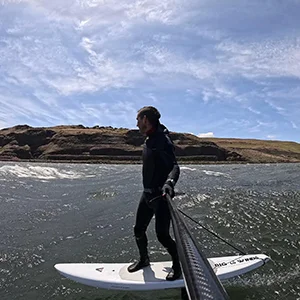
Downwind foiling, also called downwinding, is open-water hydrofoiling where you travel with the wind direction and use wind swell and rolling ocean bumps as your “track.” The goal is sustained, long-distance foiling by linking bumps and gliding for minutes at a time, rather than riding short, breaking waves.
A downwind session starts upwind and finishes miles down the coast, lake, or river corridor, with the run defined by distance, route, and conditions rather than a single wave. The ocean is your playground due to its long, organized wind swell, but large lakes and wide rivers with aligned wind and fetch also offer usable waves.
The essential tool is the downwind foil board: long, narrow, and high-volume to provide a stable stance, efficient paddling, and fast acceleration for lift onto the foil. These boards are designed to chase open-ocean swell and remain steady during takeoff and balance efforts.
Who is into downwind foiling?
If you are into downwind foiling, make sure to drop your pin on the Foilers Pin Map and help downwind foiling claim the leaderboard. Check the pin map and leaderboard for how many people into downwind foiling have marked themselves on the map.
Be more than just a dot on the map. Join the Foiling Freaks community and create your own foiling profile with a custom handle, rider photos, videos, disciplines, bio, and more.
How it Works
Power source: downwind foiling is mainly driven by wind-generated swell and rider effort. Wind forms traveling bumps, the foil turns speed into lift, and the rider adds quick paddle strokes and downwind pumping to stay connected through slower sections. A parawing may also be deployed to harness wind energy.
A typical launch-to-ride sequence looks like this
- Set a downwind route with an upwind start and a safe downwind finish, and choose water deep enough for your mast.
- Paddle to accelerate the board. The long, narrow outline and efficient hull help you build speed and track straight.
- As the foil lifts, shift to foil control and foil balance: keep the board level, control pitch, and stabilize roll while you settle into a foil glide.
- Once on foil, read the water and target energy lines: ride one bump, then connect to the next by staying efficient, preserving speed, and using brief, well-timed pumps instead of big, tiring efforts.
- Downwind foiling is sometimes combined with a small handheld parawing to make takeoffs easier or add range when the bumps soften.
What Makes it Different
Downwind foiling differs from surf foiling and wing foiling because the mission is distance and efficiency, not tight turns in a pocket or powered reach-and-return sessions. It prioritizes foil efficiency, foil speed management, and the ability to stay flying across messy water for long stretches.
Board design and volume
Downwind boards are notably longer and narrower than most wing boards. Sizes commonly range from 6’6” to 9’0” in length, about 19” to 24” wide, with downwind foil board volume typically 85 L to 145 L, depending on rider size and goals.
That extra length and volume improve paddling speed, tracking, and foil stability during takeoff attempts, which is the hardest part of the downwind foil beginner progression.
Foil setup
A downwind foil setup typically favors glide and low stall speed, so you can keep flying between bumps. Higher-aspect front wings are commonly used because they increase glide and efficiency for connecting bumps, with the tradeoff of less snappy turning compared to lower-aspect surf-oriented foils.
Mast length
Downwind foil mast length is a matter of clearance and control. In open water, chop and downwind bumps, longer masts are widely used because they help keep the wing submerged through surface turbulence, but they demand deeper water and can make falls higher-consequence.
Foot straps
Some riders use foil foot straps for security at speed and in rough water, but many downwinders stay strapless to step around during paddle-ups and to reduce injury risk in crashes.
Safety and Etiquette
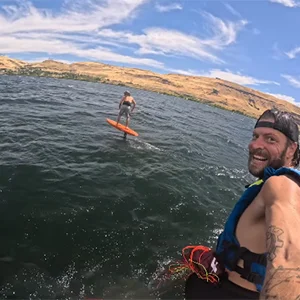
Downwind foiling is open-water travel. Main hazards include separation, impact, exposure, navigation risks, and the occasional shark.
Key hazards and mitigation
- Separation from your board: a foilboard can drift away quickly because the foil and board catch wind. Use a reliable downwind foil leash, and prefer quick-release systems for open water so you can detach if you get tangled or dragged.
- Impact risk: hydrofoils are hard and sharp-edged, unlike most boardsports. Wear a watersports helmet and an impact or flotation vest, especially while learning and in choppy water.
- Drowning and exhaustion: wear an appropriate PFD and test-fit it in the water to ensure it performs correctly and does not ride up.
- Dress for immersion, not just air temperature. Downwinders quickly take you far from launch, and rescue is not guaranteed.
- Communication and visibility: carry at least one reliable method to call for help in a waterproof setup, and use sound or light signals suited to your area and timing.
- Legal and shared-water awareness: When a paddleboard is operated outside a surf, swimming, or bathing area, the U.S. Coast Guard treats it as a vessel for regulatory purposes, which affects the required carriage of safety equipment. Check the regulations in the country or area you are operating in.
Etiquette rules that prevent collisions
- Stay out of crowded swim areas and give swimmers plenty of space. A foil needs space.
- In surf zones, follow standard surf right-of-way: the rider closest to the breaking peak has priority, and dropping in creates high collision risk.
- Do not bring motorized foils into surf lineups or crowded breaks. Keep powered craft separated from human-powered surf traffic.
- When overtaking or crossing paths, assume others do not know your course. Make your path clear, slow down early, and yield.
Starter Guide
Difficulty: advanced overall. Downwind foiling demands foil control, paddle-up or assisted takeoff skill, and open-water judgment. It has a steep learning curve because ocean energy is always moving and unpredictable.
Minimum gear list for a downwind foil beginner
- A downwind foil board with enough volume for stable stand-up paddling and repeated takeoff attempts.
- A hydrofoil tuned for glide and low stall speed.
- Paddle (for downwind SUP foil and downwind paddle foil approaches).
- Quick-release board leash suitable for open water.
- PFD that fits and works for you in-water, plus a watersports helmet.
- Provide water temperature protection and establish a basic signaling and communication plan.
Cost ranges (new gear, typical retail)
- Downwind foil boards typically cost $1,000 to $3,600 USD, depending on construction and design.
- Complete hydrofoil kits typically list for $1,900 to $2,650 USD, while individual components like masts and front wings can run into the high hundreds or well over $1,000, depending on materials.
- Used-gear pricing varies too widely by region and condition for me to give a reliable factual range.
- Downwind foilers typically have a quiver of wings for different riding conditions, which increases overall cost.
Learning curve and downwind foil progression plan
- Build foil control first in protected water: consistent takeoffs, stable straight-line flight, controlled touchdowns, and safe falling habits.
- Learn paddle-up mechanics: stance, cadence, and timing the lift as the board accelerates.
- Start with short runs in forgiving foil conditions downwind: moderate, organized bumps, plenty of depth, and a simple bailout plan.
- Train the two core downwind skills: bump reading and pumping the foil to link bumps without burning out.
- Scale distance last: Longer ocean downwind run goals come after you can reliably relaunch on foil and maintain efficiency through dead sections.
Getting started
- Watch multiple how-to videos focused on paddle-ups, linking bumps, and safe downwind logistics, then practice one skill per session.
- Find experienced local riders through foiling and paddlesports communities on social platforms, and get mentorship for route selection and safety planning.
- Keep early sessions conservative. Downwind foil tips that matter most are the unglamorous ones. Conservative conditions, reliable leash and PFD habits, and a finish plan you can execute even if you never get on foil.
Gear Selection
A true downwind foil setup starts with a purpose-built downwind foil board that paddles fast, tracks straight, and stays stable when you stand up in moving water. The common design is long, narrow, and high-volume, so you can accelerate with a paddle, pop onto foil, and then settle into a stable foil glide to link bumps. Board lengths around 7 to 9 feet are widely used for downwind SUP foil-style boards, with widths typically narrow enough to be efficient but still manageable for balance.
Volume matters more than almost anything for a downwind foil beginner because you will do a lot of repeated paddle-ups and remounts. A reliable rule of thumb is to size volume above your body weight in kilograms, with beginners typically needing substantially more float than advanced riders. If you are 70 kg, that often lands around the 110 L neighborhood for early learning, with intermediate and advanced riders stepping down as their takeoff consistency and foil control improve.
For the foil itself, downwind conditions favor glide and a low stall speed. Most riders use mid to high-aspect front wings because they carry speed well and let you connect ocean bumps without constant hard pumping. A common starting point for front wing area is roughly 1200 to 1600 cm², depending on rider weight and how powerful the wind swell is. Smaller wings can be faster and more agile once your downwind foil technique and pumping are efficient, but they demand cleaner timing and higher minimum speed.
Mast length is a balance between clearance and drag. In downwind foil conditions with chop and rolling bumps, longer masts give you more room to ride over surface turbulence without breaching, but they add drag and can make paddle-ups harder. Many downwinders settle in the 75-85 cm range as a practical middle ground, then adjust based on water depth and surface roughness.
Fuselage length and stabilizer size are your stability dials. A longer fuselage and larger stabilizer feel calmer and more predictable, which helps early progression and rough-water confidence. Shorter fuselages and smaller stabilizers reduce drag and feel more lively, which can improve foil efficiency and speed once your balance is solid.
Accessories are important for open-ocean foiling. At minimum, carry a downwind foil leash that stays out of the water and features a reliable quick release, plus a PFD, helmet, and immersion protection. Many riders also carry a waterproof communication device and basic signaling gear because downwinding is point-to-point, and you can quickly end up far from your launch.
Conditions
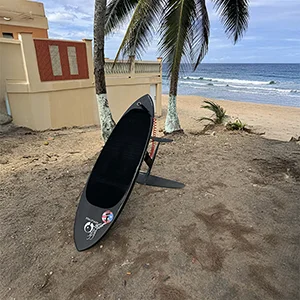
Good downwind foiling is powered by organized wind swell and enough wind to keep the bumps moving consistently in the same general direction. For early learning, steady wind in the 15 to 25 knot range is a common sweet spot because it produces usable bumps without requiring expert-level speed management, and it tends to line up swell direction in a way that supports long flights and linking bumps.
The best ocean bumps are spaced far enough apart that you can glide between them without constantly running up the back of the next swell. Short, tight, confused chop makes everything harder: takeoff timing gets messy, touchdowns become frequent, and fatigue spikes. Wind against swell, wind against current, or strong cross seas can turn an ocean downwind run into a survival exercise instead of an efficient foil run.
Traffic and obstacles matter as much as the wind. Busy boat channels, heavy personal watercraft activity, kelp beds, reef zones, and shallow sandbars all raise risk because you need room to fall, room to remount, and enough depth for your downwind hydrofoil mast. Visibility also matters: glare, rain squalls, fog, and low light increase navigation errors and make it harder for boats to see you.
Where to Go
Downwinding works anywhere you can safely do a point-to-point run with consistent wind, sufficient fetch to build wind swell, and a realistic takeout. Open-ocean coastlines with steady seasonal winds are the classic environment because they create long, rideable wind swell that supports gliding bumps and linking bumps for miles.
Several locations are widely known for downwind runs and downwind culture. Maui’s Maliko Run is one of the most famous downwind routes in the world for paddling and is frequently used as a benchmark for open-ocean downwind conditions. The Hawaiian islands also host major open-ocean crossings, such as Molokai to Oahu events, which highlight how established downwind routes can be when conditions and logistics are right.
Inland venues can be excellent when geography produces reliable wind and swell. The Columbia River Gorge is a well-known corridor for strong wind and river swell, with established downwind routes that vary in length and complexity and are shaped by both wind and current. In Europe, Tarifa is widely known for its strong winds and organized downwind sessions when conditions align.
Choose venues that have: a safe launch with room to assemble, a downwind takeout with easy landing, bailout points along the way, minimal conflict with shipping lanes, and enough water depth throughout the run for your mast length.
Setup and Tuning
Start with a neutral baseline so changes are meaningful. Put the mast in the middle of the track, use a stabilizer and fuselage that prioritize control, and choose a front wing that gives reliable lift at the speeds you can actually generate during paddle-ups and early glides.
The mast position is your first and simplest tuning lever. Moving the mast forward generally increases front foot pressure. Moving it rearward generally increases rear foot pressure. For downwind foiling, you want enough front-foot pressure that the foil doesn't feel pitchy when you accelerate on a bump, but not so much that your legs burn out or the board feels glued to the water during takeoff attempts. Make changes in small steps because a centimeter can be the difference between calm and exhausting.
Tail tuning and shims control the trade between early lift, pitch stability, and drag. Increasing stabilizer incidence typically adds support and pitch stability, which can make takeoffs and touchdowns calmer. Decreasing stabilizer incidence typically reduces drag and can improve foil efficiency and top speed, but it demands cleaner balance and more precise foil control in messy water.
Fuselage length and stabilizer size shape the feel of the foil. Longer fuselages and larger stabilizers make the setup more docile and stable, which helps early downwind foil progression and rough-water confidence. Shorter fuselages and smaller stabilizers reduce drag and make the foil more responsive, helping advanced riders maintain speed on faster bumps and keep the foil feeling free.
Mast length is not just about height. Longer masts give clearance in ocean bumps and allow smoother roll and pitch corrections without breaching, but they add drag and require deeper water. If your paddle-ups feel sluggish, mast drag is one place to look before you blame your technique.
Tips and Tricks
- Make the takeoff as easy as possible. Paddle for speed first, then stand. Many failed starts happen because riders stand too early, lose acceleration, and never reach flying speed. Your goal is repeatable, clean lift-off.
- Do not aim straight downwind and try to out-pump the ocean. Downwind speed comes from reading the water and taking efficient lines. When you point it straight and pump blindly, you tend to run up the back of bumps and get trapped high with nowhere to go. Use angles, look for gaps, and move around the energy instead of through it.
- Stay lower and faster, not higher and slower. In downwinding, altitude is not the prize. Speed is the prize. A slightly lower ride height often keeps the foil in denser, cleaner water, reduces breaches, and preserves glide when the surface is messy.
- Touch down early, on your terms. If you feel the glide dying and the next bump is not there, a controlled touchdown and quick paddle reset beats frantic pumping that ends in a crash and a slow remount.
- Train remounts and leash management like they are part of the sport, because they are. In open ocean foiling, your ability to get back on the board quickly and keep the board attached is a core safety skill, not an afterthought.
Skills Ladder
Beginner
You start by learning to manage the three fundamentals that make downwind foiling unique: paddle acceleration, clean takeoff timing, and stable flight in messy water. Your first milestone is a repeatable paddle-up to foil glide in flat to lightly textured water, followed by controlled touchdowns and quick remounts. Early downwind foil training focuses on stance discipline, keeping the nose from porpoising, and riding low enough for foil stability without breaching. Gear at this stage is intentionally forgiving: a high-volume downwind foil board that you can stand on comfortably, a front wing with low stall speed and strong glide, and a stabilizer and fuselage combo that feels calm rather than twitchy.
Intermediate
Intermediate downwinding is where you stop thinking about takeoff as the whole session and start thinking about linking bumps. You learn to read wind swell, choose lines that keep foil speed, and connect energy from one bump to the next with short, efficient downwind pumping instead of big, exhausting surges. You add reliable direction changes while flying, basic swell crossing skills, and the ability to recover speed after a touchdown without losing your route. Gear typically becomes more performance-oriented: slightly less board volume, a front wing that trades some low-end lift for more foil efficiency, and a smaller stabilizer or shorter fuselage if you want less drag and more glide.
Advanced
Advanced riders treat an ocean downwind run like a continuous problem of energy management. You link bumps through imperfect sections, handle cross-swell and current seams, and maintain foil control at higher speeds without overflying the foil. You can deliberately choose when to ride higher for clearance and when to ride lower for speed, and you can reset quickly after mistakes without spiraling into fatigue. Gear gets narrower and lower-volume, foils get faster and more glide-focused, and tuning becomes more precise because small changes in stabilizer incidence, mast position, and tail size noticeably affect foil balance and efficiency. At the highest level, riders expand the niche by combining downwinding with tools like parawinging to extend range and increase takeoff reliability in lighter wind.
Niche Specific
Downwind foiling is not a wave sport in the classic sense. It is open ocean foiling built around route choice, sustained glide, and linking bumps across moving terrain. The signature skill is converting uneven wind swell into continuous forward motion without an external power source once you are flying. That requires a unique blend of paddle craft, foil control, and real-time ocean reading.
The equipment reflects the niche. The downwind foil board is long, narrow, and buoyant because it is designed to accelerate under paddle power and release cleanly onto the foil. The technique is equally specific: you do not wait for a breaking wave, you hunt for energy lines, connect gliding bumps, and manage speed so the foil stays flying through lulls. The logistics are also niche-specific because downwinding is typically point-to-point, which means you plan launch, finish, and bailout options like a small expedition, not a lap in front of the beach.
Common Problems
Failure to get on foil
This is the number one problem for downwind foil beginners. Most misses come from standing too early, paddling with a short and frantic cadence, or trying to yank the board onto foil before you have real speed. Fix it by prioritizing acceleration first, then a stable, committed stand, then a smooth lift with the foil kept stable. If you consistently have speed but still cannot lift, your setup is likely too small or too draggy for your current skill and conditions.
Overpumping and early fatigue
Many riders treat downwind pumping like a strength test. That burns your legs and kills the run. The fix is efficiency: keep speed by choosing cleaner lines, pump only when the foil is loaded with energy, and use smaller, timed pumps rather than continuous bouncing. If you are pumping hard in dead water, you are usually on the wrong line.
Breaching and sudden crashes
Breaches happen when you ride too high, hit steeper bump faces, or get lifted by surface turbulence. The fix is to ride slightly lower when the surface is chaotic, keep your eyes farther ahead to anticipate pitch changes, and tune for pitch stability if your foil feels too sensitive. A longer mast can reduce breach frequency in rough water, but only if depth allows.
Getting knocked off line by cross-swell or current seams
Downwind foil control is hardest when the swell direction does not match the wind, or when the current creates standing waves. The fix is line choice and angle management. You rarely want to point straight downwind the whole time. Use slight angles to stay on the cleanest energy, then reconnect when a better bump line appears.
Leash tangles and board separation risk
Downwind foil leash problems usually show up during remounts and falls. The fix is to use a quick-release system appropriate for open water, keep slack out of the water when possible, and practice remounts until you can recover the board quickly without wrapping yourself in cord. Safety is an integral part of the discipline.
World Records
Longest tow-in foil ride distance on a single ocean swell
- Current record: Rush Randle's 10-mile single-swell tow-in foil ride. Holder: Rush Randle
Longest tow-in foil ride duration on a single ocean swell
- Current record: Rush Randle's 15-minute single-swell tow-in foil ride. Holder: Rush Randle
Fastest Molokai to Oahu men's downwind foil race time
- Current record: Edo Tanas sets the listed men's M2O foil record at 1:56:55 - 1:56:55. Holder: Edo Tanas
- Previous record: Edo Tanas wins the 2024 men's M2O foil race in 2:02:58 - 2:02:58. Holder: Edo Tanas
- Previous record: James Casey wins the 2023 men's M2O foil race in 2:19:02 - 2:19:02. Holder: James Casey
- Previous record: Kai Lenny lowers the men's M2O foil benchmark in 2019 - 2:29:38. Holder: Kai Lenny
- Previous record: Kai Lenny wins the 2018 Molokai to Oahu men's foil division - 2:52:58. Holder: Kai Lenny
Fastest Molokai to Oahu SUP foil crossing
- Current record: Fastest Molokai to Oahu SUP foil crossing. Holder: Kai Lenny
Fastest Molokai to Oahu men's wing-powered downwind foil race time
- Current record: Finn Spencer sets the listed men's M2O wing foil record at 1:31:29. Holder: Finn Spencer
Fastest Molokai to Oahu women's downwind foil race time
- Current record: Annie Reickert sets the listed women's M2O foil record at 2:19:51 - 2:19:51. Holder: Annie Reickert
- Previous record: Annie Reickert wins the 2024 women's M2O foil race in 2:27:12 - 2:27:12. Holder: Annie Reickert
- Previous record: Olivia Piana wins the 2023 women's M2O foil race in 2:57:01 - 2:57:01. Holder: Olivia Piana
- Previous record: Annie Reickert lowers the women's M2O foil time in 2019 - 3:20:22. Holder: Annie Reickert
- Previous record: Annie Reickert wins the 2018 women's M2O foil division - 5:20:06. Holder: Annie Reickert
Fastest Molokai to Oahu women's wing-powered downwind foil race time
- Current record: Lily Buden sets the listed women's M2O wing foil record at 2:08:03 - 2:08:03. Holder: Lily Buden
- Previous record: Nani Dalene wins the 2023 women's M2O wing foil race in 2:10:02 - 2:10:02. Holder: Nani Dalene
Longest continuous downwind foil flight without restart
- Current record: Erwan Jauffroy flies 156.5 km without stopping or restarting. Holder: Erwan Jauffroy
Longest paddle-powered downwind hydrofoil single-day distance
- Current record: Olivia Piana covers 287.4 km in a downwind foil mission - 287.4 km in 14h36m. Holder: Olivia Piana
- Previous record: James Casey completes 213 km downwind hydrofoil mission - 213 km in 11h17m. Holder: James Casey
Know about a broken record, an update needed to an existing world record, or a brand new world record that deserves to be in the public record? Submit it.
World Firsts
- First Foil Assist downwind category winner at the Mataro Foil Festival: Dave West wins the first Foil Assist category at the Mataro Foil Festival downwind races. Holder: Dave West
- First downwind SUP hydrofoiling ride: First downwind SUP hydrofoiling run. Holder: Kai Lenny
- First 200 kilometer Mediterranean downwind foil run: Jules Chollet completes a 200 km Mediterranean downwind foil run. Holder: Jules Chollet
- First SUP foil to win a SUP race in France: First SUP foil to win a SUP race in France. Holder: Eric Terrien
- First remote 300 kilometer unsupported downwind foil expedition along Ningaloo: Desert Winds team completes remote 300 km Ningaloo downwind foil expedition. Holder: Andrew Readhead, Jon Donisi, Julian Bradley, Hugh Mitchell, James Bennett, Jarvis Banfield
- First Sydney Northern Beaches Downwind Foil Race: James Casey wins the inaugural Sydney Northern Beaches Downwind Foil Race. Holder: James Casey
- First unassisted Maui to Molokai to Oahu hydrofoil connection: Jack Ho and Hobey Moss connect Maui, Molokai, and Oahu unassisted on hydrofoil. Holder: Jack Ho, Hobey Moss
- First English Channel crossing on a foil powered only by waves: Erwan Jauffroy crosses the English Channel on a foil powered only by waves. Holder: Erwan Jauffroy

Know about a broken record, an update needed to an existing world first, or a brand new world first that deserves to be in the public record? Submit it.
History
Hydrofoils existed long before modern board sports, including early 20th-century boat development and later foil waterskiing in the 1960s. In board sports, foils later became established in disciplines like kiting, windsurfing, and tow-in surf surf contexts before paddle-powered downwind use took off.
Modern downwind SUP hydrofoiling entered the wider public view in April 2016 with footage of Kai Lenny riding open-ocean bumps downwind on a standup board with a foil. That moment helped define hydrofoil riding downwind as its own discipline rather than a curiosity.
Behind that visibility was rapid experimentation in equipment and technique. Maui became a key proving ground, with riders refining board shapes and takeoff mechanics for paddle-up foiling in real wind swell. Dave Kalama is widely associated with early downwind SUP foilboard experimentation and the push toward shapes that release more easily into flight.
FAQs
Is downwind foiling only for the ocean?
No. The ocean is the primary arena because it reliably generates wind swell and long ocean bumps, but large lakes and wide rivers can produce excellent downwind foil conditions when wind direction, fetch, and safety logistics align.
How do I choose foil board volume downwind?
Choose a volume that allows you to stand comfortably and paddle efficiently during repeated takeoff attempts. If the board feels unstable while you are simply standing and paddling in textured water, it is too small for your current stage. As your takeoff success rate and foil balance improve, you can reduce volume for more speed and responsiveness.
What is the most important downwind foil technique for progressing fast?
Learn to keep speed without overworking. That means reading swell lines, choosing angles that keep you on clean energy, and using short, timed pumps to connect bumps rather than continuous, heavy pumping.
What are the best conditions for a downwind foil beginner?
Moderate, organized wind swell with room to drift and recover, minimal boat traffic, and water deep enough for your mast along the entire route. Avoid chaotic cross-chop, strong adverse current, fog, and crowded corridors until your control and safety systems are proven.
What safety gear is non-negotiable?
A reliable leash system suitable for open water, flotation appropriate for your location, exposure protection for immersion, and a way to communicate or signal if you deviate from your plan. Downwinding is point-to-point travel, so you prepare for the possibility that you finish the run without ever getting a clean foil run.
Which Foiling Freaks are into Downwind Foiling
-
 Kip Skellick
The purple sea-newt with the sixth sense for bumps. Checkout Kip Skellick's merch page.
Kip Skellick
The purple sea-newt with the sixth sense for bumps. Checkout Kip Skellick's merch page.
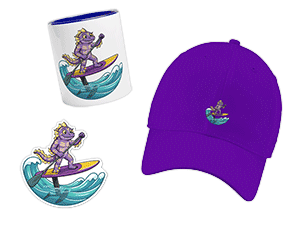
Downwind Foiling: POV pointers and concepts for reading bumps
It all starts with a very strong foundation of foil skill. Pumping mechanics, mast height, speed stability, and turning are the various foil skills needed so you can focus on what you are seeing when deciphering the bumps. Build your strong foundation so you can apply and practice the mental aspect of downwind foiling which is the most important and influential part. Get the reps nd the time out there, dont worry about struggling or failing because we all do, and continue your offshore investments! Best investment in the World!
If you know this discipline inside and out and want to help review and or edit the info on this page, drop us a line. We will credit you as a reviewer or editor and set you up with a proper bio page with links back to your site.
We could use a few more high-quality images to illustrate this discipline. If you have shots you own and are willing to share, contact us for where to send them. Bonus if you also credit the rider and give us a URL to link back to you.